Long-Run Self-Adjustment
Left alone, an economy closes its own output gap through nominal wages and input prices.
Part 1 · Hook
Why this matters
Part 2 · Before you start
What this builds on
Part 3 · Prerequisite check
Quick check before you start
1. In a recessionary gap, how does unemployment compare with the natural rate?
- It is above the natural rate
- It is below the natural rate
- It equals the natural rate
- It is zero
Show the answer
Output below full employment means fewer jobs: unemployment above the natural rate.
- Correct: It is above the natural rate:
- It is below the natural rate:
- It equals the natural rate:
- It is zero:
2. A fall in nominal wages across the economy shifts which curve, and which way?
- SRAS to the right
- SRAS to the left
- AD to the right
- LRAS to the left
Show the answer
Lower wages lower firms' costs at every price level, so SRAS shifts right.
- Correct: SRAS to the right:
- SRAS to the left:
- AD to the right:
- LRAS to the left:
Part 4 · See it
See it first
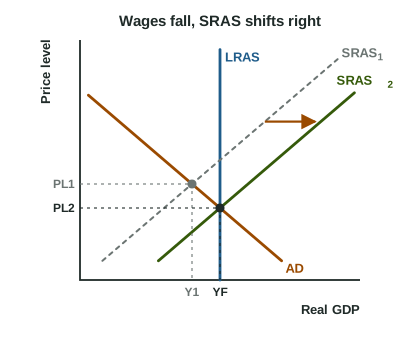
Part 5 · Step by step
How it works, step by step
- Real GDP is below full-employment output (recessionary gap)unemployment is above the natural rate
- Unemployment is above the natural ratenominal wages and input prices fall as contracts are renewed
- Nominal wages and input prices fallSRAS shifts right
- SRAS shifts right along ADreal GDP rises to full-employment output and the price level falls
Part 6 · Key ideas
Key ideas
- Long-run self-adjustment: with no policy, the economy returns to full employment because nominal wages and input prices adjust and SRAS shifts.
- Recessionary gap: unemployment above the natural rate, nominal wages fall, SRAS shifts right; the price level falls and output rises to YF.
- Inflationary gap: unemployment below the natural rate, nominal wages rise, SRAS shifts left; the price level rises and output falls to YF.
- The mechanism is never a shift in AD. In the long run, a change in AD changes only the price level.
- It can be slow, especially downward, because nominal wages resist cuts.
Part 7 · Misconception
A common mistake
The wrong idea: An economy in a recession recovers on its own because spending picks up and AD shifts back to the right.
What actually happens: Self-adjustment runs through the supply side: high unemployment lowers nominal wages and input prices, so SRAS shifts right until output is back at full employment.
Part 8 · Check yourself
Check yourself
Exam-style questions. Anything you miss goes into your review queue.
Graph
Country H's AD-AS graph today
1. If no policy is used, what happens to nominal wages in Country H over time, and why?
- They fall, because output is above full employment
- They stay the same, because wages are sticky
- They rise, because AD keeps shifting right
- They rise, as labor is scarce
Show the answer
Country H is in an inflationary gap: unemployment is below the natural rate, so nominal wages rise over time.
- They fall, because output is above full employment: Output above full employment means scarce labor, which pushes wages up, not down.
- They stay the same, because wages are sticky: Wages are sticky only in the short run; given time, contracts are renegotiated.
- They rise, because AD keeps shifting right: The graph shows no further shift in AD. Wages rise because labor is scarce.
- Correct: They rise, as labor is scarce: Right: output is above full employment, labor is scarce, and wages are bid up as contracts are renewed.
2. In Country H, which curve shifts as the economy adjusts on its own, and in which direction?
- SRAS shifts left
- SRAS shifts right
- AD shifts left
- LRAS shifts right
Show the answer
Rising nominal wages and input prices shift SRAS left: the self-adjustment always runs through SRAS.
- Correct: SRAS shifts left: Right: higher nominal wages raise costs, so SRAS shifts left until it meets AD on LRAS.
- SRAS shifts right: Rising wages raise costs, which shift SRAS left, not right.
- AD shifts left: The adjustment works through wages and costs, which are SRAS, not through spending.
- LRAS shifts right: LRAS moves with resources and technology, which have not changed.
3. Once Country H has fully adjusted, how do its price level and real GDP compare with today?
- The price level is lower and real GDP is lower
- The price level is higher and real GDP is lower
- The price level is higher and real GDP is higher
- Both are the same as today, since the gap closes itself
Show the answer
From an inflationary gap, SRAS shifts left: the price level rises further and real GDP falls back to YF.
- The price level is lower and real GDP is lower: A leftward SRAS shift raises the price level.
- Correct: The price level is higher and real GDP is lower: Right: SRAS shifts left along AD until output equals full-employment output.
- The price level is higher and real GDP is higher: Real GDP falls back to full-employment output from above it.
- Both are the same as today, since the gap closes itself: Closing the gap moves the economy: output falls to YF and the price level rises.
4. This economy is in a recessionary gap and no policy is used. Show the long-run adjustment: shift the right curve and mark the new equilibrium.
Work on the graph (it needs JavaScript), then check.
Show the answer
Unemployment above the natural rate lowers nominal wages and input prices, so SRAS shifts right: the price level falls and real GDP rises to full employment.
- Key: short-run aggregate supply shifts right
5. Put the links of self-adjustment from a recessionary gap in order.
- Real GDP is below full-employment output
- Unemployment is above the natural rate
- Nominal wages and input prices fall as contracts are renewed
- SRAS shifts right
- Real GDP rises to full-employment output and the price level falls
Show the answer
The gap causes high unemployment, which lowers wages and costs, which shifts SRAS right until output reaches YF.
- Correct order: 1. Real GDP is below full-employment output 2. Unemployment is above the natural rate 3. Nominal wages and input prices fall as contracts are renewed 4. SRAS shifts right 5. Real GDP rises to full-employment output and the price level falls
6. Make it specific: explain how an economy in an inflationary gap returns to full employment with no policy.
Build the answer part by part, then write it in your own words.
Show the answer
Labor is scarce, so nominal wages rise; SRAS shifts left until output is back at full employment, at a higher price level.
- An answer that earns the point: Unemployment is below the natural rate, so nominal wages rise because firms compete for scarce workers. Higher costs shift SRAS to the left until real GDP equals full-employment output, and the price level rises.
Part 9 · Summary
Summary
Part 10 · Up next
What comes next
Part 11 · Connections