Fiscal Policy
Fiscal policy uses government purchases, taxes and transfers to shift aggregate demand.
Part 1 · Hook
Why this matters
Part 2 · Before you start
What this builds on
Part 3 · Prerequisite check
Quick check before you start
1. With an MPC of 0.8, what is the spending multiplier?
- 5
- 0.8
- 4
- 1.25
Show the answer
Spending multiplier = 1 / MPS = 1 / 0.2 = 5.
- Correct: 5:
- 0.8:
- 4:
- 1.25:
2. Where is short-run output in a recessionary gap?
- Left of LRAS
- Right of LRAS
- On LRAS
- Above the price level
Show the answer
A recessionary gap is output below full employment: AD meets SRAS left of LRAS.
- Correct: Left of LRAS:
- Right of LRAS:
- On LRAS:
- Above the price level:
3. Left alone, how does an economy in a recessionary gap return to full employment?
- Nominal wages fall and SRAS shifts right
- AD shifts right on its own
- LRAS shifts left
- Nominal wages rise and SRAS shifts left
Show the answer
High unemployment lowers wages and input prices, shifting SRAS right.
- Correct: Nominal wages fall and SRAS shifts right:
- AD shifts right on its own:
- LRAS shifts left:
- Nominal wages rise and SRAS shifts left:
Part 4 · See it
See it first
Part 5 · Step by step
How it works, step by step
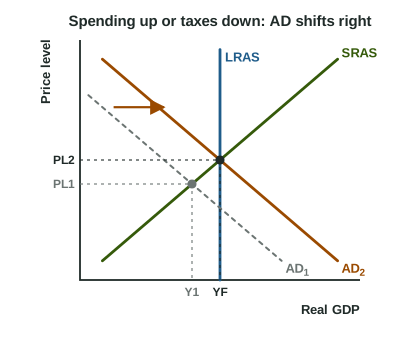
- Recessionary gap: the government raises purchases or cuts taxesspending rises (directly, or through disposable income and consumption)
- Spending rises, with the multiplierAD shifts right by a multiple of the change
- AD shifts right along SRASreal GDP and the price level rise; unemployment falls
- Inflationary gap: the government cuts purchases or raises taxesAD shifts left: the price level and real GDP fall toward full employment
Part 6 · Key ideas
Key ideas
- Fiscal policy is the government's use of purchases (G), taxes and transfer payments to change aggregate demand. Discretionary means a deliberate decision.
- Expansionary (recessionary gap): raise G, cut taxes or raise transfers, so AD shifts right. Contractionary (inflationary gap): the reverse.
- A change in G has a bigger effect than the same change in taxes or transfers: spending multiplier 1 / MPS against MPC / MPS.
- Size the policy with the gap: direction first, then divide the gap by the right multiplier.
- Lags in recognizing, deciding and carrying out policy can make it arrive at the wrong time.
Part 7 · Misconception
A common mistake
The wrong idea: Transfer payments such as pensions are government purchases, so they use the spending multiplier.
What actually happens: Transfers buy no goods or services. They raise disposable income, and households save part, so they work like a tax cut, with a multiplier of MPC / MPS.
Part 8 · Check yourself
Check yourself
Exam-style questions. Anything you miss goes into your review queue.
Scenario
Velora's overheated economy
Velora is an invented country. Its real GDP is 60 billion dollars above full-employment output, unemployment is below the natural rate, and prices are rising fast. Velora's MPC is 0.75. Its government wants to close the gap now rather than wait for the economy to adjust on its own.
1. Which fiscal policy fits Velora's situation?
- Expansionary: raise government spending or cut taxes on households
- Contractionary: cut government spending or raise taxes
- Raise government spending and cut taxes together
- Raise transfer payments to households
Show the answer
An inflationary gap calls for contractionary fiscal policy: less government spending or higher taxes, to shift AD left.
- Expansionary: raise government spending or cut taxes on households: That would shift AD right and widen an inflationary gap.
- Correct: Contractionary: cut government spending or raise taxes: Right: output is above full employment, so the government lowers spending to shift AD left.
- Raise government spending and cut taxes together: Both raise AD, which is the wrong direction for an inflationary gap.
- Raise transfer payments to households: More transfers raise disposable income and spending, shifting AD right.
2. If Velora closes the gap by cutting government purchases alone, by how much must it cut them, in billions of dollars?
Type a number. A four-function calculator is allowed, as on the exam.
Show the answer
Spending multiplier . Direction: cut spending. Divide: billion dollars.
- Answer: 15
3. If Velora instead closes the gap by raising taxes alone, by how much must it raise them, in billions of dollars?
Type a number. A four-function calculator is allowed, as on the exam.
Show the answer
Tax multiplier . Divide the gap by its size: billion dollars of higher taxes.
- Answer: 20
4. If Velora's contractionary policy works, what happens in the short run to the price level and unemployment?
- The price level rises and unemployment falls further
- The price level falls and unemployment falls
- The price level falls and unemployment rises
- Neither changes until wages adjust
Show the answer
AD shifts left along SRAS: real GDP falls to YF, the price level falls, and unemployment rises back to the natural rate.
- The price level rises and unemployment falls further: Those follow a rise in AD, not a fall.
- The price level falls and unemployment falls: Less output needs fewer workers, so unemployment rises.
- Correct: The price level falls and unemployment rises: Right: AD shifts left, so output, the price level and employment fall toward full-employment levels.
- Neither changes until wages adjust: AD shifts at once along SRAS, so the price level and output change in the short run.
5. The economy is in a recessionary gap. The government cuts income taxes. Shift the right curve and mark the new short-run equilibrium.
Work on the graph (it needs JavaScript), then check.
Show the answer
A tax cut raises disposable income and consumption, so AD shifts right: the price level and real GDP rise.
- Key: aggregate demand shifts right
6. Make it specific: explain how a rise in government purchases affects an economy in a recessionary gap.
Build the answer part by part, then write it in your own words.
Show the answer
G is part of AD, so AD shifts right (by more, through the multiplier), raising real GDP and the price level and lowering unemployment.
- An answer that earns the point: Government purchases rise, so AD shifts to the right, by a multiple of the new spending because each round of income is partly re-spent. Real GDP increases and unemployment falls.
Part 9 · Summary
Summary
Part 10 · Up next
What comes next
Part 11 · Connections