Financial Assets
Financial assets are claims on money or future income: money, bonds and stocks.
Part 1 · Hook
Why this matters
Part 2 · Before you start
What this builds on
Part 3 · Prerequisite check
Quick check before you start
1. Inflation turns out higher than borrowers and lenders expected when they agreed on a loan. Who gains?
- The borrower
- The lender
- Neither
- Both equally
Show the answer
The borrower repays with dollars that buy less than expected, so unanticipated inflation helps borrowers and hurts lenders.
- Correct: The borrower:
- The lender:
- Neither:
- Both equally:
2. Which part of aggregate demand is a firm's purchase of a new factory?
- Investment
- Consumption
- Government spending
- Net exports
Show the answer
Spending by firms on new capital goods, such as factories and equipment, is investment.
- Correct: Investment:
- Consumption:
- Government spending:
- Net exports:
Part 4 · See it
See it first
Part 5 · Step by step
How it works, step by step
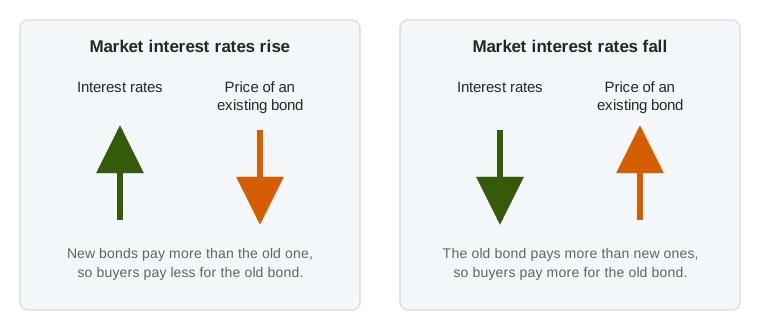
- Market interest rates risenew bonds pay more than an existing bond with a fixed payment
- New bonds pay more than the existing bondfewer buyers want the existing bond at its old price
- Fewer buyers want the existing bondits price falls until its yield matches the new market rate
Part 6 · Key ideas
Key ideas
- A financial asset is a claim on money or future income: money, bonds (loans to a government or firm) and stocks (shares of ownership).
- Assets trade off three things: liquidity (how easily they become money at full value), risk and return. Money is the most liquid and pays little or no interest.
- The interest rate is the price of borrowing: the yearly charge as a percent of the amount borrowed, and the reward a lender earns.
- A bond pays a fixed amount, so its price moves opposite to market interest rates: rates up, bond prices down.
Part 7 · Misconception
A common mistake
The wrong idea: When interest rates rise, bonds become more valuable because "bonds pay interest."
What actually happens: New bonds pay more, but existing bonds keep their old, lower payment, so their prices fall. Higher interest rates mean lower prices for existing bonds.
Part 8 · Check yourself
Check yourself
Exam-style questions. Anything you miss goes into your review queue.
1. What does liquidity measure?
- How much interest an asset pays each year
- How likely an asset is to lose value
- How easily an asset becomes money without losing value
- How many people own the asset
Show the answer
Liquidity is the ease of turning an asset into money, the medium people spend, without a loss in value.
- How much interest an asset pays each year: That is its return. Liquidity is about turning an asset into money.
- How likely an asset is to lose value: That is risk. Liquidity is about how easily it becomes spendable money.
- Correct: How easily an asset becomes money without losing value: Right: money is perfectly liquid; a house is far less so.
- How many people own the asset: Ownership counts are not liquidity. Liquidity is about converting the asset to money.
2. Which statement compares stocks and bonds correctly?
- A stock is a loan to a firm; a bond is a share of ownership
- A stock is a share of ownership; a bond is a loan to the issuer
- Both are loans that pay a fixed interest rate
- Both are shares of ownership in the issuer
Show the answer
Stocks are equity (ownership); bonds are debt (loans), which pay set interest and repay the amount borrowed.
- A stock is a loan to a firm; a bond is a share of ownership: That is reversed: a stock is ownership and a bond is a loan.
- Correct: A stock is a share of ownership; a bond is a loan to the issuer: Right: stockholders own part of the firm; bondholders are lenders.
- Both are loans that pay a fixed interest rate: A stock is not a loan and pays no fixed rate; its dividends and price can change.
- Both are shares of ownership in the issuer: A bond gives no ownership. It is a promise to repay a loan with interest.
3. Market interest rates fall sharply. What happens to people who already own bonds paying a fixed 6%?
- They lose, because their payments are cut
- They gain, because their bonds' prices rise
- Nothing happens, because their rate is fixed
- They gain, because their bonds now pay more interest
Show the answer
Falling interest rates raise the prices of existing bonds, so current bondholders gain.
- They lose, because their payments are cut: Their fixed payments do not change; the market value of their bonds rises.
- Correct: They gain, because their bonds' prices rise: Right: their 6% bonds now pay more than new ones, so buyers pay more for them.
- Nothing happens, because their rate is fixed: The fixed rate is why the price changes: their bonds become more valuable.
- They gain, because their bonds now pay more interest: The yearly payment stays the same; the gain is a higher price for the bond.
4. Which of these are financial assets? Select all that apply.
- Shares of stock in a company
- A house a family lives in
- A delivery truck a bakery owns
- A meal eaten at a restaurant
Show the answer
Financial assets are claims on money or future income, such as money, bonds and stocks; trucks and buildings are physical assets.
- Correct: Shares of stock in a company: Right: stock is a claim on a firm's profits and assets.
- A house a family lives in: A house is a physical (real) asset: it gives shelter, not a claim on someone else's income.
- A delivery truck a bakery owns: A truck is a physical (real) asset used to produce goods, not a financial claim.
- A meal eaten at a restaurant: A meal is a good that is used up; it is not an asset at all.
Data
An existing bond and the interest rate on new bonds
| Year | Interest rate on new bonds | Yearly payment on the old bond |
|---|---|---|
| 1 | 5% | $50 |
| 2 | 8% | $50 |
| 3 | 4% | $50 |
| 4 | 5% | $50 |
5. In which year would the owner of the old bond most likely have to sell it for less than $1,000?
- Year 2
- Year 3
- Year 4
- Year 1
Show the answer
When the interest rate on new bonds rises above what an old bond pays, the old bond is worth less, so its price falls.
- Correct: Year 2: Right: new bonds pay 8%, more than the old bond's 5%, so buyers offer less than $1,000 for it.
- Year 3: New bonds pay 4% in Year 3, less than the old bond, so its price rises above $1,000.
- Year 4: New bonds pay 5% again, the same as the old bond, so its price returns to about $1,000.
- Year 1: In Year 1 the bond pays the market rate, so it sells for about the $1,000 it cost.
6. In Year 3, what most likely happens to the price of the old bond, and why?
- It falls, because the interest rate fell
- It rises, because it pays more than new bonds
- It stays at $1,000, because the payment is fixed
- It rises, because the bond pays more each year
Show the answer
Bond prices and interest rates move in opposite directions: lower rates on new bonds raise the price of an old bond with a higher payment.
- It falls, because the interest rate fell: A fall in market interest rates makes the old, higher payment more attractive, so its price rises.
- Correct: It rises, because it pays more than new bonds: Right: $50 a year beats the 4% new bonds pay, so buyers bid its price above $1,000.
- It stays at $1,000, because the payment is fixed: The payment is fixed, but its price is not: buyers compare it with what new bonds pay.
- It rises, because the bond pays more each year: The yearly payment stays $50; the price rises because new bonds pay less, not because the payment grew.
7. In Year 2 a buyer pays $625 for the old bond. What interest rate does the buyer earn, as a percent of the price paid? (Divide the yearly payment by the price.)
Type a number (%). A four-function calculator is allowed, as on the exam.
Show the answer
The yield is the yearly payment over the price: , the same as new bonds pay. A lower price is how an old bond comes to pay the market rate.
- Answer: 8 %
Part 9 · Summary
Summary
Part 10 · Up next
What comes next
Part 11 · Connections