Nominal v. Real Interest Rates
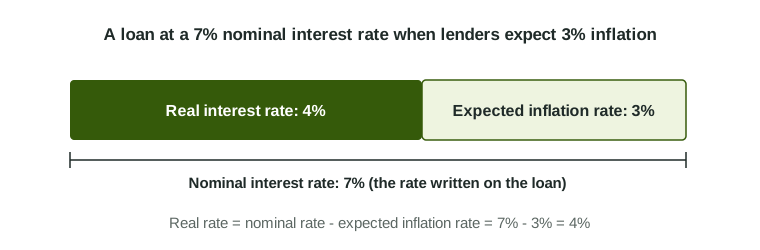
The nominal interest rate is the rate stated in dollars; the real interest rate is the gain in buying power, the nominal rate minus the expected inflation rate.
Part 1 · Hook
Why this matters
Part 2 · Before you start
What this builds on
Part 3 · Prerequisite check
Quick check before you start
1. A price index rises from 200 to 210 over a year. What is the inflation rate?
- 5%
- 10%
- 2.1%
- 105%
Show the answer
Inflation is the percent change in the index: (210 - 200) / 200 x 100 = 5%.
- Correct: 5%:
- 10%:
- 2.1%:
- 105%:
2. What is an interest rate?
- The yearly cost of borrowing, as a percent of the amount borrowed
- The total a borrower repays
- The price of a share of stock
- The fee to open a bank account
Show the answer
The interest rate is the price of borrowing money for a year, as a percent.
- Correct: The yearly cost of borrowing, as a percent of the amount borrowed:
- The total a borrower repays:
- The price of a share of stock:
- The fee to open a bank account:
Part 4 · See it
See it first
Part 5 · Step by step
How it works, step by step
- Lenders expect inflationthey add the expected inflation rate to the real return they want, so nominal rates rise
- Inflation turns out higher than expected on a fixed-rate loanthe real interest rate actually earned is lower than agreed
- The real rate earned is lower than agreedthe borrower gains and the lender loses buying power
Part 6 · Key ideas
Key ideas
- The nominal interest rate is the rate stated on a loan, in dollars. The real interest rate is the gain in buying power.
- Real interest rate = nominal interest rate - expected inflation rate. With a 7% nominal rate and a 3% expected inflation rate, the real rate is 4%.
- Lenders build the expected inflation rate into nominal rates, so when lenders expect more inflation, nominal rates rise.
- If inflation is higher than expected, fixed-rate borrowers gain and lenders lose; if lower than expected, the reverse.
Part 7 · Misconception
A common mistake
The wrong idea: A higher nominal interest rate always means lenders earn more.
What actually happens: What lenders earn in buying power is the real rate. A 10% loan with 12% inflation earns -2% real, worse than a 4% loan with 1% inflation (3% real).
Part 8 · Check yourself
Check yourself
Exam-style questions. Anything you miss goes into your review queue.
1. What is a nominal interest rate?
- The rate stated on a loan, in dollars
- The rate after the expected inflation rate is subtracted
- The rate a central authority sets for banks
- The interest rate measured in goods instead of dollars
Show the answer
Nominal means "in dollars as stated." The real rate adjusts it for inflation.
- Correct: The rate stated on a loan, in dollars: Right: the nominal rate is the rate written on the loan, before any adjustment for inflation.
- The rate after the expected inflation rate is subtracted: That is the real interest rate.
- The rate a central authority sets for banks: That describes one particular rate, not what "nominal" means.
- The interest rate measured in goods instead of dollars: Measuring in buying power is the real rate; nominal is in dollars.
2. Which formula gives the real interest rate?
- Nominal rate plus the expected inflation rate
- Nominal rate divided by the expected inflation rate
- Nominal rate minus the expected inflation rate
- Expected inflation rate minus the nominal rate
Show the answer
Real interest rate = nominal interest rate - expected inflation rate.
- Nominal rate plus the expected inflation rate: Adding inflation gives a larger number; inflation reduces the buying power gained, so subtract.
- Nominal rate divided by the expected inflation rate: The real rate is a difference, not a ratio.
- Correct: Nominal rate minus the expected inflation rate: Right: what is left after inflation is the gain in buying power.
- Expected inflation rate minus the nominal rate: That is the real rate with its sign flipped.
3. A savings bond pays a nominal interest rate of 5%, and savers expect 2% inflation. What is the expected real interest rate, in percent?
Type a number (%). A four-function calculator is allowed, as on the exam.
Show the answer
: savers expect their buying power to grow about 3% a year.
- Answer: 3 %
4. Prices fall by 2% over a year, though everyone expected them to rise by 2%. A firm repays a loan at a fixed 5% nominal rate. How is the firm affected?
- It gains, because prices fell
- It is not affected, because its rate was fixed
- It loses, because its real rate rose
- It loses, because its nominal rate rose
Show the answer
Unexpected deflation is the reverse of unexpected inflation: it hurts fixed-rate borrowers and helps lenders.
- It gains, because prices fell: Falling prices raise the buying power of each dollar the firm repays, which hurts the borrower.
- It is not affected, because its rate was fixed: The fixed rate is why the surprise matters: the real rate rose from 3% to 7%.
- Correct: It loses, because its real rate rose: Right: it repays with dollars worth more than expected; the real rate turned out 5 - (-2) = 7%, not the 3% the firm planned.
- It loses, because its nominal rate rose: The nominal rate stayed at 5%; the real rate rose because prices fell.
Scenario
A fixed-rate car loan and a surprise in inflation
A bank in the invented country of Quentar lends Sam money for a car at a fixed nominal interest rate of 7% a year. When the loan is made, both Sam and the bank expect inflation of 3% a year. Over the next year, inflation turns out to be 6%.
5. What real interest rate did the bank actually earn over the year, in percent?
Type a number (%). A four-function calculator is allowed, as on the exam.
Show the answer
After the fact, use the inflation that happened: . The bank planned on .
- Answer: 1 %
6. Who gained from the surprise in inflation, and why?
- The bank, because prices rose faster
- Sam, because his real rate fell
- Neither, because the nominal rate stayed at 7%
- Both, because incomes rose with prices
Show the answer
Unanticipated inflation helps fixed-rate borrowers and hurts lenders, because the real value of the repayment falls.
- The bank, because prices rose faster: Faster inflation means the bank is repaid in dollars that buy less than it planned, so it loses.
- Correct: Sam, because his real rate fell: Right: Sam repays with dollars that buy less than expected; his real rate fell from an expected 4% to 1%.
- Neither, because the nominal rate stayed at 7%: The nominal rate is fixed, which is why the surprise moves buying power from the lender to the borrower.
- Both, because incomes rose with prices: A surprise in inflation moves buying power between them: one side gains what the other loses.
7. If lenders in Quentar now expect inflation to stay at 6%, what most likely happens to the nominal rates they charge on new car loans?
- They rise, to keep the real rate lenders want
- They fall, because borrowers are gaining
- They stay at 7%, because the real rate fell
- They fall to the inflation rate of 6%
Show the answer
Nominal rate = real rate + expected inflation rate. When the expected inflation rate rises, nominal rates rise with it.
- Correct: They rise, to keep the real rate lenders want: Right: to earn a 4% real rate with a 6% expected inflation rate, lenders ask about 10% nominal.
- They fall, because borrowers are gaining: Lenders protect themselves from inflation by charging more, not less.
- They stay at 7%, because the real rate fell: At 7% nominal and a 6% expected inflation rate lenders would earn 1% real, so they raise the nominal rate.
- They fall to the inflation rate of 6%: At 6% nominal the real rate would be zero; lenders want a positive real return.
Part 9 · Summary
Summary
Part 10 · Up next
What comes next
Part 11 · Connections