Inflation moves purchasing power around
If every price and every income rose by exactly 5% and everyone knew it in advance, inflation would matter little: your pay would buy what it bought before. Inflation causes real trouble for two reasons. Many payments are fixed in dollars, and inflation often turns out different from what people planned on. The key question in this topic is always: who planned on what, and whose dollars are fixed?
Unanticipated inflation: borrowers and lenders
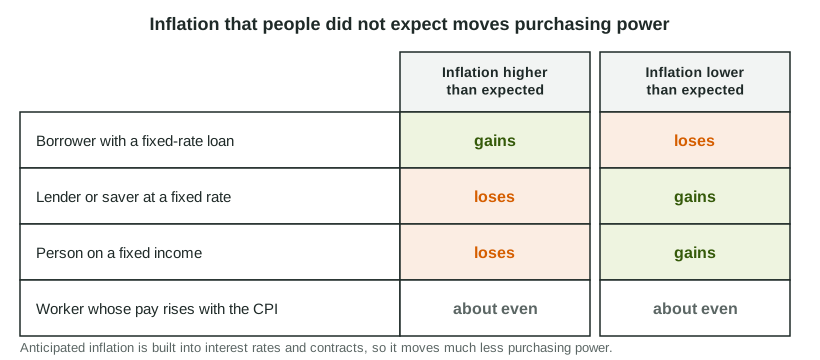
A loan at a fixed interest rate is a promise to repay a set number of dollars. When the lender and the borrower agree on the rate, they have some inflation in mind. If inflation turns out higher than they anticipated, the dollars repaid buy less than both sides planned on: the borrower gains and the lender loses. If inflation turns out lower than anticipated, or prices fall, the reverse happens.
Worked example: a loan that turned out to earn nothing.
Maya borrows $10,000 for one year at a fixed 8%, so she repays $10,800. Both sides planned on 3% inflation, so the credit union expected to gain purchasing power. Prices actually rise 8%: the CPI goes from 100 to 108.
Step 1. Value the repayment in the prices of the day she borrowed.
Step 2. Compare. The credit union lent $10,000 of purchasing power and got back $10,000 of purchasing power: the interest it earned was eaten by inflation. Maya gained relative to the deal both sides thought they had made.
The slip readers see: treating $10,800 as what the lender received, without adjusting for the higher prices.
Savers are lenders too. A deposit is a loan from you to the bank, so if your account pays a fixed 3% and inflation is 5%, your balance buys about 2% less at the end of the year: the saver loses and the bank, as borrower, gains. If inflation equals the 3% interest, purchasing power stays about the same.
Long fixed-rate contracts carry the most risk. A bank that made 30-year fixed-rate home loans loses heavily if inflation rises far above what it anticipated. That risk is one reason lenders also offer adjustable rates that change with market rates.
Fixed incomes
A fixed income pays the same number of dollars whatever happens to prices, such as a pension that is not adjusted for inflation. When prices rise faster than people planned, someone on a fixed income can buy less each month. Incomes that are indexed, adjusted each year by the rise in the CPI, keep their purchasing power, so a worker with a cost-of-living adjustment in a contract is roughly protected.
Anticipated inflation
When inflation is anticipated, people build it into their agreements: lenders ask for higher interest rates, workers ask for larger raises, pensions are indexed. Anticipated inflation therefore moves much less purchasing power between people. The redistribution comes from the unanticipated part.
| Inflation higher than anticipated | Inflation lower than anticipated (or deflation) | |
|---|---|---|
| Borrower at a fixed rate | Gains | Loses |
| Lender or saver at a fixed rate | Loses | Gains |
| Person on a fixed income | Loses | Gains |
| Income indexed to the CPI | About even | About even |
Costs that come with any inflation
- Menu costs: the cost of changing prices often, such as reprinting menus, relabeling shelves and updating websites and catalogs.
- Shoe-leather costs: when cash loses value quickly, people hold less of it and spend time and effort on more trips to the bank or moving money around. The name comes from wearing out your shoes walking to the bank.
- Uncertainty: when inflation is high and hard to predict, firms and households cannot tell what future costs and prices will be, so they hesitate to sign long contracts or build long-lived projects such as a new factory.
For the AP® Macroeconomics exam, a cost-of-inflation question usually names a person and a contract. Ask whether the dollars are fixed, whether the inflation was anticipated, and which way the surprise went. Then say who gains, who loses, and why: the dollars repaid or received buy more or less than planned.