Ocean Warming
The ocean absorbs about 90% of the extra heat.
Part 1 · Hook
Why this matters
Part 2 · Before you start
What this builds on
Part 3 · Prerequisite check
Quick check before you start
1. Which change raises sea level?
- Melting land ice
- Melting sea ice
- More sea ice
- More snow on land
Show the answer
Land ice adds water to the ocean; floating sea ice does not.
- Correct: Melting land ice:
- Melting sea ice:
- More sea ice:
- More snow on land:
2. How does temperature affect dissolved oxygen in water?
- Warmer water holds less oxygen
- Warmer water holds more oxygen
- Temperature has no effect
- Only salt water is affected
Show the answer
Gases dissolve less in warm water, which is why thermal pollution lowers oxygen.
- Correct: Warmer water holds less oxygen:
- Warmer water holds more oxygen:
- Temperature has no effect:
- Only salt water is affected:
Part 4 · See it
See it first
Part 5 · Step by step
How it works, step by step
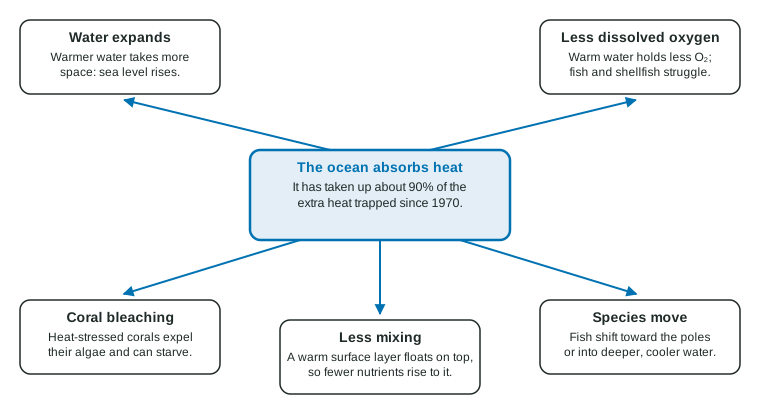
- Greenhouse gases trap extra heatthe ocean absorbs about 90% of it, because water stores heat well
- Warmer water takes up more space (thermal expansion)sea level rises, alongside water from melting land ice
- Warmer water holds less oxygen and mixes lessoxygen falls and fewer nutrients reach the surface
- Heat stress and shifting temperaturescorals bleach, fish move toward the poles, and currents can change
Part 6 · Key ideas
Key ideas
- The ocean has absorbed about 90% of the extra heat trapped since 1970.
- Thermal expansion: warmer water takes up more space. With melting land ice, it causes most sea level rise. It is caused by heat, not by dissolved CO₂.
- Warming lowers dissolved oxygen, bleaches corals, shifts species ranges and makes the surface layer mix less with nutrient-rich deep water.
- The thermohaline circulation (ocean conveyor belt) is driven by temperature and salinity; fresh meltwater could weaken it.
Part 7 · Misconception
A common mistake
The wrong idea: Seawater expands because it absorbs carbon dioxide.
What actually happens: Thermal expansion is caused by heat: warmer water molecules move faster and spread apart. CO₂ dissolving in seawater changes its chemistry, which is a different problem covered next.
Part 8 · Check yourself
Check yourself
Exam-style questions. Anything you miss goes into your review queue.
1. What is thermal expansion of seawater?
- Water takes up more space as it warms
- Water gains mass as it absorbs CO₂
- Ice on land slides into the sea
- Warm water rises and cold water sinks
Show the answer
Thermal expansion: the same mass of water fills a larger volume when it is warmer. It is one of the two main causes of sea level rise.
- Correct: Water takes up more space as it warms: Right: warmer water molecules move faster and spread apart, so the same mass fills more volume.
- Water gains mass as it absorbs CO₂: Dissolved CO₂ adds little volume; thermal expansion is caused by heat.
- Ice on land slides into the sea: That is land ice adding water, a separate cause of sea level rise.
- Warm water rises and cold water sinks: That describes circulation, not expansion.
2. Which two processes cause most of today’s sea level rise?
- Melting sea ice and more rainfall
- Melting land ice and thermal expansion
- Dissolved CO₂ and melting sea ice
- More rivers and sinking icebergs
Show the answer
Land ice adds water; thermal expansion makes the existing water take up more room.
- Melting sea ice and more rainfall: Sea ice already floats; rain is part of the water cycle and does not add new water.
- Correct: Melting land ice and thermal expansion: Right: water from glaciers and ice sheets, plus warmer water expanding.
- Dissolved CO₂ and melting sea ice: Neither raises sea level much.
- More rivers and sinking icebergs: Rivers return water that came from the ocean; they do not add new water.
Data
Dissolved oxygen that seawater can hold at each temperature
| Water temperature (°C) | Dissolved oxygen (mg/L) |
|---|---|
| 0 | 11.2 |
| 5 | 10.0 |
| 10 | 9.0 |
| 15 | 8.1 |
| 20 | 7.4 |
| 25 | 6.8 |
| 30 | 6.2 |
3. Describe the relationship in the data.
- As temperature rises, oxygen rises
- Oxygen stays about the same across temperatures
- Oxygen rises up to 15 °C, then falls
- As temperature rises, oxygen falls
Show the answer
An inverse relationship: warmer seawater holds less oxygen.
- As temperature rises, oxygen rises: The oxygen values fall as temperature goes up.
- Oxygen stays about the same across temperatures: Oxygen changes by 5 mg/L across the table.
- Oxygen rises up to 15 °C, then falls: Oxygen falls the whole way.
- Correct: As temperature rises, oxygen falls: Right: from 11.2 mg/L at 0 °C to 6.2 mg/L at 30 °C.
4. By what percent does the oxygen the seawater can hold change as it warms from 10 °C to 20 °C?
Type a number, then its unit (%). Scale words (2.5 million) and powers of ten (2.5 × 10^6) are read.
Show the answer
- Answer: -17.8 %
5. A cod population needs at least 7 mg/L of dissolved oxygen. Using the table, above about what temperature would full seawater fall below this level?
- About 12 °C
- About 22 °C
- About 30 °C
- About 2 °C
Show the answer
Find where the values cross 7 mg/L: between 20 °C (7.4) and 25 °C (6.8).
- About 12 °C: At 15 °C the water still holds 8.1 mg/L.
- Correct: About 22 °C: Right: 7.4 mg/L at 20 °C and 6.8 mg/L at 25 °C, so it falls below 7 between them.
- About 30 °C: At 30 °C it is already 6.2 mg/L, well below 7.
- About 2 °C: Cold water holds the most oxygen, over 10 mg/L.
Model or diagram
Effects of ocean warming
6. Which effect in the figure raises sea level?
- Water expands
- Less dissolved oxygen
- Coral bleaching
- Species move
Show the answer
Thermal expansion, together with melting land ice, raises sea level.
- Correct: Water expands: Right: thermal expansion makes the ocean take up more space.
- Less dissolved oxygen: Oxygen loss harms life but does not change sea level.
- Coral bleaching: Bleaching harms reefs but does not change sea level.
- Species move: Shifting ranges do not change sea level.
7. The figure shows less mixing in a warmer ocean. Why could this lower productivity at the surface?
- The surface gets too dark for photosynthesis
- Fewer nutrients rise from deep water
- Warm water has too many nutrients
- Phytoplankton sink into the warm layer
Show the answer
A warm, light surface layer floats on cold, dense water, which blocks mixing that brings nutrients up.
- The surface gets too dark for photosynthesis: Warming does not darken the surface layer.
- Correct: Fewer nutrients rise from deep water: Right: phytoplankton at the surface depend on nutrients mixed up from below.
- Warm water has too many nutrients: The problem is fewer nutrients reaching the surface.
- Phytoplankton sink into the warm layer: Phytoplankton stay near the surface; nutrients are what is missing.
Part 9 · Summary
Summary
Part 10 · Up next
What comes next
Part 11 · Connections