Eutrophication
Cultural eutrophication happens when nitrogen and phosphorus from fertilizer, manure and sewage enter water.
Part 1 · Hook
Why this matters
Part 2 · Before you start
What this builds on
Part 3 · Prerequisite check
Quick check before you start
1. What is a limiting nutrient?
- The nutrient in shortest supply, which limits growth
- The nutrient found in the largest amount
- A nutrient that is toxic to plants
- A nutrient only animals need
Show the answer
Adding the limiting nutrient lets growth increase until something else runs short.
- Correct: The nutrient in shortest supply, which limits growth:
- The nutrient found in the largest amount:
- A nutrient that is toxic to plants:
- A nutrient only animals need:
2. Which is an example of nonpoint source pollution?
- Fertilizer runoff from many farm fields
- A factory discharge pipe
- A sewage plant outfall
- A single smokestack
Show the answer
Runoff from many fields enters from everywhere, so it is nonpoint.
- Correct: Fertilizer runoff from many farm fields:
- A factory discharge pipe:
- A sewage plant outfall:
- A single smokestack:
Part 4 · See it
See it first
Part 5 · Step by step
How it works, step by step
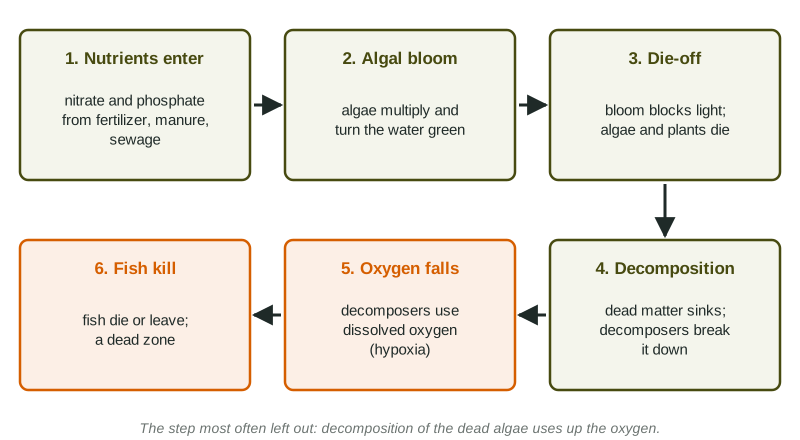
- Nitrate and phosphate from fertilizer, manure and sewage reach a lake or coastthe limiting nutrients for algae are no longer in short supply
- Algae grow rapidly near the surfacean algal bloom forms and shades out plants below
- The algae and shaded plants die and sinkdecomposers break them down
- Decomposers use oxygen in cellular respirationdissolved oxygen in the deeper water falls
- Oxygen falls below what animals need (hypoxia)fish die or leave and bottom animals die: a dead zone
Part 6 · Key ideas
Key ideas
- Eutrophication is the enrichment of water with nutrients. Cultural eutrophication is the fast, human-caused kind, from fertilizer, manure, sewage and detergents.
- The chain: nutrients, then an algal bloom, then die-off, then decomposition that uses oxygen, then low dissolved oxygen (hypoxia), then fish kills. Name every link.
- Oligotrophic lakes are low in nutrients, clear and oxygen-rich; eutrophic lakes are high in nutrients, green and low in deep-water oxygen.
- Fixes keep nutrients out: buffer strips, careful fertilizer use, cover crops, wetland restoration, nutrient removal at wastewater plants and phosphate-free detergents.
Part 7 · Misconception
A common mistake
The wrong idea: The algae use up the oxygen, so the fish suffocate.
What actually happens: Living algae make oxygen. The oxygen crash comes when the algae die and decomposers break them down, using oxygen as they respire.
Part 8 · Check yourself
Check yourself
Exam-style questions. Anything you miss goes into your review queue.
1. Which pollutants cause cultural eutrophication?
- Pesticides sprayed on crops
- Heat from power plant cooling water
- Sulfur dioxide from coal plants
- Nitrogen and phosphorus nutrients
Show the answer
Nutrients, mainly nitrogen (nitrate) and phosphorus (phosphate) from fertilizers, manure, sewage and some detergents, cause eutrophication. Pesticides do not.
- Pesticides sprayed on crops: Pesticides kill pests; they do not feed algae. This is a common mix-up.
- Heat from power plant cooling water: Heat is a different problem, covered in the next topic.
- Sulfur dioxide from coal plants: SO2 causes acid deposition, not eutrophication.
- Correct: Nitrogen and phosphorus nutrients: Right: extra nutrients feed the bloom.
2. Why does adding phosphorus to a freshwater lake so often cause an algal bloom?
- Phosphorus kills the fish that eat algae
- Phosphorus warms the water so algae grow faster
- It is usually the limiting nutrient there
- Phosphorus raises the pH so algae live longer
Show the answer
Phosphorus is usually the limiting nutrient in fresh water: it is the one in shortest supply, so adding it removes the limit on algal growth.
- Phosphorus kills the fish that eat algae: Phosphorus at these levels does not kill fish directly.
- Phosphorus warms the water so algae grow faster: Phosphate does not warm water.
- Correct: It is usually the limiting nutrient there: Right: adding the scarce nutrient releases growth.
- Phosphorus raises the pH so algae live longer: Algae still die; that is part of the problem.
Model or diagram
A lake through one summer after heavy fertilizer runoff
3. When does bottom dissolved oxygen fall fastest?
- Weeks 0 to 3, as the algae begin to grow
- Weeks 5 to 8, just after the algae peak
- Weeks 10 to 12, at the end of the summer
- Weeks 3 to 5, while the algae are growing fastest
Show the answer
DO drops from 6.5 to 1.0 mg per L between weeks 5 and 8, just after the algae peak at week 5, when the algae are dying.
- Weeks 0 to 3, as the algae begin to grow: DO barely changes then, from 8.2 to 7.8.
- Correct: Weeks 5 to 8, just after the algae peak: Right: DO falls from 6.5 to 1.0 as the bloom dies back.
- Weeks 10 to 12, at the end of the summer: DO is rising again then, from 2.8 to 5.0.
- Weeks 3 to 5, while the algae are growing fastest: DO falls only a little then; the steep drop comes after the peak.
4. Why does the steep drop in bottom DO come after the algae peak rather than during the growth of the bloom?
- Decomposers use oxygen breaking down dead algae
- Living algae breathe in most of the oxygen as they grow
- Fertilizer reacts with oxygen and removes it directly
- The water warms in late summer and boils off the oxygen
Show the answer
While algae grow they make oxygen near the surface. When they die, they sink, and decomposers break them down using oxygen from the deep water. So DO falls as the bloom dies.
- Correct: Decomposers use oxygen breaking down dead algae: Right: decomposition of the dying bloom uses up the oxygen.
- Living algae breathe in most of the oxygen as they grow: Growing algae make oxygen by photosynthesis near the surface.
- Fertilizer reacts with oxygen and removes it directly: Nitrate and phosphate do not remove oxygen themselves.
- The water warms in late summer and boils off the oxygen: Warming lowers DO somewhat, but it does not explain the timing after the peak.
5. Find the percent change in bottom DO from week 0 to week 8.
Type a number, then its unit (%). Scale words (2.5 million) and powers of ten (2.5 × 10^6) are read.
Show the answer
- Answer: -87.8 %
6. A fish kill was reported in week 8. Which conclusion is best supported by the graph?
- The fertilizer itself poisoned the fish
- Algae clogged their gills at the bloom's peak
- Cold late-summer water killed the fish
- Low oxygen after the bloom died killed them
Show the answer
At week 8 bottom DO reached 1.0 mg per L, far below what most fish need (about 5 mg per L), so the fish likely died from hypoxia caused by decomposition of the bloom.
- The fertilizer itself poisoned the fish: The graph points to oxygen, not direct poisoning by nutrients.
- Algae clogged their gills at the bloom's peak: The kill came three weeks after the algae peak, when DO was lowest.
- Cold late-summer water killed the fish: Nothing in the graph shows cold water.
- Correct: Low oxygen after the bloom died killed them: Right: DO hit 1 mg per L at week 8.
7. Complete the cause-and-effect chain that explains how fertilizer runoff causes a fish kill.
Build the answer part by part, then write it in your own words.
Show the answer
A complete chain names every link: nutrients, bloom, die-off, decomposition using oxygen, low DO, fish death. Skipping decomposition is the most common lost point.
- An answer that earns the point: Fertilizer adds nutrients, which cause an algal bloom; when the algae die, decomposers break them down and use up oxygen, so dissolved oxygen falls and fish die.
Part 9 · Summary
Summary
Part 10 · Up next
What comes next
Part 11 · Connections