Thermal Pollution
Thermal pollution is heat added to water by people, mostly from power plant and factory cooling water and from warm runoff.
Part 1 · Hook
Why this matters
Part 2 · Before you start
What this builds on
Part 3 · Prerequisite check
Quick check before you start
1. Why does a power plant need large amounts of water?
- To cool and condense the steam after it turns the turbine
- To burn with the fuel
- To make uranium
- To dissolve the coal
Show the answer
Steam that has spun the turbine is cooled back to water, often with river or lake water.
- Correct: To cool and condense the steam after it turns the turbine:
- To burn with the fuel:
- To make uranium:
- To dissolve the coal:
2. In the eutrophication chain, what lowers dissolved oxygen?
- Decomposers breaking down dead algae
- Living algae making food
- Fish swimming faster
- Sunlight on the water
Show the answer
Decomposers use oxygen as they respire.
- Correct: Decomposers breaking down dead algae:
- Living algae making food:
- Fish swimming faster:
- Sunlight on the water:
Part 4 · See it
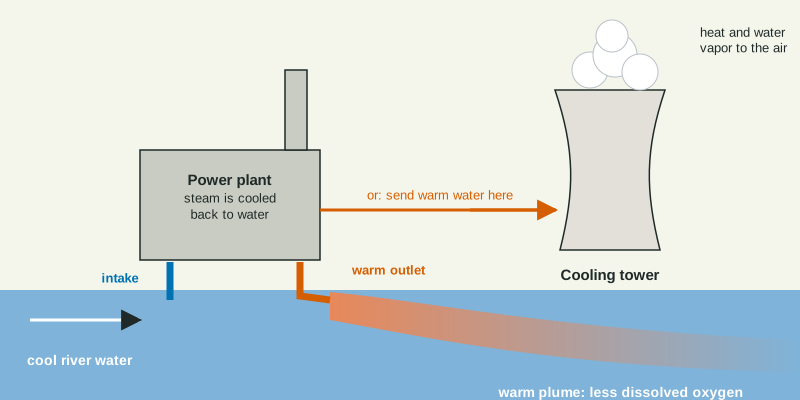
See it first
Part 5 · Step by step
How it works, step by step
- A power plant or factory uses river or lake water to cool its equipmentthe water returns to the river warmer than it was
- Warmer water can hold less dissolved oxygenoxygen in the river falls below the outlet
- Warm water speeds up the metabolism of fish and other cold-blooded animalsthey need more oxygen just as less is available
- Temperature and oxygen move outside the tolerance of sensitive speciestrout and other cold-water species die or leave; sudden changes cause thermal shock
Part 6 · Key ideas
Key ideas
- Thermal pollution is heat: a harmful rise in water temperature caused by people. Main sources: power plant and factory cooling water, warm runoff from pavement, and cutting shade trees along streams.
- Warm water holds less dissolved oxygen, while warm fish need more. Warmth can also feed algae and spread disease.
- Thermal shock: a sudden temperature change that organisms cannot adjust to, such as a plant suddenly starting or stopping its discharge.
- Fixes: cooling towers and cooling ponds that release heat to the air, shade trees on stream banks, and limits on discharge temperature.
Part 7 · Misconception
A common mistake
The wrong idea: Water from a power plant harms fish because of the metals, chemicals or radiation in it.
What actually happens: The pollutant in thermal pollution is heat. Warm water holds less oxygen and pushes temperature outside what species tolerate.
Part 8 · Check yourself
Check yourself
Exam-style questions. Anything you miss goes into your review queue.
1. What is thermal pollution?
- Metals released into a river by a factory
- Radioactive waste leaking from a nuclear plant
- Extra nutrients that cause algal blooms
- Water warmed by people to harmful levels
Show the answer
Thermal pollution is heat: a rise in water temperature caused by people, usually from industrial and power plant cooling water or warm runoff.
- Metals released into a river by a factory: Metals are chemical pollutants, not thermal pollution.
- Radioactive waste leaking from a nuclear plant: That is radioactive contamination, not thermal pollution.
- Extra nutrients that cause algal blooms: That is eutrophication.
- Correct: Water warmed by people to harmful levels: Right: the pollutant is heat.
2. Which is a major source of thermal pollution?
- Fertilizer runoff from corn fields
- Pesticides sprayed on orchards
- Power plant cooling water
- Sulfur dioxide from smokestacks
Show the answer
Power plants (fossil fuel and nuclear) take in river or lake water to cool their steam and return it warmer.
- Fertilizer runoff from corn fields: Runoff adds nutrients; that is eutrophication.
- Pesticides sprayed on orchards: Pesticides are chemical pollutants.
- Correct: Power plant cooling water: Right: the warmed water heats the river or lake.
- Sulfur dioxide from smokestacks: SO2 is an air pollutant that forms acid.
Model or diagram
How much oxygen fresh water can hold at different temperatures
3. Describe the relationship shown in the graph.
- Warmer water holds more dissolved oxygen
- Warmer water holds less dissolved oxygen
- Oxygen stays about level as it warms
- Oxygen falls until 20 °C, then rises again
Show the answer
As water warms, the oxygen it can hold falls: from 14.6 mg per L at 0 °C to 6.9 mg per L at 35 °C.
- Warmer water holds more dissolved oxygen: The line falls, not rises, with temperature.
- Correct: Warmer water holds less dissolved oxygen: Right: the line falls as temperature rises.
- Oxygen stays about level as it warms: It falls from 14.6 to 6.9 mg per L.
- Oxygen falls until 20 °C, then rises again: It keeps falling past 20 °C.
4. Using the graph, find the percent change in the oxygen water can hold when it warms from 15 °C to 30 °C.
Type a number, then its unit (%). Scale words (2.5 million) and powers of ten (2.5 × 10^6) are read.
Show the answer
- Answer: -24.75 %
5. Warm water also speeds up fish metabolism. Why does that make thermal pollution doubly hard on fish?
- Less oxygen just as fish need more
- Warm water holds more oxygen, so fish grow too fast
- Faster metabolism lets fish live without oxygen
- Warm water turns oxygen into carbon dioxide
Show the answer
Warmer water holds less oxygen, while warmer fish need more oxygen because their metabolism speeds up. Supply falls as demand rises.
- Correct: Less oxygen just as fish need more: Right: less oxygen available, more oxygen needed.
- Warm water holds more oxygen, so fish grow too fast: Warm water holds less oxygen, not more.
- Faster metabolism lets fish live without oxygen: Fish need oxygen; faster metabolism means they need more.
- Warm water turns oxygen into carbon dioxide: Water temperature does not convert oxygen into CO2.
6. Trout need at least about 7 mg of dissolved oxygen per liter. Based on the graph, above about what temperature could fully oxygenated water no longer meet that need?
- About 10 °C, where the line reaches 11 mg per L
- About 20 °C, where the line reaches 9 mg per L
- About 0 °C, where the line is highest
- About 34 °C, below 7 mg per L
Show the answer
The saturation line drops below 7 mg per L between 30 °C (7.6) and 35 °C (6.9), at about 34 °C. Real streams are often below saturation, so trouble starts at lower temperatures.
- About 10 °C, where the line reaches 11 mg per L: At 10 °C the water can hold far more than 7 mg per L.
- About 20 °C, where the line reaches 9 mg per L: 9 mg per L is still above 7.
- About 0 °C, where the line is highest: Cold water holds the most oxygen.
- Correct: About 34 °C, below 7 mg per L: Right: between 7.6 at 30 °C and 6.9 at 35 °C.
7. A plant switches from returning hot water to a cooling tower. What trade-off does this create?
- It protects the river and makes the plant use less water
- It raises the river temperature even more
- It adds metals to the river
- It protects the river but evaporates water
Show the answer
Cooling towers protect the river from heat, but they cost money to build and run, and they evaporate large amounts of water to the air, so the plant uses more water overall.
- It protects the river and makes the plant use less water: Towers lose water by evaporation, so the plant consumes more.
- It raises the river temperature even more: The point of the tower is to keep heat out of the river.
- It adds metals to the river: Towers do not add metals.
- Correct: It protects the river but evaporates water: Right: the heat and some water go to the air.
Part 9 · Summary
Summary
Part 10 · Up next
What comes next
Part 11 · Connections