Weak Acid and Base Equilibria
A weak acid or base reacts with water only partly, so its pH comes from an equilibrium.
Part 1 · Hook
Why this matters
Part 2 · Before you start
What this builds on
Part 3 · Prerequisite check
Quick check before you start
1. For A ⇌ 2 B with K = 4.0 × 10⁻⁶ and [A]₀ = 0.10 M, what does the small-x approximation replace (0.10 − x) with?
- 0.10
- x
- 0.10 + x
- 2x
Show the answer
When K is small, x is tiny compared with 0.10, so 0.10 − x ≈ 0.10. You check afterwards that x is under 5% of 0.10.
- Correct: 0.10:
- x:
- 0.10 + x:
- 2x:
2. What is the pH of 0.010 M HCl?
- 2.00
- 12.00
- 0.010
- 1.00
Show the answer
HCl is strong: [H₃O⁺] = 0.010 M, pH = 2.00.
- Correct: 2.00:
- 12.00:
- 0.010:
- 1.00:
3. What is the conjugate base of HNO₂?
- NO₂⁻
- H₂NO₂⁺
- NO₂
- OH⁻
Show the answer
Remove one H⁺ from the acid: HNO₂ → NO₂⁻.
- Correct: NO₂⁻:
- H₂NO₂⁺:
- NO₂:
- OH⁻:
Part 4 · See it
See it first
Part 5 · Step by step
How it works, step by step
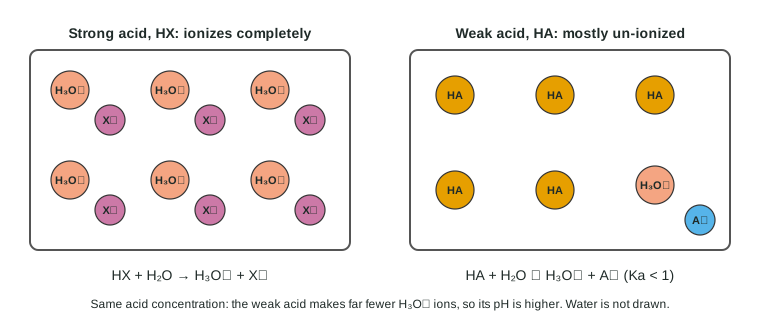
- A weak acid holds its proton fairly tightlyHA + H₂O ⇌ H₃O⁺ + A⁻ reaches equilibrium with most HA un-ionized (Ka ≪ 1)
- Only a small amount x ionizesan ICE table gives Ka = x²/(C − x) ≈ x²/C, so [H₃O⁺] ≈ √(Ka·C)
- Diluting lowers every concentrationQ falls below Ka, so a larger fraction ionizes: percent ionization rises
- An acid and its conjugate base are linked through waterKa × Kb = Kw, so the weaker the acid, the stronger its conjugate base
Part 6 · Key ideas
Key ideas
- Weak acid: Ka ≪ 1, mostly un-ionized. Larger Ka (smaller pKa) = stronger acid.
- Weak acid pH: [H₃O⁺] = x ≈ √(Ka × C). Check x < 5% of C; if not, solve the quadratic.
- Weak base: same method with Kb to find [OH⁻], then pOH, then pH.
- Ka × Kb = Kw for a conjugate pair; pKa + pKb = 14.00 at 25 °C. Kb is not 1/Ka.
Part 7 · Misconception
A common mistake
The wrong idea: A weak acid is one that is dilute.
What actually happens: Weak means it ionizes only partly (Ka ≪ 1); dilute means low concentration. Concentrated acetic acid is still weak, and 0.0010 M HCl is still strong.
Part 8 · Check yourself
Check yourself
Exam-style questions. Anything you miss goes into your review queue.
Data table
Ka values of four acids
Acid dissociation constants at 25 °C. Each acid gives up one proton: HA + H₂O ⇌ H₃O⁺ + A⁻.
| Acid | Formula | Ka |
|---|---|---|
| Hypochlorous acid | HOCl | 3.0 × 10⁻⁸ |
| Acetic acid | CH₃COOH | 1.8 × 10⁻⁵ |
| Nitrous acid | HNO₂ | 4.0 × 10⁻⁴ |
| Hydrofluoric acid | HF | 6.8 × 10⁻⁴ |
1. What is the pH of 0.20 M acetic acid?
Type a number.
Show the answer
Ka = x² / (0.20 − x) = 1.8 × 10⁻⁵. Assume x ≪ 0.20: x = √(1.8 × 10⁻⁵ × 0.20) = 1.90 × 10⁻³ M = [H₃O⁺]. Check: 0.9% of 0.20, under 5%, so the assumption holds. pH = −log(1.9 × 10⁻³) = 2.72.
- Answer: 2.72
2. For 0.10 M solutions of each acid, which has the highest pH?
- Hypochlorous acid
- Hydrofluoric acid
- Nitrous acid
- Acetic acid
Show the answer
At equal concentration, the acid with the smallest Ka ionizes least, makes the least H₃O⁺ and so has the highest pH. HOCl has Ka = 3.0 × 10⁻⁸.
- Correct: Hypochlorous acid: Right: the smallest Ka, the least H₃O⁺.
- Hydrofluoric acid: HF has the largest Ka here, so it gives the most H₃O⁺ and the lowest pH.
- Nitrous acid: HNO₂ has the second-largest Ka, so its pH is low.
- Acetic acid: Acetic acid ionizes more than HOCl (Ka 1.8 × 10⁻⁵ vs 3.0 × 10⁻⁸), so its pH is lower.
3. What is Kb for the fluoride ion, F⁻? Give your answer in scientific notation.
Type a number.
Show the answer
F⁻ is the conjugate base of HF. Ka × Kb = Kw, so Kb = (1.0 × 10⁻¹⁴) / (6.8 × 10⁻⁴) = 1.5 × 10⁻¹¹.
- Answer: 1.5 × 10⁻¹¹
Particle view
Three acid solutions of equal volume
Key: HA a whole acid molecule; H₃O⁺ hydronium; A⁻ the anion left when HA loses a proton. Water is not drawn. Each box holds one kind of acid.
4. Which box represents a strong acid?
- Box 2
- Box 1
- Box 3
- A pH reading of each box is needed to tell
Show the answer
A strong acid ionizes fully, so no HA molecules remain. Only Box 2 has none.
- Correct: Box 2: Right: only ions, no whole molecules.
- Box 1: Box 1 is mostly whole HA molecules: a weak acid.
- Box 3: Box 3 still has whole HA molecules: a weak acid.
- A pH reading of each box is needed to tell: The particle view is enough: a strong acid leaves no whole HA molecules, and only Box 2 has none.
5. Boxes 1 and 3 contain the same acid at the same temperature. Which statement is best supported?
- Box 3 is the more dilute solution, and a larger fraction of its acid is ionized
- Box 3 has the larger Ka, because a larger fraction of its acid is ionized
- Box 3 has the lower pH, because a larger fraction of its acid is ionized
- Both boxes have the same percent ionization, because they hold the same acid
Show the answer
Box 1: 2 of 14 acid particles ionized (14%); Box 3: 1 of 4 (25%), with fewer acid particles in the same volume, so it is more dilute. Both boxes give the same Ka (2 × 2/12 = 1 × 1/3 in particle units), as one acid at one temperature must. Diluting a weak acid raises its percent ionization: Q = [H₃O⁺][A⁻]/[HA] falls below Ka on dilution, so more HA ionizes.
- Correct: Box 3 is the more dilute solution, and a larger fraction of its acid is ionized: Right: fewer particles per volume, a larger fraction ionized.
- Box 3 has the larger Ka, because a larger fraction of its acid is ionized: Ka is fixed for an acid at a given temperature; it does not change with concentration.
- Box 3 has the lower pH, because a larger fraction of its acid is ionized: Box 3 has 1 H₃O⁺ against 2 in Box 1 in the same volume, so its pH is higher. A larger fraction ionized does not mean more H₃O⁺ when the solution is more dilute.
- Both boxes have the same percent ionization, because they hold the same acid: Percent ionization depends on concentration as well as on the acid.
Experimental setup
A household ammonia solution
A cleaning solution is 0.15 M aqueous ammonia, NH₃, at 25 °C. For NH₃, Kb = 1.8 × 10⁻⁵.
NH₃(aq) + H₂O(l) ⇌ NH₄⁺(aq) + OH⁻(aq)
6. What is the pH of the ammonia cleaning solution?
Type a number.
Show the answer
pOH = −log(1.64 × 10⁻³) = 2.784; pH = 14.00 − 2.784 = 11.216, which is 11.22 (two significant figures in 0.15 M, two decimal places). Solving the quadratic gives 11.21; both are accepted.
- Answer: 11.22
7. Solution 1 is 0.10 M HCl and Solution 2 is 0.10 M HF. Each is diluted tenfold. How do their pH values change?
- HCl rises by 1.0 unit; HF rises by less than 1.0 unit
- Both rise by exactly 1.0 unit
- HCl rises by 1.0 unit; HF rises by more than 1.0 unit
- Neither changes, because Ka and Kw do not change
Show the answer
HCl ionizes fully, so [H₃O⁺] falls tenfold and pH rises by 1.0. For HF, dilution makes Q < Ka, so more HF ionizes and partly offsets the dilution: [H₃O⁺] falls only by about √10, and pH rises by about 0.5.
- Correct: HCl rises by 1.0 unit; HF rises by less than 1.0 unit: Right: dilution raises the percent ionization of the weak acid.
- Both rise by exactly 1.0 unit: Only the strong acid follows the one-unit rule; the weak acid ionizes more when diluted.
- HCl rises by 1.0 unit; HF rises by more than 1.0 unit: The extra ionization of HF on dilution makes its pH rise less, not more.
- Neither changes, because Ka and Kw do not change: K values stay the same, but concentrations change, so pH changes.
Part 9 · Summary
Summary
Part 10 · Up next
What comes next
Part 11 · Connections