Cell Potential Under Nonstandard Conditions
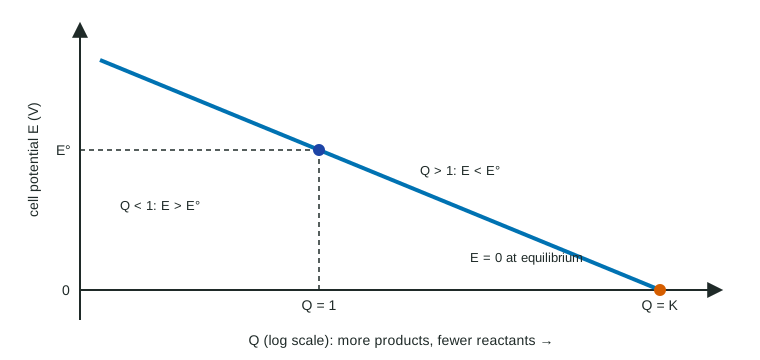
Away from standard conditions, a cell’s potential depends on Q: it is above E° when Q < 1, equal to E° at Q = 1, below E° when Q > 1, and zero at equilibrium (Q = K).
Part 1 · Hook
Why this matters
Part 2 · Before you start
What this builds on
Part 3 · Prerequisite check
Quick check before you start
1. How is Q compared with K to predict the direction of a reaction?
- Q < K: net forward; Q > K: net reverse
- Q < K: net reverse; Q > K: net forward
- Q and K are always equal
- Only K matters
Show the answer
A reaction proceeds in the direction that moves Q toward K.
- Correct: Q < K: net forward; Q > K: net reverse:
- Q < K: net reverse; Q > K: net forward:
- Q and K are always equal:
- Only K matters:
2. For a galvanic cell under standard conditions, what is the sign of E°cell?
- Positive
- Negative
- Zero
- It depends on the salt bridge
Show the answer
A galvanic cell runs a favored reaction, so E°cell > 0.
- Correct: Positive:
- Negative:
- Zero:
- It depends on the salt bridge:
Part 4 · See it
See it first
Part 5 · Step by step
How it works, step by step
- A cell away from standard conditions has Q ≠ 1its actual drive, ΔG, differs from ΔG°, so E differs from E°
- Less product or more reactant makes Q < 1the reaction is further from equilibrium and E > E°
- As the cell runs, reactants are used and products formQ rises and E falls
- When Q reaches K, there is no net driveE = 0 and the battery is dead
Part 6 · Key ideas
Key ideas
- Q < 1 → E > E°. Q = 1 → E = E°. Q > 1 → E < E°. Q = K → E = 0 (equilibrium, a dead battery).
- The Nernst equation, E = E° − (RT/nF) ln Q, describes this; the exam focuses on the direction of the change.
- Q uses only dissolved species and gases: solid electrodes and spectator ions do not affect E.
- A concentration cell has the same half-reaction on both sides (E° = 0) and runs until the concentrations are equal.
Part 7 · Misconception
A common mistake
The wrong idea: A cell’s voltage is always E°, and a dead battery has run out of electrons.
What actually happens: E equals E° only when Q = 1. As the cell runs, Q rises toward K and E falls toward zero; a dead battery is a cell at equilibrium, with reactants often still present.
Part 8 · Check yourself
Check yourself
Exam-style questions. Anything you miss goes into your review queue.
Data table
A zinc-copper cell at different concentrations
A student measures the voltage of the cell Zn(s) | Zn²⁺(aq) || Cu²⁺(aq) | Cu(s), which runs Zn(s) + Cu²⁺(aq) → Zn²⁺(aq) + Cu(s) with E° = 1.10 V, at 25 °C with different starting concentrations.
| Trial | [Zn²⁺] (M) | [Cu²⁺] (M) | E (V) |
|---|---|---|---|
| 1 | 1.0 | 1.0 | 1.100 |
| 2 | 0.10 | 1.0 | 1.130 |
| 3 | 0.010 | 1.0 | 1.159 |
| 4 | 1.0 | 0.10 | 1.070 |
| 5 | 1.0 | 0.010 | 1.041 |
1. In which trial is the cell at standard conditions, so that E = E°?
- Trial 3, where the voltage is highest
- Trial 1, where both ions are 1.0 M and Q = 1
- Trial 5, where the voltage is lowest
- Each of the five trials, because each is at 25 °C
Show the answer
Q = [Zn²⁺]/[Cu²⁺] = 1 only in Trial 1, so only there does E equal E°.
- Trial 3, where the voltage is highest: The highest voltage comes from Q < 1, not from standard conditions.
- Correct: Trial 1, where both ions are 1.0 M and Q = 1: Right: standard conditions mean 1 M for every dissolved species, so Q = 1 and E = E° = 1.100 V.
- Trial 5, where the voltage is lowest: The lowest voltage comes from Q > 1, far from standard conditions.
- Each of the five trials, because each is at 25 °C: Standard conditions also require 1 M concentrations, which only Trial 1 has.
2. Which statement explains why E is greater than E° in Trials 2 and 3?
- Less Zn²⁺ means fewer ions in solution, so the electrons meet less resistance in the wire.
- E° itself increases when [Zn²⁺] decreases.
- The reaction reaches equilibrium faster when [Zn²⁺] is low.
- Q < 1, so the cell is further from equilibrium and its drive is greater.
Show the answer
When Q < 1 the reaction has a larger drive to proceed (ΔG < ΔG°), so E > E°.
- Less Zn²⁺ means fewer ions in solution, so the electrons meet less resistance in the wire.: Electrons in the wire do not depend on the ion concentration. The change in E comes from Q.
- E° itself increases when [Zn²⁺] decreases.: E° is fixed (1.10 V); E changes with concentration through Q.
- The reaction reaches equilibrium faster when [Zn²⁺] is low.: At equilibrium E would be zero. The higher E shows the cell is further from equilibrium.
- Correct: Q < 1, so the cell is further from equilibrium and its drive is greater.: Right: a lower product concentration (Zn²⁺) or a higher reactant concentration makes Q < 1, raising E above E°.
3. A sixth trial uses [Zn²⁺] = 0.50 M and [Cu²⁺] = 0.050 M. How does its voltage compare with E°?
- Less than 1.10 V, because Q = 10 > 1
- Greater than 1.10 V, because both concentrations are below 1 M
- Equal to 1.10 V, because neither concentration is zero
- Zero, because the concentrations are not equal
Show the answer
Q > 1 means E < E°. The ratio, not the individual concentrations, decides it.
- Correct: Less than 1.10 V, because Q = 10 > 1: Right: Q = 0.50/0.050 = 10, the same as Trial 4, so E ≈ 1.07 V.
- Greater than 1.10 V, because both concentrations are below 1 M: What matters is the ratio Q = [Zn²⁺]/[Cu²⁺], here 10, not whether each is below 1 M.
- Equal to 1.10 V, because neither concentration is zero: E equals E° only when Q = 1.
- Zero, because the concentrations are not equal: E = 0 only at equilibrium, where Q = K (an enormous number here).
4. The cell from Trial 1 is left running until it no longer lights a bulb. What are E and Q at that point?
- E = E° and Q = 1, because the reaction has stopped
- E = 0 and Q = 0, because one reactant is used up
- E = 0 and Q = K: the reaction is at equilibrium
- E is negative and Q > K, because the reaction runs backward
Show the answer
As the cell runs, Q rises toward K and E falls toward 0. At equilibrium, Q = K and E = 0.
- E = E° and Q = 1, because the reaction has stopped: E = E° only at Q = 1; as the cell runs, [Zn²⁺] rises and [Cu²⁺] falls, so Q grows.
- E = 0 and Q = 0, because one reactant is used up: Q = [Zn²⁺]/[Cu²⁺] grows, not shrinks, as the cell runs.
- Correct: E = 0 and Q = K: the reaction is at equilibrium: Right: a "dead" battery is at equilibrium: no net drive, so no voltage.
- E is negative and Q > K, because the reaction runs backward: Left alone, a galvanic cell runs down to equilibrium; it does not overshoot.
5. For a galvanic cell, how does E compare with E° when Q > 1?
- E is smaller than E°
- E is larger than E°
- E equals E°
- E is zero
Show the answer
Q < 1: E > E°. Q = 1: E = E°. Q > 1: E < E°. Q = K: E = 0.
- Correct: E is smaller than E°: Right: more products (or fewer reactants) than standard lowers the drive, so E < E°.
- E is larger than E°: That is the case for Q < 1.
- E equals E°: That is the case only for Q = 1.
- E is zero: That is the case only at equilibrium, Q = K.
6. A galvanic cell runs Ni(s) + 2 Ag⁺(aq) → Ni²⁺(aq) + 2 Ag(s), starting at standard conditions. Predict the effect of each change on the measured cell potential, E.
| Variable | Change |
|---|---|
| Adding solid AgNO₃ to the silver half-cell, raising [Ag⁺] | — |
| Adding solid Ni(NO₃)₂ to the nickel half-cell, raising [Ni²⁺] | — |
| Using a larger nickel strip of the same metal | — |
| Letting the cell run for an hour | — |
| Replacing the KNO₃ salt bridge with a NaNO₃ salt bridge | — |
Show the answer
E depends on Q = [Ni²⁺]/[Ag⁺]². Raising reactants lowers Q and raises E; raising products does the opposite. Solids and spectator ions do not appear in Q.
- Adding solid AgNO₃ to the silver half-cell, raising [Ag⁺]: increases. More reactant lowers Q, so E rises above E°.
- Adding solid Ni(NO₃)₂ to the nickel half-cell, raising [Ni²⁺]: decreases. More product raises Q, so E falls below E°.
- Using a larger nickel strip of the same metal: no change. Solids do not appear in Q, so the size of the strip does not change E.
- Letting the cell run for an hour: decreases. As the cell runs, Ag⁺ is used and Ni²⁺ forms, so Q rises and E falls.
- Replacing the KNO₃ salt bridge with a NaNO₃ salt bridge: no change. The salt bridge ions are spectators; they do not appear in Q.
7. For Zn(s) + Cu²⁺(aq) → Zn²⁺(aq) + Cu(s), which change raises the cell potential the most?
- Lowering [Cu²⁺] to 0.010 M while keeping [Zn²⁺] at 1.0 M
- Lowering both concentrations to 0.010 M
- Using a zinc strip twice as large
- Lowering [Zn²⁺] to 0.010 M, with [Cu²⁺] at 1.0 M
Show the answer
E is largest when Q = [Zn²⁺]/[Cu²⁺] is smallest.
- Lowering [Cu²⁺] to 0.010 M while keeping [Zn²⁺] at 1.0 M: Q = 100: E falls below E° to about 1.04 V.
- Lowering both concentrations to 0.010 M: Q = 1, so E = E° = 1.10 V: no change.
- Using a zinc strip twice as large: Solids do not appear in Q, so E is unchanged.
- Correct: Lowering [Zn²⁺] to 0.010 M, with [Cu²⁺] at 1.0 M: Right: Q = 0.010, the smallest Q of the choices, so E is the largest (about 1.16 V).
Part 9 · Summary
Summary
Part 10 · Up next
What comes next
Part 11 · Connections