Electrolysis and Faraday's Law
In electrolysis a current drives an unfavored redox reaction.
Part 1 · Hook
Why this matters
Part 2 · Before you start
What this builds on
Part 3 · Prerequisite check
Quick check before you start
1. In an electrolytic cell, what does the power supply do?
- Drives a redox reaction that is not favored
- Lowers the activation energy
- Makes E°cell positive
- Keeps the solutions from mixing
Show the answer
An electrolytic cell uses outside energy to drive an unfavored reaction.
- Correct: Drives a redox reaction that is not favored:
- Lowers the activation energy:
- Makes E°cell positive:
- Keeps the solutions from mixing:
2. What is the Faraday constant?
- 96,485 C per mole of electrons
- 6.022 × 10²³ electrons
- 8.314 J/(mol·K)
- 1.602 × 10⁻¹⁹ C per mole
Show the answer
F is the charge on one mole of electrons.
- Correct: 96,485 C per mole of electrons:
- 6.022 × 10²³ electrons:
- 8.314 J/(mol·K):
- 1.602 × 10⁻¹⁹ C per mole:
3. How many moles of Cu form from 0.10 mol of electrons in Cu²⁺ + 2e⁻ → Cu?
- 0.050 mol
- 0.10 mol
- 0.20 mol
- 0.025 mol
Show the answer
Two electrons per Cu: 0.10 ÷ 2 = 0.050 mol.
- Correct: 0.050 mol:
- 0.10 mol:
- 0.20 mol:
- 0.025 mol:
Part 4 · See it
See it first
Part 5 · Step by step
How it works, step by step
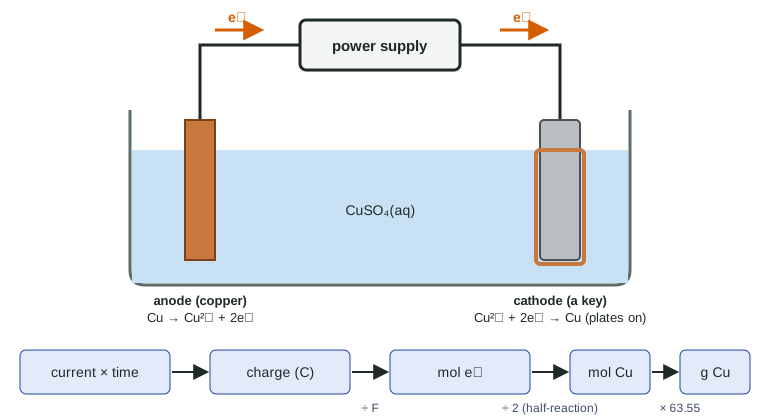
- A current I flows for a time ta charge q = It, in coulombs, passes through the cell
- Each mole of electrons carries 96,485 Cmoles of electrons = q ÷ F
- The half-reaction fixes how many electrons each ion needsmoles of product = mol e⁻ ÷ electrons per ion
- Each mole of product has a known massmass = moles × molar mass
Part 6 · Key ideas
Key ideas
- Electrolysis uses an electric current to drive an unfavored redox reaction, such as plating a metal or splitting a molten salt.
- Charge: q = It (coulombs = amperes × seconds). Convert minutes and hours to seconds.
- Moles of electrons: q ÷ F, with F = 96,485 C/mol e⁻.
- Use the half-reaction: Ag⁺ needs 1 e⁻, Cu²⁺ needs 2, Al³⁺ needs 3. Then moles × molar mass.
- The same charge through cells in series gives the same mol e⁻ but different masses of metal.
Part 7 · Misconception
A common mistake
The wrong idea: One mole of electrons deposits one mole of any metal.
What actually happens: The half-reaction decides: one mole of electrons deposits 1 mol Ag (Ag⁺ + e⁻), ½ mol Cu (Cu²⁺ + 2e⁻) or ⅓ mol Al (Al³⁺ + 3e⁻). Always divide moles of electrons by the electrons per ion.
Part 8 · Check yourself
Check yourself
Exam-style questions. Anything you miss goes into your review queue.
Experimental setup
Copper plating a key
A student plates copper onto a brass key. The key and a copper strip dip into 1.0 M CuSO₄(aq) and are connected to a power supply. A steady current of 2.50 A runs for 30.0 minutes. Cu²⁺(aq) + 2e⁻ → Cu(s). Molar mass of Cu = 63.55 g/mol; F = 96,485 C/mol e⁻.
1. How much charge, in coulombs, passes through the circuit?
Type a number and its unit.
Show the answer
q = It = (2.50 A)(30.0 min × 60 s/min) = (2.50 C/s)(1800 s) = 4.50 × 10³ C.
- Answer: 4.50e+3 C
2. Calculate the mass of copper plated onto the key.
Type a number and its unit.
Show the answer
4.50 × 10³ C × (1 mol e⁻ / 96,485 C) = 0.04664 mol e⁻; × (1 mol Cu / 2 mol e⁻) = 0.02332 mol Cu; × 63.55 g/mol = 1.48 g Cu.
- Answer: 1.48 g
3. Which electrode is the key, and what happens there?
- The anode, where Cu²⁺ ions gain electrons and copper plates on
- The cathode, where Cu²⁺ gains electrons and copper plates on
- The cathode, where copper atoms lose electrons and dissolve
- The anode, where copper atoms lose electrons and dissolve
Show the answer
The key gains copper, so Cu²⁺ is reduced on it: the key is the cathode.
- The anode, where Cu²⁺ ions gain electrons and copper plates on: Gaining electrons is reduction, which happens at the cathode, not the anode.
- Correct: The cathode, where Cu²⁺ gains electrons and copper plates on: Right: plating is reduction, which happens at the cathode.
- The cathode, where copper atoms lose electrons and dissolve: Losing electrons is oxidation, which happens at the anode.
- The anode, where copper atoms lose electrons and dissolve: That is what happens at the copper strip, not at the key.
4. How many minutes would it take to plate 2.00 g of copper at the same current?
Type a number and its unit.
Show the answer
2.00 g ÷ 63.55 g/mol = 0.03147 mol Cu; × 2 = 0.06294 mol e⁻; × 96,485 C/mol = 6073 C; t = q/I = 6073 C ÷ 2.50 A = 2429 s = 40.5 min.
- Answer: 40.5 min
Data table
Three cells in series
Three electrolytic cells are connected one after another (in series), so the same charge, 1.93 × 10⁴ C, passes through each. F = 96,485 C/mol e⁻.
| Cell | Solution | Cathode half-reaction | Molar mass of metal (g/mol) |
|---|---|---|---|
| 1 | AgNO₃ | Ag⁺ + e⁻ → Ag | 107.87 |
| 2 | Cu(NO₃)₂ | Cu²⁺ + 2e⁻ → Cu | 63.55 |
| 3 | Al₂O₃ dissolved in molten cryolite | Al³⁺ + 3e⁻ → Al | 26.98 |
5. What mass of aluminum is produced in Cell 3?
Type a number and its unit.
Show the answer
0.2000 mol e⁻ × (1 mol Al / 3 mol e⁻) × 26.98 g/mol = 1.80 g Al.
- Answer: 1.80 g
6. Which cell produces the greatest mass of metal, and why?
- Cell 3: aluminum ions carry the largest charge, so they attract the most electrons.
- The three masses are equal, because the same charge passes through each cell.
- Cell 2: copper is between silver and aluminum, so it balances charge and mass best.
- Cell 1: Ag⁺ needs one electron, giving the most moles, and Ag is heaviest.
Show the answer
Same mol e⁻ in each cell; mol metal = mol e⁻ ÷ (electrons per ion), then × molar mass. Silver wins on both counts.
- Cell 3: aluminum ions carry the largest charge, so they attract the most electrons.: A larger charge means more electrons per atom, so fewer atoms form from the same charge.
- The three masses are equal, because the same charge passes through each cell.: Equal charge gives equal moles of electrons, but different moles and masses of metal.
- Cell 2: copper is between silver and aluminum, so it balances charge and mass best.: There is no balancing; work out each cell: Ag is largest in both moles and mass.
- Correct: Cell 1: Ag⁺ needs one electron, giving the most moles, and Ag is heaviest.: Right: 0.200 mol Ag (21.6 g) versus 0.100 mol Cu (6.36 g) and 0.0667 mol Al (1.80 g).
7. A student plates copper and finds the key gained less mass than calculated from the current and time. Which is a plausible cause?
- Some current went into another reduction at the cathode, such as making H₂.
- The student used a larger key, which needs more copper.
- The copper anode lost mass during the run.
- The CuSO₄ solution was more concentrated than 1.0 M.
Show the answer
Faraday’s law assumes every electron reduces Cu²⁺. Side reactions use some electrons, so less copper forms.
- Correct: Some current went into another reduction at the cathode, such as making H₂.: Right: if not every electron reduces Cu²⁺, less copper plates than Faraday’s law predicts.
- The student used a larger key, which needs more copper.: The mass plated depends on the charge, not on the size of the key.
- The copper anode lost mass during the run.: The anode is expected to lose mass as Cu dissolves; it does not reduce the mass plated.
- The CuSO₄ solution was more concentrated than 1.0 M.: A more concentrated solution would not reduce the copper plated by a given charge.
Part 9 · Summary
Summary
Part 10 · Up next
What comes next
This is the last topic in the course.
Part 11 · Connections