Multistep Reaction Energy Profile
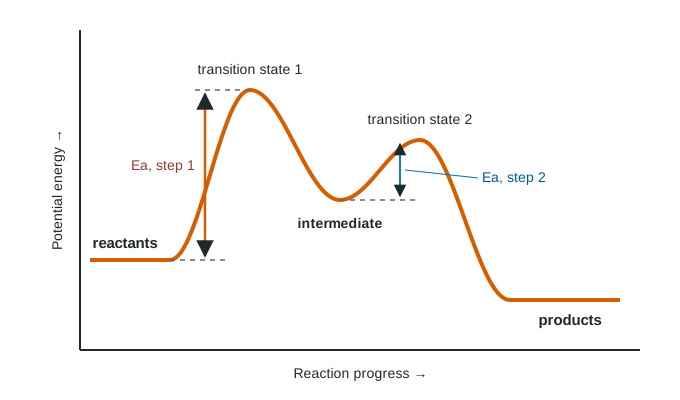
A multistep energy profile has one peak, a transition state, for each elementary step, with intermediates in the valleys between them.
Part 1 · Hook
Why this matters
Part 2 · Before you start
What this builds on
Part 3 · Prerequisite check
Quick check before you start
1. On a one-step energy profile, the activation energy is:
- the climb from the reactants to the peak
- the energy of the products
- products minus reactants
- the energy of the peak alone
Show the answer
Ea = E(transition state) − E(reactants).
- Correct: the climb from the reactants to the peak:
- the energy of the products:
- products minus reactants:
- the energy of the peak alone:
2. Which step of a mechanism sets the overall rate?
- The slowest step
- The first step
- The last step
- The fastest step
Show the answer
The overall reaction cannot be faster than its slowest step.
- Correct: The slowest step:
- The first step:
- The last step:
- The fastest step:
Part 4 · See it
See it first
Part 5 · Step by step
How it works, step by step
- Each elementary step has its own transition statea mechanism with n steps has n peaks on its profile
- An intermediate is a real species between two stepsit sits in a valley between neighboring peaks
- Each step starts from the level the previous step ended atits barrier is measured from that level, not from the reactants
- The step with the largest barrier has the fewest successful collisionsit is the slow, rate-determining step
Part 6 · Key ideas
Key ideas
- A multistep energy profile has one peak per elementary step; valleys between peaks are intermediates.
- A step's Ea is its peak minus the level it starts from.
- The step with the largest Ea is the rate-determining step; it need not be the first.
- The overall energy change is products minus reactants, whatever happens in between.
Part 7 · Misconception
A common mistake
The wrong idea: On a multistep profile, every activation energy is measured from the reactants.
What actually happens: Each step's barrier starts from the level that step begins at: the reactants for step 1, the intermediate for step 2, and so on.
Part 8 · Check yourself
Check yourself
Exam-style questions. Anything you miss goes into your review queue.
Graph
A two-step reaction
The energy profile for a reaction that happens in two elementary steps:
Step 1: A + B → C Step 2: C → D
Reaction progress has no units.
Data table
| Reaction progress | Energy |
|---|---|
| 0 | 50 |
| 1 | 50 |
| 2 | 50 |
| 3 | 72.5 |
| 4 | 117.5 |
| 5 | 140 |
| 6 | 125 |
| 7 | 95 |
| 8 | 80 |
| 9 | 87.5 |
| 10 | 102.5 |
| 11 | 110 |
| 12 | 87.5 |
| 13 | 42.5 |
| 14 | 20 |
| 15 | 20 |
| 16 | 20 |
1. Where is the intermediate C on the profile?
- In the valley between the two peaks, at 80 kJ/mol
- At the first peak, at 140 kJ/mol
- At the second peak, at 110 kJ/mol
- At the right-hand plateau, at 20 kJ/mol
Show the answer
An intermediate is a real species made in step 1 and used in step 2, so it sits in the local minimum between the two transition states.
- Correct: In the valley between the two peaks, at 80 kJ/mol: Right: the valley between the steps.
- At the first peak, at 140 kJ/mol: The first peak is the transition state of step 1, not a species that can be isolated.
- At the second peak, at 110 kJ/mol: The second peak is the transition state of step 2.
- At the right-hand plateau, at 20 kJ/mol: The right-hand plateau is the product D.
2. What is the activation energy of step 2, in kJ/mol?
Type a number in kJ/mol.
Show the answer
Step 2 starts at the intermediate (80 kJ/mol) and climbs to the second transition state (110 kJ/mol): Ea = 110 − 80 = 30 kJ/mol.
- Answer: 30 kJ/mol
3. Which step is rate-determining, and what is the evidence?
- Step 1: its barrier, 90 kJ/mol, is larger
- Step 2: its transition state comes later in the reaction
- Step 2: its barrier ends nearest to the products
- Step 1: being first, it is the slowest by rule
Show the answer
Step 1 climbs 140 − 50 = 90 kJ/mol; step 2 climbs 110 − 80 = 30 kJ/mol. The larger barrier means fewer successful collisions, so step 1 is slower and limits the rate.
- Correct: Step 1: its barrier, 90 kJ/mol, is larger: Right: compares the two activation energies.
- Step 2: its transition state comes later in the reaction: Position along the reaction coordinate does not decide which step is slower.
- Step 2: its barrier ends nearest to the products: Where a step ends says nothing about its barrier.
- Step 1: being first, it is the slowest by rule: The first step is not slowest by rule; here it is slowest because of its barrier.
4. What rate law does this profile predict for the overall reaction A + B → D?
- rate = k[A][B]
- rate = k[C]
- rate = k[A][B][C]
- rate = k[D]
Show the answer
Step 1 (A + B → C) is the slow step and comes first, so its rate law is the overall rate law: rate = k[A][B].
- Correct: rate = k[A][B]: Right: from the slow first step.
- rate = k[C]: That is the rate law of the fast step, and C is an intermediate.
- rate = k[A][B][C]: C is an intermediate and does not belong in the rate law.
- rate = k[D]: D is a product.
5. On a multistep energy profile, what does each peak represent?
- The transition state of one elementary step
- An intermediate that can be isolated
- The products of the overall reaction
- A point where no bonds are changing
Show the answer
Each elementary step has its own barrier, so each peak is that step's transition state.
- Correct: The transition state of one elementary step: Right: one peak per step.
- An intermediate that can be isolated: Intermediates are in the valleys, not at the peaks.
- The products of the overall reaction: The products are the final plateau.
- A point where no bonds are changing: At a peak, bonds are partly broken and partly formed.
6. A three-step reaction profile is drawn. How many valleys lie between the reactant and product plateaus?
- 1
- 2
- 3
- 4
Show the answer
There is one valley between each pair of neighboring peaks: three peaks give two valleys, one for each intermediate.
- 1: One valley would mean two steps.
- Correct: 2: Right: two intermediates.
- 3: Three is the number of peaks.
- 4: Four would mean five steps.
Part 9 · Summary
Summary
Part 10 · Up next
What comes next
Part 11 · Connections