Introduction to Acids and Bases
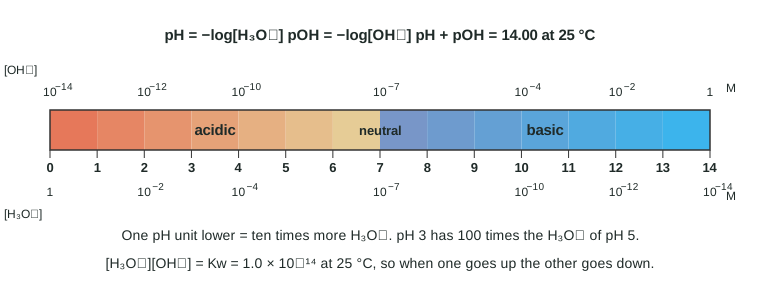
Water ionizes itself slightly, so every water solution holds both H₃O⁺ and OH⁻, tied together by Kw = [H₃O⁺][OH⁻] = 1.0 × 10⁻¹⁴ at 25 °C.
Part 1 · Hook
Why this matters
Part 2 · Before you start
What this builds on
Part 3 · Prerequisite check
Quick check before you start
1. What is log(1 × 10⁻⁵)?
- −5
- 5
- 0.00001
- −0.00001
Show the answer
The base-10 log of a power of ten is the exponent: log(10⁻⁵) = −5.
- Correct: −5:
- 5:
- 0.00001:
- −0.00001:
2. In the reaction H₂O + H₂O ⇌ H₃O⁺ + OH⁻, what does the first water molecule do?
- Accepts a proton
- Donates a proton
- Gains an electron
- Loses an oxygen atom
Show the answer
It becomes H₃O⁺ by gaining H⁺, so it acts as a Brønsted-Lowry base; the other water molecule donates the proton.
- Correct: Accepts a proton:
- Donates a proton:
- Gains an electron:
- Loses an oxygen atom:
3. Which species are left out of an equilibrium constant expression?
- Pure liquids and solids
- Gases
- Dissolved ions
- Products
Show the answer
Pure liquids and solids have constant concentrations, so they are left out. That is why water does not appear in Kw.
- Correct: Pure liquids and solids:
- Gases:
- Dissolved ions:
- Products:
Part 4 · See it
See it first
Part 5 · Step by step
How it works, step by step
- Water molecules collide and a few transfer a proton to a neighborpure water always holds equal, tiny amounts of H₃O⁺ and OH⁻
- That self-ionization is an equilibriumKw = [H₃O⁺][OH⁻] has one value at a given temperature: 1.0 × 10⁻¹⁴ at 25 °C
- Adding acid raises [H₃O⁺]some of the added H₃O⁺ reacts with OH⁻ until the product is back to Kw, so [OH⁻] falls
- Concentrations span many powers of tenchemists report them as pH = −log[H₃O⁺], where each unit is a factor of ten
- Self-ionization absorbs heatwarm water has a larger Kw, so neutral water there has a pH below 7
Part 6 · Key ideas
Key ideas
- Kw = [H₃O⁺][OH⁻] = 1.0 × 10⁻¹⁴ at 25 °C, in every water solution. Know one ion and you know the other.
- pH = −log[H₃O⁺] and pOH = −log[OH⁻]; at 25 °C pH + pOH = 14.00. One pH unit is ten times the [H₃O⁺].
- Acidic: [H₃O⁺] > [OH⁻]. Basic: [OH⁻] > [H₃O⁺]. Neutral: equal. Neutral is pH 7.00 only at 25 °C.
- Significant figures: the pH gets as many decimal places as the concentration has significant figures.
Part 7 · Misconception
A common mistake
The wrong idea: Water at pH 6.6 must be acidic, because neutral is pH 7.
What actually happens: Neutral means [H₃O⁺] = [OH⁻]. Pure water is neutral at every temperature; at 50 °C, where Kw is larger, neutral water has a pH of about 6.6.
Part 8 · Check yourself
Check yourself
Exam-style questions. Anything you miss goes into your review queue.
Data table
Four solutions at 25 °C
A student records one measured quantity for each of four aqueous solutions, all at 25 °C.
| Solution | Quantity measured | Value |
|---|---|---|
| A | [H₃O⁺] | 3.2 × 10⁻⁴ M |
| B | [OH⁻] | 2.5 × 10⁻³ M |
| C | pH | 9.15 |
| D | pOH | 11.62 |
1. Find the pH of Solution A from its measured hydronium concentration.
Type a number.
Show the answer
pH = −log(3.2 × 10⁻⁴) = 3.495. The concentration has two significant figures, so the pH gets two decimal places: 3.49.
- Answer: 3.49
2. What is the pH of Solution B?
Type a number.
Show the answer
pOH = −log(2.5 × 10⁻³) = 2.602; pH = 14.00 − 2.60 = 11.40. Two significant figures in [OH⁻] give two decimal places.
- Answer: 11.40
3. Which solution has the highest concentration of H₃O⁺?
- Solution D, with a pOH of 11.62
- Solution A, with [H₃O⁺] = 3.2 × 10⁻⁴ M
- Solution B, with [OH⁻] = 2.5 × 10⁻³ M
- Solution C, with a pH of 9.15
Show the answer
Convert each to pH: A 3.49, B 11.40, C 9.15, D 14.00 − 11.62 = 2.38. The lowest pH, D, has the most H₃O⁺.
- Correct: Solution D, with a pOH of 11.62: Right: a large pOH means little OH⁻, so pH = 2.38, the lowest of the four.
- Solution A, with [H₃O⁺] = 3.2 × 10⁻⁴ M: Solution A is acidic (pH 3.49), but D's pH of 2.38 is lower, so D has more H₃O⁺. A was the only one stated as [H₃O⁺], which is not the same as having the most.
- Solution B, with [OH⁻] = 2.5 × 10⁻³ M: This reads [OH⁻] as if it were [H₃O⁺]. A large [OH⁻] means a basic solution, pH 11.40, with very little H₃O⁺.
- Solution C, with a pH of 9.15: A larger pH number means less H₃O⁺, not more: pH 9.15 is basic.
Particle view
Ions in four samples of water
Key: H₃O⁺ hydronium ion; OH⁻ hydroxide ion. Water molecules and any other ions are not drawn. Boxes 1, 2 and 3 are at the same temperature; Box 4 is pure water at a different temperature.
4. Which box represents a basic solution?
- Box 3
- Box 1
- Box 2
- Box 4
Show the answer
A solution is basic when [OH⁻] > [H₃O⁺]. Only Box 3 has more hydroxide (4) than hydronium (1).
- Correct: Box 3: Right: 4 OH⁻ to 1 H₃O⁺.
- Box 1: Box 1 has equal numbers of the two ions, so it is neutral.
- Box 2: Box 2 has more H₃O⁺ than OH⁻, so it is acidic.
- Box 4: Box 4 has equal numbers of the two ions, so it is neutral even though it holds more ions than Box 1.
5. In Boxes 1, 2 and 3 the product (number of H₃O⁺) × (number of OH⁻) is the same. What does this show?
- [H₃O⁺][OH⁻] is fixed at a given temperature, so raising one lowers the other
- Each solution contains the same total number of ions
- Adding acid to water adds OH⁻ ions as well as H₃O⁺ ions
- The pH of each of the three solutions is the same
Show the answer
Each box has 2 × 2 = 4 × 1 = 1 × 4 = 4. This mirrors Kw = [H₃O⁺][OH⁻], which has one value at a given temperature: more H₃O⁺ means less OH⁻.
- Correct: [H₃O⁺][OH⁻] is fixed at a given temperature, so raising one lowers the other: Right: the product is the model of Kw.
- Each solution contains the same total number of ions: The totals differ: 4, 5 and 5 ions. It is the product that stays the same.
- Adding acid to water adds OH⁻ ions as well as H₃O⁺ ions: Box 2 has fewer OH⁻ than Box 1. Added H₃O⁺ reacts with OH⁻, which lowers [OH⁻].
- The pH of each of the three solutions is the same: The boxes have different [H₃O⁺], so different pH values; only the product is the same.
6. A solution at 25 °C has [H₃O⁺] = 4.0 × 10⁻³ M. What is [OH⁻]? Include the unit.
Type a number and its unit.
Show the answer
[OH⁻] = Kw / [H₃O⁺] = (1.0 × 10⁻¹⁴) / (4.0 × 10⁻³) = 2.5 × 10⁻¹² M.
- Answer: 2.5 × 10⁻¹² M
7. A solution has [H₃O⁺] = 0.0050 M. How should its pH be reported?
- 2.30
- 2.3
- 2.301
- 2.3010
Show the answer
0.0050 has two significant figures, so the pH gets two decimal places: −log(0.0050) = 2.3010 → 2.30. The digits before the decimal point only give the power of ten.
- Correct: 2.30: Right: two significant figures, two decimal places.
- 2.3: One decimal place throws away a measured digit: 0.0050 has two significant figures.
- 2.301: Three decimal places claim more precision than the two significant figures measured.
- 2.3010: Four decimal places treat the trailing zero of 2.3010 as measured, which it is not.
Part 9 · Summary
Summary
Part 10 · Up next
What comes next
Part 11 · Connections