Estimating a Derivative at a Point
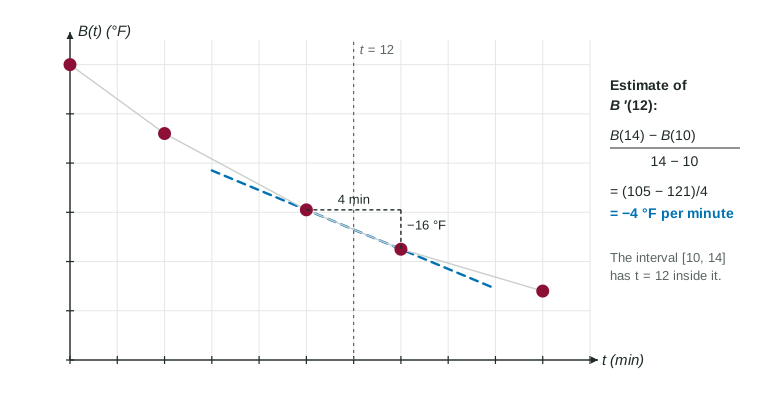
With data instead of a formula, estimate f′(a) with a difference quotient from two table inputs on either side of a , as close as possible, and give the units.
Part 1 · Hook
Why this matters
Part 2 · Before you start
What this builds on
Part 3 · Prerequisite check
Quick check before you start
1. The derivative is the limit of
- as
- as
- as
- as
Show the answer
A derivative is a limit of difference quotients: average rates on shrinking intervals.
- Correct: as :
- as :
- as :
- as :
2. If is a temperature in degrees Celsius and is in minutes, the units of are
- degrees Celsius per minute
- degrees Celsius
- minutes per degree Celsius
- degrees Celsius per minute per minute
Show the answer
A change in temperature over a change in time.
- Correct: degrees Celsius per minute:
- degrees Celsius:
- minutes per degree Celsius:
- degrees Celsius per minute per minute:
Part 4 · See it
See it first
Part 5 · Step by step
How it works, step by step
- Only a table of values is knownthe limit in the definition cannot be taken, so use a difference quotient with the data
- The two table inputs sit on either side of and close to ittheir difference quotient is a good estimate of
- The quotient divides output units by input unitsthe estimate is a rate with units, such as degrees per minute
- A formula is known but hard to work with by handa calculator's numerical derivative estimates with a tiny symmetric difference quotient
Part 6 · Key ideas
Key ideas
- From a table, estimate by with : the two closest data points on either side of .
- At the end of a table, only one side exists: use the closest one-sided quotient.
- The symmetric difference quotient averages the left and right quotients and is usually the most accurate.
- A numerical derivative on a graphing calculator gives a decimal estimate of ; report it to three decimal places.
- From a graph, read the slope of the tangent line from two points on it.
Part 7 · Misconception
A common mistake
The wrong idea: To estimate from and , average the values: .
What actually happens: Averaging values estimates , a value. A derivative is a rate:
Part 8 · Check yourself
Check yourself
Exam-style questions. Anything you miss goes into your review queue.
Table
A cup of coffee cooling on a desk
| (minutes) | 0 | 2 | 5 | 9 | 12 |
|---|---|---|---|---|---|
| (degrees Celsius) | 92 | 85 | 77 | 69 | 64 |
1. Use the data in the table to estimate . Include units.
No calculator. Type the exact value (a fraction, π, e or a root is fine), then its unit.
Show the answer
lies between the data at and :
- Answer: -2 degrees Celsius per minute
2. Which sentence interprets in context?
- At minutes, the coffee's temperature is decreasing at about 2 degrees Celsius per minute.
- At minutes, the coffee's temperature is about degrees Celsius.
- From to minutes, the coffee's temperature drops a total of 2 degrees Celsius.
- At minutes, the temperature is decreasing at about 2 degrees Celsius per minute per minute.
Show the answer
A derivative is a rate at one instant; the negative sign means the temperature is going down.
- Correct: At minutes, the coffee's temperature is decreasing at about 2 degrees Celsius per minute.: It names the time, the quantity, the direction and the units.
- At minutes, the coffee's temperature is about degrees Celsius.: That reads the derivative as a temperature; it is a rate of change of the temperature.
- From to minutes, the coffee's temperature drops a total of 2 degrees Celsius.: Over those 4 minutes the drop is 8 degrees; is a rate per minute.
- At minutes, the temperature is decreasing at about 2 degrees Celsius per minute per minute.: That unit is a rate of a rate; is in degrees Celsius per minute.
3. Using the table, which is the best estimate of ?
- degrees Celsius per minute
- degrees Celsius per minute
- degrees Celsius per minute
- degrees Celsius per minute
Show the answer
The closest data on either side of 10.5 are at 9 and 12:
- Correct: degrees Celsius per minute: Change over 3 minutes.
- degrees Celsius per minute: That is the change in temperature; divide by 3 minutes.
- degrees Celsius per minute: The quotient is upside down.
- degrees Celsius per minute: That uses and , data that does not contain .
4. Which difference quotient should NOT be used to estimate ?
Show the answer
An estimate of must use an interval that contains . The interval describes a later stretch of time.
- Correct: : Its interval, , does not contain .
- : A one-sided quotient ending at is a reasonable estimate.
- : A one-sided quotient starting at is a reasonable estimate.
- : This interval has inside it, so it is reasonable, if wider.
5. A runner has covered meters after seconds, with and . Which is the best estimate of ?
- meters per second
- meters per second
- meters
- seconds per meter
Show the answer
- Correct: meters per second: Change in distance over change in time, with rate units.
- meters per second: That is the 9 meters covered; divide by the 2 seconds.
- meters: The number is right but a derivative of distance is a rate, in meters per second.
- seconds per meter: That is time over distance, upside down.
6. A bacteria culture has thousand bacteria after hours, with and . Which is the best estimate of ?
- thousand bacteria per hour
- thousand bacteria
- thousand bacteria per hour
- thousand bacteria
Show the answer
- Correct: thousand bacteria per hour: A rate: change in population over change in time.
- thousand bacteria: That averages the two values, which estimates , not .
- thousand bacteria per hour: That is the change over 2 hours; divide by 2.
- thousand bacteria: The number is right but the units are those of ; a rate is per hour.
Part 9 · Summary
Summary
Part 10 · Up next
What comes next
Part 11 · Connections