Types of Discontinuity
A discontinuity is a point where the graph breaks.
Part 1 · Hook
Why this matters
Part 2 · Before you start
What this builds on
Part 3 · Prerequisite check
Quick check before you start
1. If and , then
- does not exist
- is undefined
Show the answer
Equal one-sided limits give the two-sided limit. They say nothing about f(2).
- Correct: :
- :
- does not exist:
- is undefined:
2. Substituting into gives . Near , the expression is
- unbounded
- close to 5
- close to 0
- close to 1
Show the answer
A nonzero number over a shrinking denominator grows without bound.
- Correct: unbounded:
- close to 5:
- close to 0:
- close to 1:
Part 4 · See it
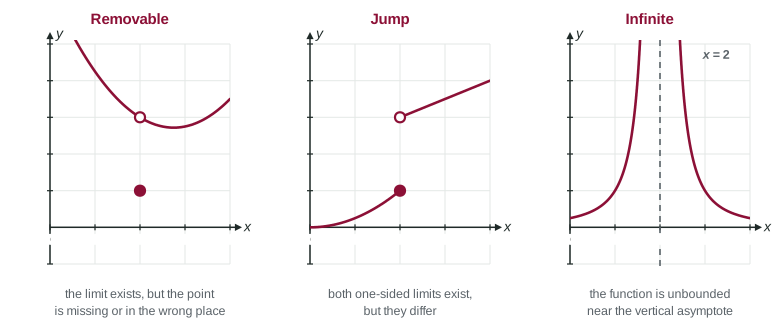
See it first
Part 5 · Step by step
How it works, step by step
- exists, but is missing or differentthe graph has a hole: a removable discontinuity
- Both one-sided limits are finite but not equalthe graph steps from one height to another: a jump discontinuity
- is unbounded on at least one side of the graph has a vertical asymptote : an infinite discontinuity
- A formula gives at and the zero factor cancelsexpect a hole; a factor that stays in the denominator gives an asymptote
Part 6 · Key ideas
Key ideas
- A function is continuous at when exists and equals ; its graph has no break there. A discontinuity is a point where this fails.
- Removable: the limit exists, but the point is missing or misplaced (a hole).
- Jump: both one-sided limits are finite and different.
- Infinite: the function is unbounded near (a vertical asymptote).
- To classify, find the one-sided limits first, then compare them with .
Part 7 · Misconception
A common mistake
The wrong idea: If a function is undefined at a point, its graph has a vertical asymptote there.
What actually happens: Undefined is not the same as unbounded. is undefined at 2 but equals nearby, so its graph has a hole at , a removable discontinuity. An asymptote needs the values to grow without bound.
Part 8 · Check yourself
Check yourself
Exam-style questions. Anything you miss goes into your review queue.
Graph
The graph of
1. What kind of discontinuity does have at ?
- Removable
- Jump
- Infinite
- No discontinuity; is continuous there
Show the answer
From both sides the curve approaches height 1, so . But . The limit exists and differs from the value: a removable discontinuity.
- Correct: Removable: The limit exists (1) but does not equal ; moving one point would fix it.
- Jump: A jump needs different one-sided limits. Both sides approach 1 here.
- Infinite: Nothing is unbounded near .
- No discontinuity; is continuous there: The value is not where the curve is heading, so there is a break.
2. What kind of discontinuity does have at ?
- Removable
- Jump
- Infinite
- No discontinuity; is defined
Show the answer
and
- Removable: A removable discontinuity has a two-sided limit. Here the sides disagree.
- Correct: Jump: Left side to 4, right side to : two different finite one-sided limits.
- Infinite: Both one-sided limits are finite numbers.
- No discontinuity; is defined: A defined value is not enough; the sides must also meet at that value.
3. What kind of discontinuity does have at ?
- Jump
- Removable
- Infinite
- No discontinuity; is simply not defined at 3
Show the answer
Near the graph rises without bound on both sides of the dashed vertical asymptote, so the discontinuity is infinite.
- Jump: A jump needs two finite one-sided limits. These values grow without bound.
- Removable: There is no finite limit at 3 to fill a hole with.
- Correct: Infinite: is unbounded near 3: an infinite discontinuity, with a vertical asymptote.
- No discontinuity; is simply not defined at 3: Not being defined at 3 already breaks continuity there, and is unbounded nearby: an infinite discontinuity.
Table
Four functions with breaks
| Function | Formula |
|---|---|
4. Which describes all the discontinuities of ?
- Removable at and infinite at
- Infinite at and infinite at
- Removable at and removable at
- Removable at and infinite at
Show the answer
- Correct: Removable at and infinite at : A canceled factor gives a hole; a factor left in the denominator gives a vertical asymptote.
- Infinite at and infinite at : At the zero factor cancels, so the limit is , a finite number.
- Removable at and removable at : At the numerator is and the denominator is 0, so is unbounded there.
- Removable at and infinite at : makes the numerator 0, which gives a zero of , not a break.
5. A function has , , and . What kind of discontinuity is at ?
- Jump
- Infinite
- There is no discontinuity
- Removable
Show the answer
The one-sided limits agree, so exists. It does not equal : a removable discontinuity.
- Jump: A jump needs unequal one-sided limits; these are both 2.
- Infinite: All the limits are finite.
- There is no discontinuity: is not the limit 2, so the graph has a break.
- Correct: Removable: The limit exists but the point is in the wrong place, like a hole with a dot above it.
6. A function has , , and . What kind of discontinuity is at ?
- Jump
- Removable
- Infinite
- There is no discontinuity
Show the answer
The one-sided limits, 2 and 6, are finite and different, so the limit does not exist: a jump. The value matching one side does not change that.
- Correct: Jump: Two different finite one-sided limits make a jump.
- Removable: A removable discontinuity needs the two-sided limit to exist.
- Infinite: Both one-sided limits are finite.
- There is no discontinuity: The left side heads to 2, not 6, so the graph breaks.
7. A student says has a vertical asymptote at because is undefined. What is the best response?
- Yes; any point where is undefined has a vertical asymptote
- No; , so has no discontinuity at
- Yes; the denominator is 0 at , so is unbounded
- No; for , so there is a hole at
Show the answer
Undefined is not the same as unbounded. Here the zero factor cancels:
- Yes; any point where is undefined has a vertical asymptote: A hole is also a point where the function is undefined.
- No; , so has no discontinuity at : is , which is undefined, not 0.
- Yes; the denominator is 0 at , so is unbounded: The numerator is also 0 at 2, so the denominator alone does not decide. The limit is 4.
- Correct: No; for , so there is a hole at : The canceled factor leaves a hole at height 4, not an asymptote.
Part 9 · Summary
Summary
Part 10 · Up next
What comes next
Part 11 · Connections