You can pick up an egg without crushing it and a suitcase without dropping it, using the same arm muscles. How does one muscle produce such different forces when each of its fibers either contracts or doesn't? This page explains the muscle twitch, summation and tetanus, motor units and recruitment, muscle tone, the difference between isotonic and isometric contraction, and the length–tension relationship: everything your nervous system uses to grade the force of a skeletal muscle.
Muscle tension and load
Hold a bag of groceries with your elbow bent. Two forces act on your forearm. The bag pulls it down. Your arm muscle pulls it up.
Muscle tension (tens- = stretched) is the force a contracting muscle exerts on the bones or other structures it is attached to. It comes from all the cross-bridges pulling at once, transmitted through the connective tissue wrappings and the tendon. The opposing force, here the weight of the bag, is the load. Whether your forearm rises, falls or stays still depends on which of the two is larger. Everything on this page is about how your nervous system sets the tension to match the load.
Motor units
A single motor neuron in your spinal cord sends its axon out to a muscle. Near the muscle, the axon branches, and each branch ends at the neuromuscular junction of a different muscle fiber. One motor neuron can therefore control ten fibers or two thousand.
A motor unit is one motor neuron together with all the muscle fibers it supplies (Figure 1). Three facts about motor units shape everything that follows:
- Each fiber belongs to one motor unit. A skeletal muscle fiber has a single neuromuscular junction, so it answers to one motor neuron only.
- A motor unit works as a whole. One action potential in the motor neuron reaches every branch, releases acetylcholine at every junction and triggers an action potential in every fiber of the unit. All of them contract together. The nervous system cannot make half a motor unit contract.
- A unit's fibers are scattered. The fibers of one motor unit are spread through the muscle, mixed in among fibers of other units, so even a small unit pulls on the whole tendon evenly.
Small and large motor units
Motor units vary enormously in size. The muscles that move your eyeball have units of roughly 10 to 20 fibers each. A large muscle in your calf has units of a thousand fibers or more. The size sets the step in force when one more unit joins in:
- Small motor units add a tiny step of force each. Muscles built of them, such as the muscles of the eye and the fingers, can be controlled finely.
- Large motor units add a big step each. Muscles built of them, such as the muscles of the thigh and back, produce great force but less precisely.
The muscle twitch
In a lab, you can stimulate a muscle with one brief electric shock and record its tension. The result is a muscle twitch: a single, brief contraction and relaxation of a muscle fiber (or motor unit) in response to one action potential. A recording of tension over time is a myogram (my/o = muscle, -gram = record). Figure 2 shows one twitch with its three phases.
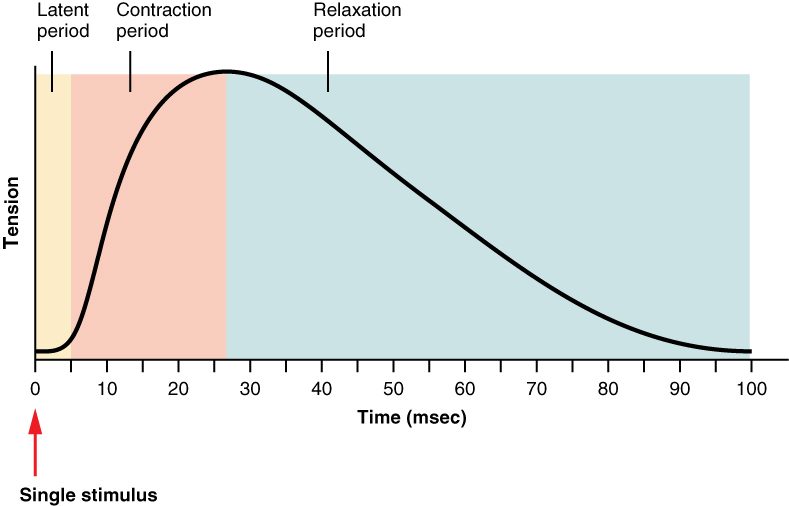
- Latent period (latent = hidden), the first few milliseconds. The action potential spreads along the sarcolemma and down the T tubules, the sarcoplasmic reticulum releases calcium, and calcium binds troponin. Cross-bridges are just starting to form, and they must take up the slack in the fiber's elastic parts before tension shows. The chemistry is under way, but the myogram is still flat.
- Contraction phase. Cross-bridges cycle, and tension rises to a peak.
- Relaxation phase. The SR's calcium pump draws calcium back in, tropomyosin covers the binding sites on actin again, and cross-bridges stop forming. Tension falls. This phase is usually the longest, because pumping calcium back takes longer than releasing it.
Twitch length varies between muscles. An eye muscle's twitch is over in about 10 ms; a twitch in the deep calf muscle can last 100 ms or more. The difference comes from how fast each fiber's myosin splits ATP and how fast its SR pumps calcium back.
A single twitch is weak. It reaches only a fraction of the tension the fiber can produce, often a fifth to a third. You almost never use single twitches: nearly every movement you make is built from the next idea.
Wave summation and tetanus
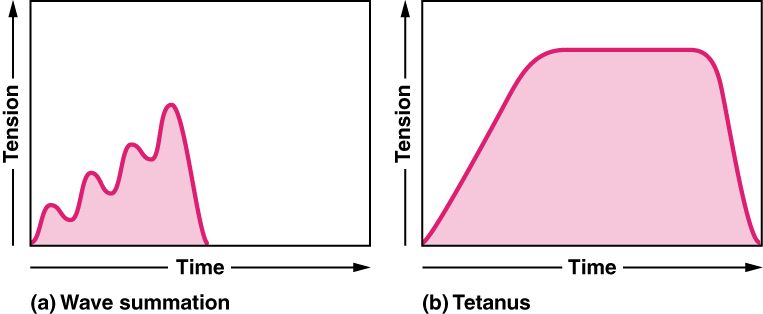
Stimulate the fiber a second time before it has finished relaxing, and the second twitch starts from a higher point and climbs higher. This is wave summation: the adding together of twitches when action potentials arrive faster than the fiber can relax (Figure 3).
Why the twitches add up
- Each action potential triggers a release of calcium from the SR.
- In a single twitch, the pumps clear that calcium before the cross-bridges have had time to pull the fiber's elastic parts (the connective tissue and tendon) fully taut, so tension never reaches its full value.
- When action potentials arrive close together, calcium is released again before it has been cleared. Calcium in the cytosol stays high for longer.
- Cross-bridges keep cycling, the elastic parts are pulled fully taut, and tension climbs higher than any single twitch could reach.
Tetanus
As the frequency of stimulation rises, the dips between waves get smaller:
- Incomplete tetanus (also called unfused tetanus): the fiber relaxes a little between stimuli, so the myogram shows a wavy plateau.
- Complete tetanus (fused tetanus): stimuli arrive so fast that the fiber has no time to relax at all. Tension rises to a smooth, sustained maximum, often three to five times the tension of one twitch.
Tetanus (tetan- = rigid, tense) in physiology is this sustained, fused contraction. It is normal: your motor neurons fire at rates that put their motor units into incomplete tetanus every time you hold a cup or stand up.
Why summation is possible in skeletal muscle
You met the refractory period with action potentials. In a skeletal muscle fiber, the action potential and its refractory period last only a few milliseconds, while the twitch lasts tens of milliseconds. So a new action potential can fire, and release more calcium, while the fiber is still contracting from the last one. The last topic in this chapter shows that heart muscle is built differently here.
Treppe
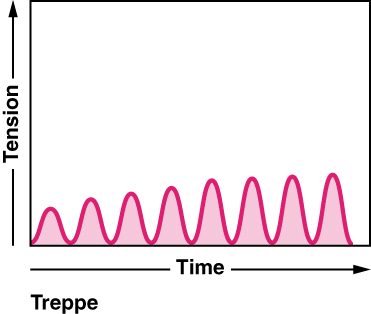
One more pattern appears in a muscle that has been resting. Stimulate it at a rate slow enough for full relaxation between twitches, and for the first several twitches each peak is a little higher than the last (Figure 4). This staircase rise is treppe (German for "staircase"; say "TREP-uh"). Unlike summation, each twitch starts from full relaxation. The best-supported explanation in human skeletal muscle is that repeated activity adds phosphate groups to part of the myosin molecule, which makes the cross-bridges respond more strongly to the same calcium. Older textbooks attribute it to calcium building up in the cytosol and to the muscle warming, and both may add a little. Treppe is one reason athletes warm up before an event.
Recruitment: adding motor units
A fiber's twitch is all-or-none, and a motor unit contracts as a whole. So your nervous system has two ways to grade the force of a whole muscle:
- How many motor units fire. Recruitment (recruit = to enlist) is increasing the force of a muscle by activating more motor units. It is also called motor unit recruitment. Together with firing rate (below), it produces the graded muscle response: force that can be set anywhere from a gentle hold to a full push.
- How fast each unit fires. Firing a motor unit faster moves it from single twitches through wave summation toward tetanus.
Both work at once. For a light task, a few motor units fire slowly. As the task gets harder, more units join and all of them fire faster.
The size principle
Units are not recruited at random. Small motor neurons have a small cell surface, so the same incoming synaptic current depolarizes them more, and they reach threshold first. Large motor neurons need more input. So small motor units are recruited first and large ones last. This is called the size principle.
The result is a force ladder with fine rungs at the bottom and coarse rungs at the top. Lifting an egg uses only small units, each adding a sliver of force, so you can adjust grip precisely. Lifting a suitcase recruits the large units too, each adding a big step of force.
Why your movements are smooth
Each motor unit, firing on its own at 10 to 30 times a second, is usually in incomplete tetanus, with small ripples of tension. Your movements are still smooth, because different motor units fire out of step with one another. As one unit's tension dips, another's rises, and the ripples cancel at the tendon. Rotating which units are active also spreads the work during a long hold.
Muscle tone
Lift a sleeping friend's relaxed arm and let it go, and it falls. Yet while you lift it, you feel a slight resistance: the arm is not as floppy as a rag. That resistance is muscle tone.
Muscle tone (ton- = tension) is the slight tension and resistance to stretch that a relaxed skeletal muscle keeps at rest. It has two sources:
- Passive elasticity. The muscle's connective tissue and the elastic proteins inside its fibers resist being stretched, even with no motor units firing. In a fully relaxed muscle, recordings of its electrical activity are often almost silent, so much of the tone at rest is passive.
- Low-level activity of motor units. When a muscle is being stretched, or when it is holding your posture (the muscles of your neck, back and legs as you sit or stand), a few motor units fire at a low rate, taking turns.
Tone keeps muscles ready to respond, keeps joints steady and holds your posture without conscious effort. Doctors check it by moving a relaxed limb.
- Hypotonia (hypo- = under): low tone. The limb feels floppy and offers little resistance. It follows damage to the motor neurons that supply the muscle, and it is seen in some newborns ("floppy infant").
- Hypertonia (hyper- = over): high tone. The limb feels stiff and resists being moved. It follows some kinds of damage to the brain or spinal cord.
Isotonic and isometric contraction
A contraction is not the same as a shortening. What the muscle does depends on its tension compared with the load (Figure 5):
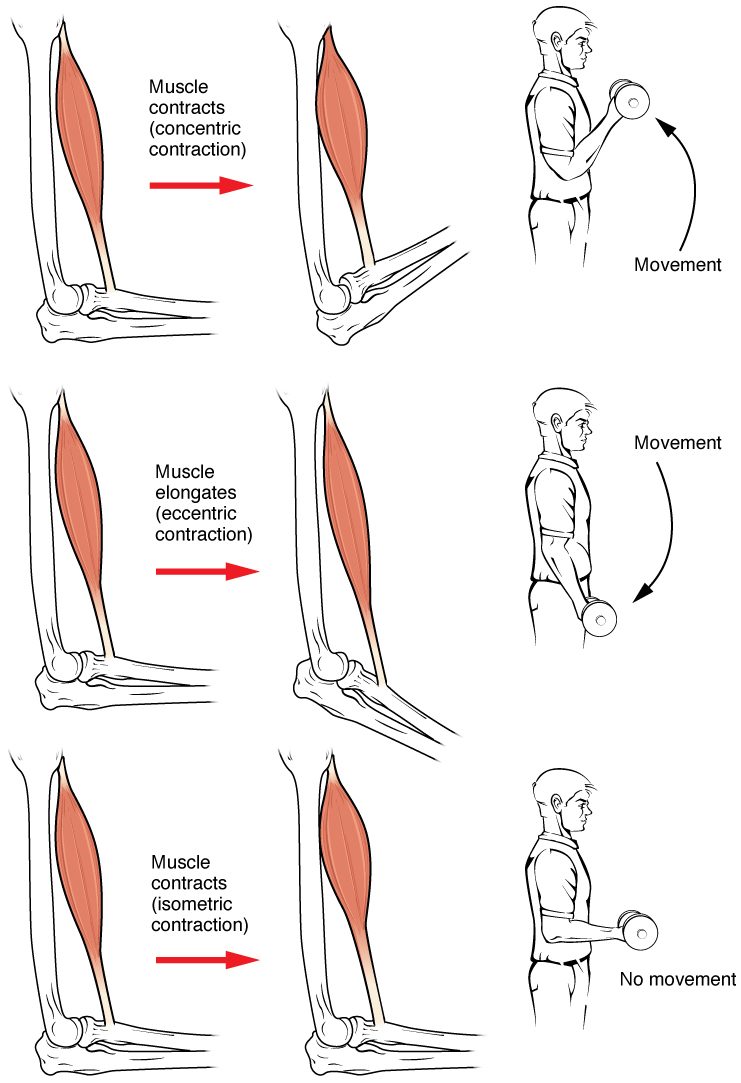
- Isotonic contraction (iso- = equal, ton- = tension): the muscle's tension overcomes or yields to the load, so its length changes and the joint moves. There are two kinds:
- Concentric contraction (con- = together, centr- = center): tension is greater than the load, and the muscle shortens. Lifting the dumbbell.
- Eccentric contraction (ec- = out of): the load is greater than the tension, and the muscle lengthens while its cross-bridges keep pulling, braking the movement. Lowering the dumbbell slowly, or walking downstairs.
- Isometric contraction (metr- = length): tension rises but equals the load, or the load cannot be moved, so the muscle's length does not change. Holding the dumbbell still, pushing on a wall, or holding a plank.
| Isotonic contraction | Isometric contraction | |
|---|---|---|
| Tension compared with load | Greater than the load (concentric) or less than it (eccentric) | Equal to the load, or the load cannot move |
| Muscle length | Changes: shortens (concentric) or lengthens (eccentric) | Stays the same |
| Joint movement | Yes | No |
| Cross-bridges | Cycle and move the thin filaments (concentric) or resist being pulled back (eccentric) | Cycle and pull, but the filaments do not slide overall |
| Everyday example | Lifting or lowering a grocery bag | Holding a grocery bag still, carrying a tray |
| External work done | Yes: the load is moved | None, although ATP is spent and heat is released |
Real movements mix these. Every lift begins isometrically: tension must rise until it matches the load before anything moves. And in a real lift, tension changes as the joint angle changes, so "isotonic" (equal tension) is an idealization; what the word means in practice is "length changes".
Eccentric contractions are special in two ways. A muscle can hold more tension while it is being lengthened than it can produce while holding still, and it uses less ATP to do so, because cross-bridges are pulled off actin rather than completing their cycle. And unaccustomed eccentric work, such as a long downhill run, causes the most muscle soreness a day or two later, from small injuries to the fibers.
The length–tension relationship
Try to do a pull-up starting from a full hang with your arms straight: the first part is the hardest. The muscles that bend your elbow are stretched, and they cannot pull as hard as they can halfway up. The reason is in the sarcomere.
The length–tension relationship is the dependence of the tension a muscle fiber can produce on the length of its sarcomeres when it is stimulated. Tension depends on how many myosin heads can reach actin, and that depends on how much the thick and thin filaments overlap (Figure 6):
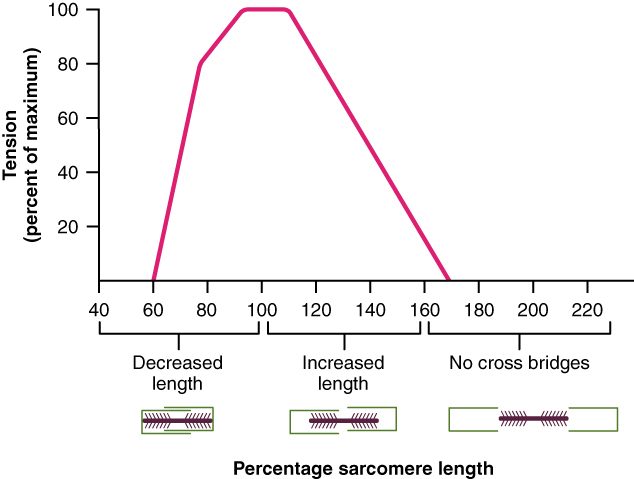
- Optimal length, around the sarcomere's resting length (about 95 to 110 percent of it on Figure 6; tension stays above about 80 percent of maximum from roughly 80 to 120 percent). Thin filaments overlap the whole length of the thick filament that carries myosin heads, and they do not yet meet in the middle. The largest number of cross-bridges can form, and tension is greatest.
- Stretched. The thin filaments are pulled out toward the ends of the thick filaments, and fewer myosin heads can reach actin. Tension falls. At about 170 percent of resting length, the filaments no longer overlap at all, and the fiber can produce no active tension.
- Too short. The thin filaments from the two ends crowd past each other in the middle and get in each other's way, and the thick filaments butt against the Z discs. Tension falls steeply, reaching zero at about 60 percent of resting length.
Worked example: reading the length–tension graph
Problem. Using Figure 6, estimate the tension a fiber can produce, as a percent of maximum, at 100 percent and at 140 percent of resting sarcomere length. Then explain the difference.
- Find 100 percent on the horizontal axis. Go straight up to the line: it is on the flat top, at 100 percent of maximum tension.
- Find 140 percent. The line has fallen on its straight downward slope. It passes roughly halfway between 100 (at 110 percent length) and 0 (at 170 percent length): about 50 percent of maximum.
- Explain. At resting length, overlap is optimal, so the most myosin heads can bind actin. At 140 percent, the thin filaments have been pulled partway off the thick filaments, so only about half as many heads reach actin.
Answer. About 100 percent and about 50 percent of maximum tension.
What do the percentages mean in micrometers? The classic curve was measured in single frog fibers, whose thick filaments are 1.6 µm long and whose thin filaments reach 1.0 µm in from each Z disc, the numbers in the band worked example of the cross-bridge cycle. There, tension peaks at about 2.1 µm, and overlap ends at about 3.6 µm, 170 percent of it. Human thin filaments are a little longer, about 1.2 to 1.3 µm. A human curve has the same shape, but it peaks at about 2.6 to 2.8 µm, so a human sarcomere resting at about 2.5 µm sits near the top.
In your body, bones and joints keep most skeletal muscles within about 70 to 130 percent of their resting length, close to the top of the curve. The same overlap idea returns in the heart, where filling stretches the muscle before each beat.
Putting it together
To lift something heavier, your nervous system does not make fibers contract harder: every fiber's twitch is all-or-none. Instead it recruits more motor units, starting with the small ones, and fires them all faster, moving each from summation toward tetanus. Whether the muscle shortens, lengthens or holds still depends on that tension compared with the load, and how much tension the fibers can produce depends on their length.