The action potential in detail
1Why this matters
Dana, 31, notices that her right eye blurs whenever she steps out of a hot shower, and clears once she cools down. A month ago her left leg tingled for a week. Her MRI shows patches of lost myelin in her brain: multiple sclerosis. Nothing is wrong with her neurons' action potentials themselves. What has failed is how those action potentials travel, and heat is enough to tip the damaged axons from slow into silent.
2What this builds on
3Quick check before you start
1. A neuron at rest sits at about −70 mV. At about what membrane potential does it reach threshold?
- −90 mV
- −55 mV
- +30 mV
Show the answer
Threshold in a typical neuron is about −55 mV: the point where sodium entry outruns potassium exit and the action potential takes off. −90 mV is potassium's equilibrium potential, and +30 mV is the peak.
- −90 mV:
- Correct: −55 mV:
- +30 mV:
2. Which cells make the myelin sheath around axons in the peripheral nervous system?
- Astrocytes
- Oligodendrocytes
- Schwann cells
Show the answer
Schwann cells wrap peripheral axons. Oligodendrocytes make myelin in the CNS, and astrocytes do not make myelin.
- Astrocytes:
- Oligodendrocytes:
- Correct: Schwann cells:
3. If potassium were the only ion that could cross a neuron's membrane, the membrane would settle near potassium's equilibrium potential. About what is that value?
- −90 mV
- −70 mV
- +60 mV
Show the answer
Potassium's equilibrium potential is about −90 mV. The resting potential, −70 mV, sits a little above it because some sodium also leaks in. +60 mV is sodium's equilibrium potential.
- Correct: −90 mV:
- −70 mV:
- +60 mV:
4Anatomy
With labels hidden, select a box to reveal its label.
5How it works, step by step
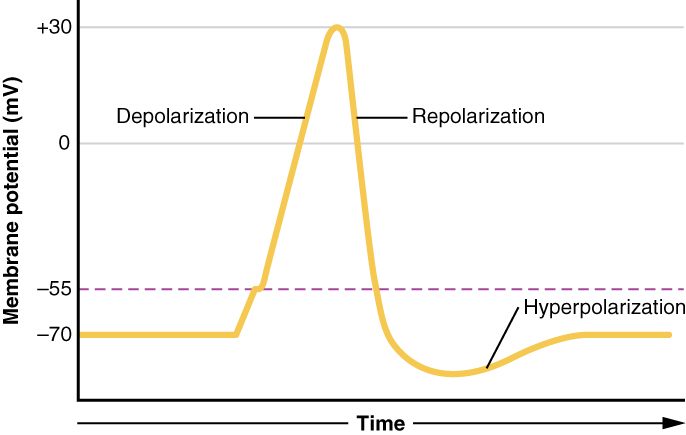
- A graded depolarization brings the trigger zone to threshold, about −55 mV.Enough sodium activation gates open that sodium entering outruns potassium leaving.
- Sodium entry depolarizes the membrane, which opens more activation gates.Positive feedback drives the rising phase to about +30 mV in about half a millisecond.
- About a millisecond after opening, inactivation gates plug the sodium channels, and the delayed potassium channels open.Sodium inflow stops, potassium flows out, and the falling phase repolarizes the membrane.
- The potassium channels close slowly.Extra potassium leaves, and the membrane dips to about −80 mV: the afterhyperpolarization.
- Repolarization lets the sodium channels reset to the closed, ready state over a few milliseconds.The absolute refractory period ends, then the relative one, and the membrane can fire normally again.
- Current from the firing patch spreads along the inside of the axon; myelin keeps it from leaking out.The next patch or node reaches threshold and fires, so the action potential moves forward: continuously in bare axons, node to node (saltatory) in myelinated ones.
6Core concepts
7A common mistake
The wrong idea: The refractory period happens because the sodium–potassium pump has to restore the ion concentrations after each action potential.
What actually happens: One action potential moves only a tiny fraction of the ions, and the pump works slowly in the background. The refractory period comes from the sodium channels: after they open they inactivate, and they cannot reset until the membrane repolarizes. While none are ready, no stimulus works (absolute); while only some are ready and potassium channels are still open, only a stronger stimulus works (relative).
8Check yourself
Anything you miss goes into your review queue.
1. During the rising phase of a neuron's action potential, what are the two gates of a voltage-gated sodium channel doing?
- Activation gate shut, inactivation gate open
- Both gates open
- Activation gate open, inactivation gate plugging the pore
- Both gates shut
Show the answer
Sodium can pass only while both gates are open. Depolarization swings the fast activation gate open, and the slower inactivation gate has not yet swung in, so sodium rushes in and drives the rising phase.
- Activation gate shut, inactivation gate open: This is the closed, ready state at rest. The channel can open, but no sodium flows yet.
- Correct: Both gates open: Correct. For well under a millisecond both gates are open, and sodium floods in.
- Activation gate open, inactivation gate plugging the pore: This is the inactivated state, reached about a millisecond later, at the peak and during the falling phase. No sodium flows.
- Both gates shut: Both gates are shut only briefly, while a channel resets after repolarization. During the rising phase the activation gate is open.
2. At 3 ms on this graph, a stimulus exactly as strong as the one that started the first action potential arrives. It fails to trigger a second one. Why?
- The sodium–potassium pump has not yet restored the sodium and potassium concentrations after the first spike
- Voltage-gated potassium channels have closed and cannot reopen yet
- Some sodium channels are still inactivated, and open potassium channels hold the membrane below rest
- Every sodium channel is still in the inactivated state
Show the answer
At 3 ms the membrane is in the relative refractory period. Only some sodium channels have reset to the ready state, and the slow potassium channels are still open, holding the membrane near −80 mV, farther from threshold. A normal stimulus falls short; a stronger one would work.
- The sodium–potassium pump has not yet restored the sodium and potassium concentrations after the first spike: One action potential moves only a tiny fraction of the ions. The concentrations have barely changed, so the pump is not what limits a second spike.
- Voltage-gated potassium channels have closed and cannot reopen yet: The potassium channels are still open at 3 ms; that is what holds the membrane below rest. And potassium channels closing would not block a new spike.
- Correct: Some sodium channels are still inactivated, and open potassium channels hold the membrane below rest: Correct. Fewer ready sodium channels plus a membrane pulled below rest mean a normal stimulus cannot reach threshold.
- Every sodium channel is still in the inactivated state: If every sodium channel were inactivated, no stimulus of any strength would work. That describes the absolute refractory period, which ended at about 2.1 ms.
3. An immune attack strips the myelin from a 3 mm stretch of a CNS axon. Predict each variable for signals traveling along that axon, compared with before.
| Variable | Change |
|---|---|
| Current leaking out across the bare stretch | — |
| Current reaching the next healthy node | — |
| Time for the next node to reach threshold | — |
| Conduction velocity through the damaged stretch | — |
| Peak voltage of an action potential at a healthy node that does fire | — |
Show the answer
Myelin does not make action potentials bigger; it keeps current inside the axon so the next node reaches threshold quickly. Strip it away and current leaks out, the next node depolarizes slowly or not at all, and conduction slows or is blocked, while any spike that does fire is still full-sized.
- Current leaking out across the bare stretch: up. Without the insulating layers of membrane, current escapes through the axon membrane instead of flowing along the inside.
- Current reaching the next healthy node: down. More leaks out on the way, so less arrives to depolarize the next node.
- Time for the next node to reach threshold: up. A smaller current depolarizes the node more slowly, so it reaches threshold later, if at all.
- Conduction velocity through the damaged stretch: down. Each delay at a node adds up, and the bare stretch has few sodium channels to help, so the signal slows or stops.
- Peak voltage of an action potential at a healthy node that does fire: no change. Action potentials are all-or-none. A node that reaches threshold fires a full-sized spike, set by its own channels and gradients.
4. Put the events of a neuron action potential in order, starting when a graded depolarization reaches the trigger zone.
- The membrane reaches threshold, about −55 mV
- Sodium activation gates open, and sodium rushing in drives the membrane to about +30 mV
- Sodium inactivation gates plug the channels as delayed potassium channels open
- Potassium flows out and the membrane repolarizes
- Slow-closing potassium channels leave the membrane near −80 mV
- Potassium channels close and the membrane returns to −70 mV
Show the answer
Threshold starts the positive feedback of sodium entry, which carries the membrane to the peak. Inactivation stops the sodium inflow as potassium channels open; potassium leaving repolarizes the membrane and, because those channels close slowly, overshoots into the afterhyperpolarization before rest returns.
- Correct order: 1. The membrane reaches threshold, about −55 mV 2. Sodium activation gates open, and sodium rushing in drives the membrane to about +30 mV 3. Sodium inactivation gates plug the channels as delayed potassium channels open 4. Potassium flows out and the membrane repolarizes 5. Slow-closing potassium channels leave the membrane near −80 mV 6. Potassium channels close and the membrane returns to −70 mV
5. Dana, 31, has multiple sclerosis. After a hot shower, the vision in her right eye blurs, and it clears once she cools off. Which explanation fits?
- Heat melts some of the remaining myelin, which regrows once she cools
- Warmth speeds sodium inactivation, so current at demyelinated stretches falls short of threshold
- Warmth slows every axon in her body below a useful speed
- Heat raises her resting potential above threshold, so her neurons fire nonstop
Show the answer
Warmth makes sodium channels inactivate sooner, so each action potential carries a little less current. Healthy axons have plenty to spare. In a demyelinated stretch that was barely bringing the next node to threshold, that small loss causes conduction block. Cooling restores the margin.
- Heat melts some of the remaining myelin, which regrows once she cools: Myelin is not melted by a shower, and it could not regrow in minutes. The change is too fast to be structural.
- Correct: Warmth speeds sodium inactivation, so current at demyelinated stretches falls short of threshold: Correct. A small, reversible loss of current tips barely-conducting demyelinated axons into block.
- Warmth slows every axon in her body below a useful speed: Warmth speeds conduction in healthy axons. Only axons already near failure are affected.
- Heat raises her resting potential above threshold, so her neurons fire nonstop: Nonstop firing would cause positive symptoms such as flashing lights, not blurring. The resting potential does not rise to threshold in a warm shower.
6. A motor axon conducts at 60 m/s. How long does an action potential take to travel 0.9 m from the spinal cord to a muscle in the foot?
- 1.5 ms
- 54 ms
- 15 ms
- 150 ms
Show the answer
Time = distance ÷ velocity = 0.9 m ÷ 60 m/s = 0.015 s = 15 ms.
- 1.5 ms: This is ten times too short: 0.015 s is 15 ms, not 1.5 ms. Check the conversion from seconds to milliseconds.
- 54 ms: This multiplies distance by velocity (0.9 × 60 = 54). Time is distance divided by velocity.
- Correct: 15 ms: Correct. 0.9 ÷ 60 = 0.015 s, which is 15 ms.
- 150 ms: This is ten times too long. 0.015 s × 1,000 = 15 ms.
7. During saltatory conduction, what happens in the stretch of axon under the myelin between two nodes of Ranvier?
- Current flows along the inside with little leak, and no action potential fires there
- The action potential leaps through the extracellular fluid outside the myelin sheath to the next node
- A full action potential fires in every patch, but faster than without myelin
- No current flows until the next node fires on its own
Show the answer
Myelin insulates the internode and very few sodium channels sit there. Current from the firing node flows through the inside of the axon to the next node with little loss, and only the node regenerates the action potential.
- Correct: Current flows along the inside with little leak, and no action potential fires there: Correct. Current travels the whole way; only the slow firing step is skipped.
- The action potential leaps through the extracellular fluid outside the myelin sheath to the next node: Nothing leaps outside. "Saltatory" describes how the spike seems to hop from node to node; the current runs inside the axon.
- A full action potential fires in every patch, but faster than without myelin: The internode has too few sodium channels to fire, and it is not in contact with the extracellular fluid. Firing happens only at the nodes.
- No current flows until the next node fires on its own: A node fires only when current from the previous node depolarizes it to threshold. Without current flowing under the myelin, nothing would reach it.
8. Sodium's equilibrium potential is about +60 mV, yet a neuron's action potential peaks near +30 mV. Why does the rise stop short?
- The sodium gradient is used up by all the sodium that has entered during the rising phase
- The sodium–potassium pump switches on at the peak
- Sodium's equilibrium potential falls to +30 mV during the spike
- Sodium channels inactivate and potassium channels open, cutting the rise off
Show the answer
Two things end the rise at once: the inactivation gates plug the sodium channels, stopping the inward flow, and the delayed potassium channels open, starting an outward flow. The membrane turns around before it can reach +60 mV.
- The sodium gradient is used up by all the sodium that has entered during the rising phase: Only a tiny fraction of the sodium crosses in one action potential. The gradient is almost unchanged.
- The sodium–potassium pump switches on at the peak: The pump runs all the time and is far too slow to stop a spike in a fraction of a millisecond.
- Sodium's equilibrium potential falls to +30 mV during the spike: Because concentrations barely change, sodium's equilibrium potential stays near +60 mV.
- Correct: Sodium channels inactivate and potassium channels open, cutting the rise off: Correct. Timing, not the gradient, sets the peak: inactivation plus potassium outflow.
9Summary
The voltage-gated sodium channel has a fast activation gate and a slower inactivation gate, so it cycles from closed (ready) to open to inactivated, and resets only when the membrane repolarizes. Delayed potassium channels open slowly and close slowly. Together they give the phases: rest at −70 mV, depolarization to threshold at −55 mV, a rising phase to about +30 mV driven by sodium entry, a falling phase driven by potassium exit, and an afterhyperpolarization to about −80 mV. In the absolute refractory period no stimulus can fire the membrane; in the relative refractory period a stronger one can. Action potentials travel by continuous conduction in unmyelinated axons and by faster, cheaper saltatory conduction between nodes of Ranvier in myelinated ones. Conduction velocity rises with axon diameter, myelination and warmth. In demyelinating diseases such as multiple sclerosis, current leaks out where myelin is lost, and conduction slows or fails.