Cardiac muscle cells and their action potential
1Why this matters
Dana, 45, swallowed a whole bottle of her blood pressure pills, a drug that blocks the calcium channels in heart muscle. In the emergency department her heart is still beating, but each beat is feeble and her blood pressure is dangerously low. The treatment starts with an infusion of calcium into her vein. To see why, you need to know what calcium does inside a heart muscle cell.
2What this builds on
3Quick check before you start
1. During a neuron's action potential, what carries the rapid upstroke from about −55 mV to about +30 mV?
- Potassium leaving through voltage-gated potassium channels
- Sodium entering through voltage-gated sodium channels
- Calcium entering through ligand-gated channels
Show the answer
At threshold, voltage-gated sodium channels open and sodium rushes in down its electrochemical gradient, driving the upstroke. Potassium leaving drives repolarization.
- Potassium leaving through voltage-gated potassium channels:
- Correct: Sodium entering through voltage-gated sodium channels:
- Calcium entering through ligand-gated channels:
2. Why can't a second action potential start during the absolute refractory period?
- The sodium–potassium pump has stopped working
- The voltage-gated sodium channels are inactivated
- The cell has run out of sodium ions
Show the answer
After opening, voltage-gated sodium channels inactivate. They cannot open again until the membrane repolarizes and their inactivation gates reopen, so no stimulus can start a new action potential.
- The sodium–potassium pump has stopped working:
- Correct: The voltage-gated sodium channels are inactivated:
- The cell has run out of sodium ions:
3. In a skeletal muscle fiber, what does calcium released from the sarcoplasmic reticulum bind to?
- Myosin heads
- Tropomyosin
- Troponin
Show the answer
Calcium binds troponin, which shifts tropomyosin off the binding sites on actin so cross-bridges can form.
- Myosin heads:
- Tropomyosin:
- Correct: Troponin:
4Anatomy
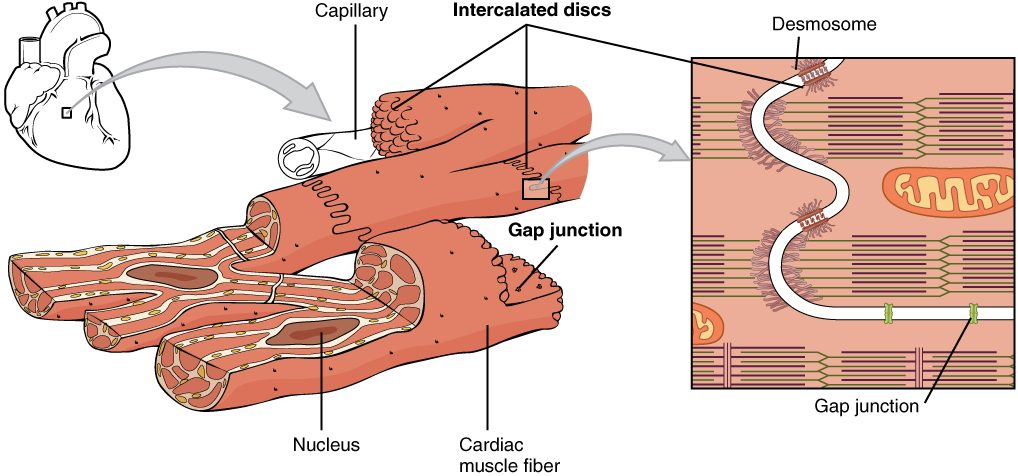
With labels hidden, select a box to reveal its label.
5How it works, step by step
- A neighboring cell fires, and positive charge flows in through the gap junctions of the intercalated discs.The cell depolarizes from −90 mV to threshold, about −70 mV.
- The membrane reaches threshold.Voltage-gated sodium channels open, sodium rushes in, and the membrane swings to about +20 mV (phase 0).
- The membrane is now depolarized.The sodium channels inactivate, and L-type calcium channels slowly open.
- Calcium flows in through the L-type channels while potassium flows out.The two currents nearly balance, and the membrane holds near 0 mV for about 200 ms (the plateau).
- Calcium entering during the plateau opens calcium release channels on the sarcoplasmic reticulum.The SR releases a much larger amount of calcium; calcium binds troponin and the cell contracts.
- The sodium channels stay inactivated for the whole plateau.No new action potential can start until the cell is already relaxing, so contractions cannot sum into tetanus.
6Core concepts
7A common mistake
The wrong idea: Heart muscle contracts using calcium that comes in from outside the cell, while skeletal muscle uses calcium from the sarcoplasmic reticulum.
What actually happens: Both use mostly calcium from the sarcoplasmic reticulum. In a human ventricle only about a quarter of the calcium that activates contraction comes in through L-type channels. Its main job is to act as a trigger: it opens the SR's release channels, which supply the rest. That is calcium-induced calcium release. The outside calcium is still essential, because without the trigger the SR does not release.
8Check yourself
Anything you miss goes into your review queue.
1. In a ventricular contractile cell, which ion movement carries the rapid upstroke (phase 0) of the action potential?
- Calcium entering through L-type channels
- Sodium entering through voltage-gated sodium channels
- Potassium leaving through voltage-gated channels
- Calcium leaving the sarcoplasmic reticulum
Show the answer
At threshold, voltage-gated sodium channels open and sodium rushes in down its electrochemical gradient, taking the membrane from about −70 mV to about +20 mV in about a millisecond. This is the same fast upstroke as in neurons and skeletal muscle.
- Calcium entering through L-type channels: L-type calcium channels open too slowly to carry a millisecond-long upstroke. Calcium entry holds the plateau that follows.
- Correct: Sodium entering through voltage-gated sodium channels: Correct. Fast sodium entry carries phase 0.
- Potassium leaving through voltage-gated channels: Potassium leaving makes the inside more negative. It carries repolarization in phase 3, not the upstroke.
- Calcium leaving the sarcoplasmic reticulum: Calcium released from the SR goes into the cytosol, not across the plasma membrane, so it does not change the membrane potential's upstroke. It activates contraction.
2. Dana has taken an overdose of a drug that blocks L-type calcium channels in her heart muscle. Predict the change in each variable in a ventricular cell.
| Variable | Change |
|---|---|
| Calcium entering the cell during the plateau | — |
| Calcium released by the sarcoplasmic reticulum each beat | — |
| Force of each contraction | — |
| Height of the phase 0 upstroke | — |
Show the answer
Blocking L-type channels shrinks the calcium trigger, so calcium-induced calcium release falls and each contraction weakens. The sodium upstroke is unaffected.
- Calcium entering the cell during the plateau: down. The blocked L-type channels are the path calcium takes into the cell during the plateau, so less enters.
- Calcium released by the sarcoplasmic reticulum each beat: down. Entering calcium is the trigger that opens the SR's release channels, so a smaller trigger opens fewer of them and less calcium is released.
- Force of each contraction: down. Less calcium in the cytosol binds less troponin, so fewer cross-bridges form and each contraction is weaker.
- Height of the phase 0 upstroke: no change. The upstroke is carried by sodium through voltage-gated sodium channels, which the drug does not block.
3. Put these events in a ventricular contractile cell in order, from its neighbor firing to the cell contracting.
- Charge flows in from a neighboring cell through gap junctions
- The membrane reaches threshold and sodium channels open
- L-type calcium channels open and calcium enters
- Calcium opens release channels on the sarcoplasmic reticulum
- The SR releases a large amount of calcium into the cytosol
- Calcium binds troponin and cross-bridges form
Show the answer
Charge from a neighbor brings the cell to threshold; the sodium upstroke depolarizes it; depolarization opens L-type channels; entering calcium opens the SR's release channels; the SR floods the cytosol with calcium; calcium binds troponin and the cell contracts.
- Correct order: 1. Charge flows in from a neighboring cell through gap junctions 2. The membrane reaches threshold and sodium channels open 3. L-type calcium channels open and calcium enters 4. Calcium opens release channels on the sarcoplasmic reticulum 5. The SR releases a large amount of calcium into the cytosol 6. Calcium binds troponin and cross-bridges form
4. A physiologist stimulates a strip of ventricle faster and faster. Unlike skeletal muscle, it never goes into a sustained, fused contraction. What best explains this?
- Its absolute refractory period lasts almost as long as its contraction
- Its sarcoplasmic reticulum holds too little calcium to sustain contraction
- Gap junctions spread each stimulus so fast that no two ever overlap
- Heart muscle stores too little ATP to hold a contraction for long
Show the answer
The sodium channels stay inactivated through the whole plateau, so the absolute refractory period lasts about 200 to 250 ms, nearly as long as the contraction. No new action potential can start until the cell is already relaxing, so twitches cannot add up into tetanus.
- Correct: Its absolute refractory period lasts almost as long as its contraction: Correct. The long refractory period prevents wave summation and tetanus.
- Its sarcoplasmic reticulum holds too little calcium to sustain contraction: Even with a smaller SR, cardiac muscle cells get enough calcium for strong contractions. The limit is electrical, not a shortage of calcium.
- Gap junctions spread each stimulus so fast that no two ever overlap: Fast spread through gap junctions does not stop a cell from being restimulated. What stops it is that the cell cannot fire again until its refractory period ends.
- Heart muscle stores too little ATP to hold a contraction for long: Heart muscle makes ATP continuously by aerobic respiration. The lack of tetanus comes from the refractory period, not from an ATP limit.
5. An experimental toxin closes the gap junctions between ventricular muscle cells but leaves their ion channels working. What happens when one cell fires an action potential?
- The neighbors fire sooner, at a lower threshold voltage than usual
- The neighbors fire, but their plateau is missing
- The neighbors do not fire, because charge cannot pass to them
- The first cell stays depolarized and cannot repolarize
Show the answer
A contractile cell fires only when charge from a neighbor brings it to threshold. That charge travels through gap junctions. With them closed, the charge cannot pass, so the neighbors stay at rest.
- The neighbors fire sooner, at a lower threshold voltage than usual: Closing gap junctions does not change a cell's threshold. It stops the charge that would reach it.
- The neighbors fire, but their plateau is missing: If a neighbor did fire, its own L-type channels would still produce a plateau. The problem is that it never reaches threshold.
- Correct: The neighbors do not fire, because charge cannot pass to them: Correct. Without gap junctions, the action potential cannot spread from cell to cell.
- The first cell stays depolarized and cannot repolarize: The first cell's own channels still work, so it repolarizes normally when its potassium channels open.
6. A ventricular cell has an absolute refractory period of 200 ms. What is the fastest rate at which it could fire action potentials?
- 200 per minute
- 300 per minute
- 500 per minute
- 120 per minute
Show the answer
The shortest possible time between upstrokes is 0.2 s. That gives 1 ÷ 0.2 s = 5 per second, and 5 × 60 = 300 per minute.
- 200 per minute: 200 is the refractory period in milliseconds, not a rate.
- Correct: 300 per minute: Correct. 5 per second times 60 seconds is 300 per minute.
- 500 per minute: 500 per minute would mean one action potential every 0.12 s, which is shorter than this cell's 0.2 s refractory period allows.
- 120 per minute: 120 per minute would mean one action potential every 0.5 s, far slower than the refractory period allows.
7. A classmate says: "Cardiac muscle doesn't use its sarcoplasmic reticulum; it just contracts with calcium from the blood." Which correction is accurate?
- Most calcium comes from the SR; entering calcium is the trigger
- All calcium comes from the SR; outside calcium plays no part
- Half comes from the blood and half from the mitochondria
- Most comes from the blood, and the SR adds more only during fast heart rates
Show the answer
In a human ventricle about three quarters of the calcium that activates contraction comes from the SR. The quarter that enters through L-type channels mainly triggers that release: calcium-induced calcium release.
- Correct: Most calcium comes from the SR; entering calcium is the trigger: Correct. The SR supplies most of the calcium; entering calcium triggers its release.
- All calcium comes from the SR; outside calcium plays no part: Outside calcium is essential. Without it there is no trigger, and the SR does not release its calcium.
- Half comes from the blood and half from the mitochondria: Mitochondria are not a source of calcium for contraction. The two sources are the SR and the extracellular fluid.
- Most comes from the blood, and the SR adds more only during fast heart rates: The SR is the main source at every rate, not an extra added at fast rates. Entering calcium acts as the trigger.
9Summary
Contractile cardiac muscle cells are short, branched, striated cells full of mitochondria, joined by intercalated discs whose gap junctions pass the action potential from cell to cell. Their action potential starts with a fast sodium upstroke, then holds a plateau near 0 mV for about 200 ms as calcium entering through L-type calcium channels balances potassium leaving, then repolarizes as potassium exit wins. The calcium that enters triggers the sarcoplasmic reticulum to release much more (calcium-induced calcium release), and the size of that trigger sets how strongly the cell contracts. Because the sodium channels stay inactivated through the plateau, the refractory period lasts nearly as long as the contraction, so heart muscle cannot go into tetanus.