Mutually Exclusive Events
The joint probability P(A∩B) is the chance both events happen; in a table it is one cell over the grand total.
Part 1 · Hook
Why this matters
Part 2 · Before you start
What this builds on
Part 3 · Prerequisite check
Quick check before you start
1. One of 40 students is chosen at random; 8 are juniors. What is P(junior)?
- 0.2
- 0.8
- 8
- 0.25
Show the answer
: equally likely students.
- Correct: 0.2:
- 0.8:
- 8:
- 0.25:
2. In a two-way table of 200 students, 15 are seniors who play a sport. What is the joint relative frequency?
- 0.075
- 0.15
- 0.3
- 15
Show the answer
One cell over the grand total: .
- Correct: 0.075:
- 0.15:
- 0.3:
- 15:
Part 4 · See it
See it first
Part 5 · Step by step
How it works, step by step
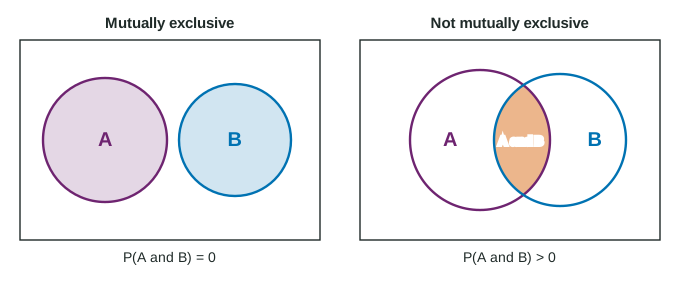
- Two events share some outcomesthe joint event ("A and B") is those shared outcomes, and its probability is above 0
- Two events share no outcomesthey are mutually exclusive:
- Events are mutually exclusivethe probability of one or the other is the sum:
- Events overlap and you add anywaythe shared outcomes are counted twice and the answer is too big
Part 6 · Key ideas
Key ideas
- The joint probability is the probability that A and B both happen.
- Events are mutually exclusive (disjoint) when they cannot happen together: .
- For mutually exclusive events, P(A or B) = P(A) + P(B). If they overlap, plain adding double counts.
- Two events whose probabilities add to more than 1 cannot be mutually exclusive.
Part 7 · Misconception
A common mistake
The wrong idea: Any two events about different things, such as class and sport, are mutually exclusive.
What actually happens: Mutually exclusive means no outcome is in both. A junior can play a sport, so "junior" and "plays a sport" overlap: the joint probability is 0.09.
Part 8 · Check yourself
Check yourself
Exam-style questions. Anything you miss goes into your review queue.
Table
Students by class and sport
| Class | Plays a sport | No sport | Total |
|---|---|---|---|
| Freshman | 20 | 30 | 50 |
| Sophomore | 22 | 28 | 50 |
| Junior | 18 | 32 | 50 |
| Senior | 15 | 35 | 50 |
| Total | 75 | 125 | 200 |
1. What is , the probability that the student is a senior and plays a sport?
Type a number. A table answer and a calculator answer are both accepted.
Show the answer
The joint event is one cell: 15 seniors play a sport. Out of 200 equally likely students, .
- Answer: 0.075
2. Are the events "the student is a freshman" and "the student is a senior" mutually exclusive?
- No: each event has the same probability, 0.25
- No: some freshmen and some seniors play a sport
- Yes: together they make up the whole school of 200 students
- Yes: no student is both a freshman and a senior
Show the answer
No student is in two classes, so the joint event has no outcomes: .
- No: each event has the same probability, 0.25: Equal probabilities have nothing to do with being mutually exclusive.
- No: some freshmen and some seniors play a sport: Sharing a third feature does not put a student in both classes.
- Yes: together they make up the whole school of 200 students: Together they cover only 100 students; and covering everything is not the test.
- Correct: Yes: no student is both a freshman and a senior: Right: they cannot happen together.
3. Are "the student is a junior" and "the student plays a sport" mutually exclusive?
- No, because 18 students are juniors on a team, so the joint probability is 0.09
- Yes, because more juniors do not play a sport (32) than play one (18)
- Yes, because class and sport are two different variables
- No, because both events have probability above 0.2
Show the answer
18 students are juniors who play a sport, so
- Correct: No, because 18 students are juniors on a team, so the joint probability is 0.09: Right: the joint probability is not 0.
- Yes, because more juniors do not play a sport (32) than play one (18): Mutually exclusive means no overlap at all, not "mostly separate".
- Yes, because class and sport are two different variables: Events on different variables can happen together, as these do.
- No, because both events have probability above 0.2: The size of each probability is not the test; the joint probability is.
Diagram
Events for one roll of a die
4. Which pair of events is mutually exclusive?
- V and G
- F and G
- G and "the roll is 6"
- V and F
Show the answer
V is 2, 4, 6 and F is 5: no outcome is in both. V and G share 4 and 6; F and G share 5.
- V and G: They share 4 and 6, so they can happen together.
- F and G: A 5 is greater than 3, so F and G happen together on a 5.
- G and "the roll is 6": A 6 is in G, so they overlap.
- Correct: V and F: Right: an even roll can never be a 5.
5. What is , the probability that the roll is even and greater than 3?
Type a number. A table answer and a calculator answer are both accepted.
Show the answer
The outcomes in both events are 4 and 6. Two of six equally likely outcomes: .
- Answer: 0.3333
6. Event H has probability 0.6 and event K has probability 0.5. Can H and K be mutually exclusive?
- Yes: any two events with different probabilities are mutually exclusive
- Yes: mutually exclusive events have probabilities that add to more than 1
- No: then the chance of one or the other would be 1.1, more than 1
- It depends on whether H makes K more likely to happen
Show the answer
If they could not happen together, the probability of H or K would be , more than 1, which is impossible. So H and K must overlap.
- Yes: any two events with different probabilities are mutually exclusive: Different probabilities do not separate events.
- Yes: mutually exclusive events have probabilities that add to more than 1: Probabilities of mutually exclusive events add to at most 1.
- Correct: No: then the chance of one or the other would be 1.1, more than 1: Right: no probability can exceed 1.
- It depends on whether H makes K more likely to happen: The numbers alone settle it: 0.6 + 0.5 is more than 1.
Part 9 · Summary
Summary
Part 10 · Up next
What comes next
Part 11 · Connections