Conditional Probability
Given B, the outcomes in B are the new whole, so P(A|B) = (P(A∩B))/(P(B)) .
Part 1 · Hook
Why this matters
Part 2 · Before you start
What this builds on
Part 3 · Prerequisite check
Quick check before you start
1. Of 150 returning park visitors, 54 fished. What is the conditional relative frequency of fishing for returning visitors?
- 0.36
- 0.216
- 0.783
- 0.54
Show the answer
: divide by the group's total.
- Correct: 0.36:
- 0.216:
- 0.783:
- 0.54:
2. What is ?
- The probability that A and B both happen
- The probability that A or B happens
- The probability of A minus B
- The probability that neither happens
Show the answer
is "and": both events.
- Correct: The probability that A and B both happen:
- The probability that A or B happens:
- The probability of A minus B:
- The probability that neither happens:
Part 4 · See it
See it first
Part 5 · Step by step
How it works, step by step
- You are told that B happenedonly the outcomes in B are possible now, so B becomes the new total
- So the share of B that is also Ais the conditional probability:
- Rearrange the rulethe multiplication rule: , which is multiplying along a tree's path
- Add every path that ends in the result you wantyou get its total probability, and dividing one path by it reverses the condition
Part 6 · Key ideas
Key ideas
- A conditional probability is the probability of A given that B happened: . In a table, divide by the total of B's row or column.
- The multiplication rule: . Drawing without replacement changes the second probability.
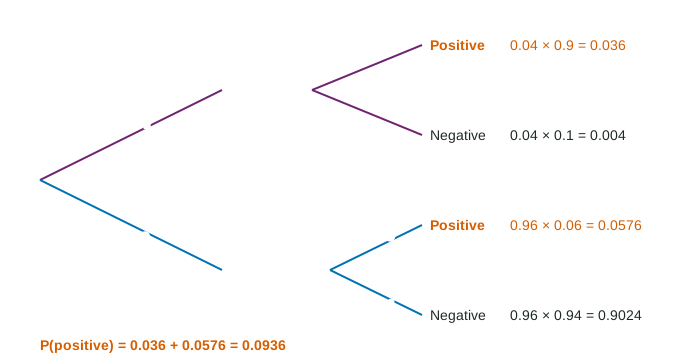
- A tree diagram shows stages: first-stage probabilities, then conditional ones. Multiply along a path; add paths.
- and are usually different. Name the group after the bar.
Part 7 · Misconception
A common mistake
The wrong idea: If the test is positive for 90% of people with the condition, then 90% of people who test positive have it.
What actually happens: Those are different conditional probabilities:
Part 8 · Check yourself
Check yourself
Exam-style questions. Anything you miss goes into your review queue.
Table
Main news source by age group
| Age group | Online | TV | Total | |
|---|---|---|---|---|
| Under 40 | 132 | 66 | 22 | 220 |
| 40 and over | 54 | 90 | 36 | 180 |
| Total | 186 | 156 | 58 | 400 |
1. What is the probability that the adult gets news mainly online, given that the adult is under 40?
- 0.33
- 0.710
- 0.6
- 0.465
Show the answer
Given under 40, the 220 adults under 40 are the new total:
- 0.33: That is , the joint probability of under 40 and online.
- 0.710: That is , the probability of under 40 given online: the condition is reversed.
- Correct: 0.6: Right: 132 of the 220 adults under 40.
- 0.465: That is , the probability of online for everyone.
2. Given that the adult gets news mainly from TV, what is the probability that the adult is under 40?
- 0.3
- 0.165
- 0.55
- 0.423
Show the answer
The condition is TV, so divide by the 156 TV viewers:
- 0.3: That is , the probability of TV given under 40: the condition is reversed.
- 0.165: That is , a joint probability.
- 0.55: That is , the probability of under 40 for everyone.
- Correct: 0.423: Right: 66 of the 156 TV viewers.
3. What is the probability that the adult is 40 or over and gets news mainly from print?
- 0.09
- 0.2
- 0.621
- 0.145
Show the answer
This is a joint probability, one cell over all 400:
- Correct: 0.09: Right: 36 of all 400 adults.
- 0.2: That is , a conditional probability given 40 or over.
- 0.621: That is , a conditional probability given print.
- 0.145: That is , the probability of print for everyone.
Diagram
A screening test
4. What is the probability that the test is positive?
Type a number. A table answer and a calculator answer are both accepted.
Show the answer
Add the two branches that end in positive:
- Answer: 0.0936
5. Given that the test is positive, what is the probability that the person has the condition?
Type a number. A table answer and a calculator answer are both accepted.
Show the answer
- Answer: 0.3846
6. A bag has 5 red and 3 blue tokens. Two tokens are drawn at random without replacement. What is the probability that both are red?
Type a number. A table answer and a calculator answer are both accepted.
Show the answer
Multiplication rule:
- Answer: 0.3571
Part 9 · Summary
Summary
Part 10 · Up next
What comes next
Part 11 · Connections