Independent Events and Unions of Events
Events are independent when P(A|B) = P(A) ; then the probability of both is the product P(A)⋅P(B) .
Part 1 · Hook
Why this matters
Part 2 · Before you start
What this builds on
Part 3 · Prerequisite check
Quick check before you start
1. Of 40 art students, 15 take Spanish. What is P(Spanish given art)?
- 0.375
- 0.15
- 0.3
- 0.125
Show the answer
Given art, divide by the 40 art students: .
- Correct: 0.375:
- 0.15:
- 0.3:
- 0.125:
2. Events R and T are mutually exclusive. What is ?
- 0
- 1
- 0.5
Show the answer
Mutually exclusive events cannot happen together.
- Correct: 0:
- 1:
- :
- 0.5:
Part 4 · See it
See it first
Part 5 · Step by step
How it works, step by step
- Knowing that B happened leaves the probability of A unchangedA and B are independent:
- Put into the multiplication rulefor independent events,
- Add P(A) and P(B) for "A or B"the outcomes in both are counted twice
- Subtract the overlap oncethe general addition rule:
Part 6 · Key ideas
Key ideas
- Events are independent when knowing one happened does not change the probability of the other: . Then, and only then, .
- To check independence, compare with , or with , using the numbers.
- The union is "A or B or both". The general addition rule:
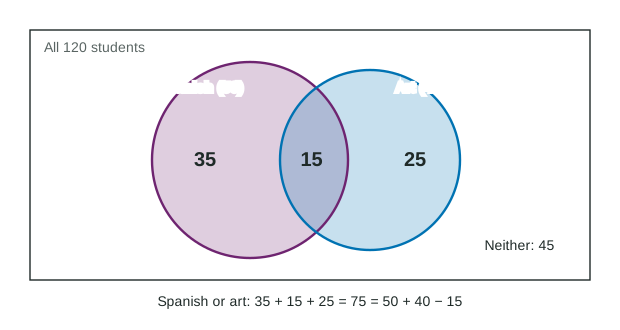
. - A Venn diagram shows events as overlapping circles; fill the overlap first.
- Mutually exclusive is not independent: events that cannot happen together affect each other completely.
Part 7 · Misconception
A common mistake
The wrong idea: Mutually exclusive events are independent, because one has nothing to do with the other.
What actually happens: If two events cannot happen together, knowing one happened makes the other impossible, so its probability drops to 0. They are as dependent as events can be.
Part 8 · Check yourself
Check yourself
Exam-style questions. Anything you miss goes into your review queue.
Diagram
Spanish and art students
1. What is the probability that the student takes Spanish or art?
- 0.75
- 0.125
- 0.625
- 0.375
Show the answer
Addition rule:
- 0.75: That is : the 15 students in both were counted twice.
- 0.125: That is , the students who take both, not either.
- Correct: 0.625: Right: 75 of the 120 students take at least one of the two.
- 0.375: That is , the students who take neither.
2. Given that the student takes art, what is the probability that the student takes Spanish?
- 0.3
- 0.125
- 0.417
- 0.375
Show the answer
Given art, the 40 art students are the total, and 15 of them take Spanish: .
- 0.3: That is , the probability of art given Spanish.
- 0.125: That is , the joint probability.
- 0.417: That is , the probability of Spanish for all students.
- Correct: 0.375: Right: 15 of the 40 art students.
3. Are "takes Spanish" and "takes art" independent events?
- No: P(Spanish given art) is 0.375 but P(Spanish) is about 0.417
- Yes, because 15 students take both classes, so the events overlap
- No, because they are mutually exclusive events at this school
- Yes, because the students chose their own classes
Show the answer
Compare
- Correct: No: P(Spanish given art) is 0.375 but P(Spanish) is about 0.417: Right: knowing art changes the probability of Spanish.
- Yes, because 15 students take both classes, so the events overlap: Overlapping is not independence; independence compares probabilities.
- No, because they are mutually exclusive events at this school: They are not mutually exclusive: 15 students take both.
- Yes, because the students chose their own classes: How classes were chosen does not settle it; compare the probabilities.
Table
Phone brand and battery life
| Brand | Lasted a full day | Did not | Total |
|---|---|---|---|
| Brand X | 60 | 40 | 100 |
| Brand Y | 90 | 60 | 150 |
| Total | 150 | 100 | 250 |
4. Are "Brand Y" and "battery lasted a full day" independent?
- No: more Brand Y phones (90) than Brand X phones (60) lasted a full day
- No: a phone can be Brand Y and last a full day, so they overlap
- Yes: a phone is either Brand X or Brand Y and is not both at once
- Yes: the probability of a full day is 0.6 with or without knowing the brand
Show the answer
- No: more Brand Y phones (90) than Brand X phones (60) lasted a full day: Counts depend on how many of each brand were tested; compare probabilities.
- No: a phone can be Brand Y and last a full day, so they overlap: Overlap is not how independence is checked.
- Yes: a phone is either Brand X or Brand Y and is not both at once: That makes the brands mutually exclusive, which is a different idea.
- Correct: Yes: the probability of a full day is 0.6 with or without knowing the brand: Right: equal conditional and unconditional probabilities.
5. A factory has two machines that work independently. On a given day, machine 1 breaks down with probability 0.05 and machine 2 with probability 0.08. What is the probability that both break down on the same day?
Type a number. A table answer and a calculator answer are both accepted.
Show the answer
For independent events,
- Answer: 0.004
6. In a town, 55% of households have a streaming subscription, 30% have cable, and 15% have both. What is the probability that a randomly chosen household has streaming or cable?
Type a number. A table answer and a calculator answer are both accepted.
Show the answer
General addition rule:
- Answer: 0.7
Part 9 · Summary
Summary
Part 10 · Up next
What comes next
Part 11 · Connections