Psychology of Social Situations
Situations shape behavior powerfully.
Part 1 · Hook
Why this matters
Part 2 · Before you start
What this builds on
Part 3 · Prerequisite check
Quick check before you start
1. A study has to deceive participants about its purpose. What must happen at the end?
- Debriefing
- Random sampling
- A double-blind procedure
- A larger sample
Show the answer
Debriefing explains the deception and the study's real purpose. Many classic social psychology studies used deception.
- Correct: Debriefing:
- Random sampling:
- A double-blind procedure:
- A larger sample:
2. Which is an example of in-group bias?
- Giving more to a stranger on your own team than to one on the other team
- Seeing the other team as all alike
- Blaming a victim for bad luck
- Liking a song more after hearing it often
Show the answer
Favoring your own group is in-group bias; it returns in this topic when groups compete and cooperate.
- Correct: Giving more to a stranger on your own team than to one on the other team:
- Seeing the other team as all alike:
- Blaming a victim for bad luck:
- Liking a song more after hearing it often:
3. Students under heavy mental strain rely more on stereotypes. What explains this?
- Cognitive load
- Mere exposure
- Relative deprivation
- Belief perseverance
Show the answer
High cognitive load leaves less room to check quick judgments.
- Correct: Cognitive load:
- Mere exposure:
- Relative deprivation:
- Belief perseverance:
Part 4 · See it
See it first
Part 5 · Step by step
How it works, step by step
- A person is unsure of the right answer or wants to be acceptedthey conform through informational or normative social influence
- An authority gives direct orders and takes responsibilitymany people obey, even against their values
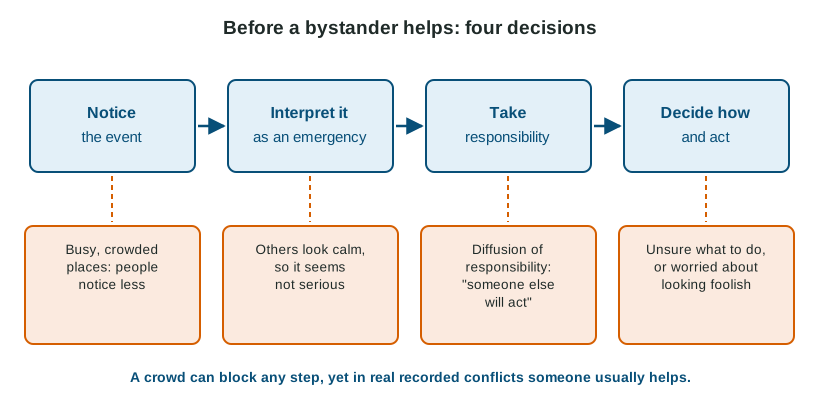
- Others are present in an emergencyeach person feels less responsible (diffusion of responsibility), so each is less likely to help
- Individual effort is pooled and not identifiablepeople put in less effort (social loafing)
Part 6 · Key ideas
Key ideas
- Conformity is matching a group; obedience is following an authority's orders. Informational influence: "they know better." Normative influence: "I want to fit in."
- Persuasion: the central route (arguments) and the peripheral route (cues such as celebrities); foot-in-the-door (small then large), door-in-the-face (large then small), the halo effect.
- Groups: group polarization, groupthink, social facilitation, social loafing, deindividuation, false consensus; superordinate goals reduce conflict; social traps hurt everyone.
- Helping: altruism, the reciprocity and social responsibility norms; the bystander effect lowers each person's chance of helping, though in real conflicts someone usually helps.
Part 7 · Misconception
A common mistake
The wrong idea: The bystander effect means people in crowds do not help.
What actually happens: It means each individual is less likely to help as the number of bystanders grows. Real-world camera studies show that in most public conflicts at least one person steps in, and more bystanders make that more likely.
Part 8 · Check yourself
Check yourself
Exam-style questions. Anything you miss goes into your review queue.
1. At her first dinner with her boyfriend's family, Keiko waits to see which fork everyone else uses before she starts eating, because she is unsure what is correct. Which concept explains her behavior?
- Informational social influence
- Normative social influence
- Group polarization
- Deindividuation
Show the answer
Looking to others when you are unsure of the right answer is informational social influence.
- Correct: Informational social influence: Right: she follows others because she believes they know the right answer.
- Normative social influence: Normative influence is going along to be liked or to avoid rejection. Keiko is looking for the correct choice.
- Group polarization: Group polarization is a group's views becoming more extreme after discussion.
- Deindividuation: Deindividuation is a loss of self-awareness in a group, often in anonymous settings.
2. Marcus thinks a new movie is boring, but when all his friends rave about it at lunch, he says he loved it too, to fit in. Which concept explains his statement?
- Normative social influence
- Informational social influence
- Social facilitation
- Foot-in-the-door technique
Show the answer
Public agreement to gain acceptance, while privately disagreeing, is conformity through normative social influence.
- Correct: Normative social influence: Right: he goes along with the group to be accepted, not because he changed his mind.
- Informational social influence: Informational influence means believing the group is right. Marcus still thinks the movie was boring.
- Social facilitation: Social facilitation is better performance on easy tasks when others are present.
- Foot-in-the-door technique: That is a persuasion technique using a small request first.
Data
Invented study: judging lines with a unanimous group
3. In this invented study, a participant judged which of three lines matched a standard line after hearing others (confederates) give a clearly wrong answer. What pattern does the graph show?
- Conformity rises as the group grows to 3, then levels off
- Conformity rises by the same amount per person
- Conformity falls as the group grows
- Group size has no effect on conformity
Show the answer
The bars climb steeply up to 3 people and then flatten: the effect of a unanimous majority levels off after about three.
- Correct: Conformity rises as the group grows to 3, then levels off: Right: from 4% to 30% by 3 people, then only 32% and 33%.
- Conformity rises by the same amount per person: Adding people beyond 3 changes little (30%, 32%, 33%).
- Conformity falls as the group grows: The bars rise from left to right.
- Group size has no effect on conformity: Conformity rises from 4% to 30% as the group grows from 1 to 3.
4. The lines were easy to judge: people alone almost never erred. Which kind of influence most likely explains the conformity in the graph?
- Normative social influence
- Informational social influence
- Social facilitation
- Obedience to authority
Show the answer
When the answer is clear, going along with a group shows the pull of acceptance: normative social influence.
- Correct: Normative social influence: Right: with an obvious answer, people go along mainly to avoid standing out, not because they believe the group.
- Informational social influence: Informational influence is strongest when the right answer is unclear; here it was obvious.
- Social facilitation: Social facilitation is about performance in front of others, not adopting a group's answer.
- Obedience to authority: The other people were peers, not authority figures giving orders.
5. Find the median conformity percent across the five group sizes.
Type a number (%). No calculator needed: work it out by hand, as on the exam.
Show the answer
In order: 4, 13, 30, 32, 33. The middle value is 30%.
- Answer: 30 %
Figure
Four decisions before a bystander helps
6. A student sees a classmate slumped in a hallway. Dozens of students walk by, and each assumes a teacher or someone else will deal with it. At which step in the figure does helping break down, and what is the concept?
- Responsibility: diffusion of responsibility
- Noticing: social loafing
- Deciding how to act: groupthink
- Interpreting: superordinate goals
Show the answer
"Someone else will do it" is diffusion of responsibility, the third step.
- Correct: Responsibility: diffusion of responsibility: Right: with many others present, each person feels less responsible to act.
- Noticing: social loafing: Students did notice, and social loafing concerns effort on group tasks.
- Deciding how to act: groupthink: Groupthink concerns group decision-making, not individual helping.
- Interpreting: superordinate goals: Superordinate goals reduce conflict between groups.
Part 9 · Summary
Summary
Part 10 · Up next
What comes next
Part 11 · Connections