Sinusoidal Functions
A sinusoidal function is a sine or cosine graph after dilations and translations.
Part 1 · Hook
Why this matters
Part 2 · Before you start
What this builds on
Part 3 · Prerequisite check
Quick check before you start
1. What is the period of ?
Show the answer
The point on the unit circle returns to the same place after one full turn, .
- Correct: :
- :
- :
- :
2. The graph of is the graph of
- moved up 3 units
- moved right 3 units
- stretched vertically by a factor of 3
- moved left 3 units
Show the answer
Adding 3 to every output moves each point up 3 units.
- Correct: moved up 3 units:
- moved right 3 units:
- stretched vertically by a factor of 3:
- moved left 3 units:
Part 4 · See it
See it first
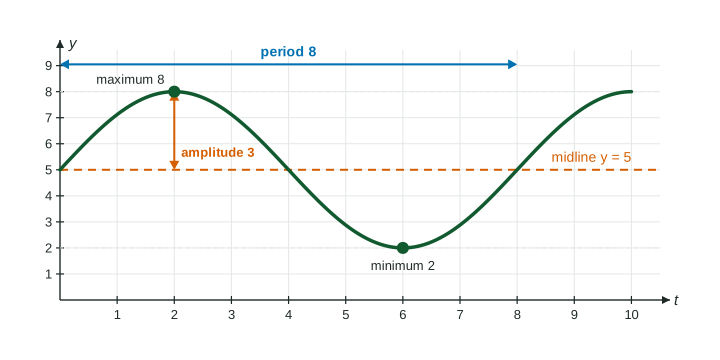
Part 5 · Step by step
How it works, step by step
- Stretch or shrink the graph of sine or cosine and slide it aroundyou get a sinusoidal function: the same smooth wave shape, with new heights and a new cycle length
- Average the greatest and least valuesthe midline , the horizontal line the wave oscillates around
- Take half the distance from the least value to the greatestthe amplitude , how far the wave reaches above and below its midline
- Measure one full cycle along the input axisthe period ; the frequency counts the cycles per unit of input
Part 6 · Key ideas
Key ideas
- A sinusoidal function has the shape of a sine graph after dilations and translations. and are both sinusoidal, each with amplitude 1, midline and period .
- Amplitude is a distance, so it is never negative. Midline is a line, so write it as an equation: .
- Frequency . A period of 8 seconds means of a cycle per second; 220 cycles per second means a period of second.
- Sine is odd, ; cosine is even, .
Part 7 · Misconception
A common mistake
The wrong idea: The amplitude is the distance from the lowest point to the highest point.
What actually happens: That distance is twice the amplitude. The amplitude is measured from the midline to the highest point (or to the lowest), so it is half of .
Part 8 · Check yourself
Check yourself
Exam-style questions. Anything you miss goes into your review queue.
Graph
A sinusoidal function
1. What is the amplitude of ?
Show the answer
The greatest value is and the least is : amplitude .
- Correct: : Half of .
- : is the full distance from the lowest to the highest point, twice the amplitude.
- : is the greatest value, measured from the -axis instead of from the midline.
- : is the size of the least value, measured from the -axis instead of from the midline.
2. What is the midline of the graph of ?
Show the answer
The midline is halfway between and : .
- Correct: : Average of the greatest and least values.
- : The -axis is not the midline here: the wave reaches 1 above it but 3 below it.
- : is the least value, the bottom of the wave, not its center line.
- : is the amplitude, not the height of the midline.
3. What is the period of ?
No calculator. Type the exact value (a fraction, π, e or a root is fine).
Show the answer
Highest points at and : one full cycle takes 6 units.
- Answer: 6
4. What is the frequency of , in cycles per unit of ?
No calculator. Type the exact value (a fraction, π, e or a root is fine).
Show the answer
Frequency cycle per unit of .
- Answer: ≈ 0.167
5. What is the average rate of change of on ?
Show the answer
- Correct: : Change in output over change in input .
- : is the change in output; divide by the 3 units of input.
- : This is the change in input over the change in output, upside down.
- : This uses the amplitude 2 as the change in output; the graph drops 4, from the top to the bottom.
6. A guitar string vibrates with a frequency of 220 cycles per second. What is the period of its vibration, in seconds?
No calculator. Type the exact value (a fraction, π, e or a root is fine), in seconds.
Show the answer
Period second.
- Answer: ≈ 0.005 seconds
7. A pendulum's horizontal position, measured from a mark on the floor, swings smoothly between cm and cm. Its position is a sinusoidal function of time. What are its amplitude and midline?
- Amplitude 15 cm, midline
- Amplitude 30 cm, midline
- Amplitude 15 cm, midline
- Amplitude 18 cm, midline
Show the answer
Amplitude cm; midline . Check: gives and .
- Correct: Amplitude 15 cm, midline : Half the swing, and the average of the two extremes.
- Amplitude 30 cm, midline : 30 cm is the whole swing, twice the amplitude.
- Amplitude 15 cm, midline : The mark on the floor is not the center of the swing: the pendulum goes further right than left.
- Amplitude 18 cm, midline : 18 is the greatest position, not the amplitude, and , not 6.
Part 9 · Summary
Summary
Part 10 · Up next
What comes next
Part 11 · Connections