Periodic Phenomena
A periodic function repeats its outputs every P units of input, f(x + P) = f(x) , and the smallest such P is the period.
Part 1 · Hook
Why this matters
Part 2 · Before you start
What this builds on
Part 3 · Prerequisite check
Quick check before you start
1. A table gives and . What is the average rate of change of on ?
Show the answer
Change in output over change in input:
- Correct: :
- :
- :
- :
2. Over the equal intervals , and , the average rates of change of are , and . What does this suggest about the graph of on ?
- It is concave down
- It is concave up
- It is decreasing
- It is a straight line
Show the answer
The rates are positive, so is increasing, and they get smaller over equal intervals, so the graph is concave down.
- Correct: It is concave down:
- It is concave up:
- It is decreasing:
- It is a straight line:
Part 4 · See it
See it first
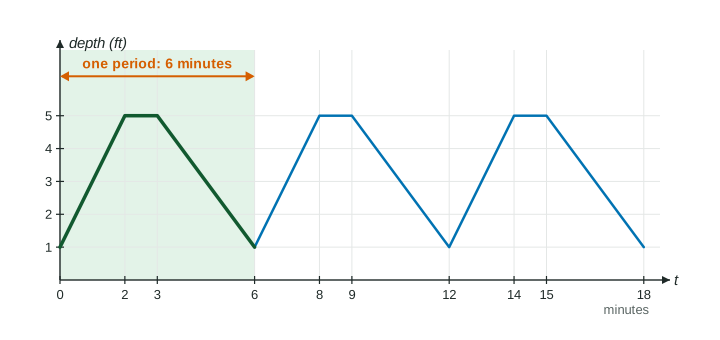
Part 5 · Step by step
How it works, step by step
- The outputs of repeat the same pattern every units of input is periodic, and the smallest such positive is the period: for every
- You know on one full cycle, an interval of length copy that piece of graph left and right, units at a time, to get the whole graph
- You need the output at an input far from the known cycleadd or subtract whole periods until the input lands in the cycle: with ,
- Every feature of one cycle repeatsintervals where increases or decreases, concavity and average rates of change all repeat every units
Part 6 · Key ideas
Key ideas
- A periodic function repeats its outputs: there is a positive number with for every input . The smallest such is the period.
- One full cycle, any interval of length , holds all the information. Shift inputs by whole periods to reach any other input.
- Over any interval one full period long, the average rate of change is , because the output ends where it started.
- Two inputs can share an output without being a period apart: a cycle usually passes through each in-between value twice.
Part 7 · Misconception
A common mistake
The wrong idea: The period is the distance between two inputs that have the same output.
What actually happens: Inside one cycle the graph usually reaches the same output twice, once going up and once going down. The period is the length of the smallest interval after which the whole pattern repeats, so check that the graph matches from that point on, not only one value.
Part 8 · Check yourself
Check yourself
Exam-style questions. Anything you miss goes into your review queue.
Graph
A periodic function
1. What is the period of ?
Show the answer
The highest points are at , and , four units apart, and the whole pattern on repeats on . The period is .
- Correct: : From one highest point to the next is , and the graph matches from there on.
- : That is the distance from a highest point () to the next lowest point (), only part of a cycle.
- : Shifting by 6 does not keep the outputs: but .
- : does hold, but 12 is three periods. The period is the smallest positive value that works.
2. The pattern in the graph continues for all . What is ?
No calculator. Type the exact value (a fraction, π, e or a root is fine).
Show the answer
The period is and , so .
- Answer: -1
3. What is the average rate of change of on ?
Show the answer
is exactly one period long, so and the average rate of change is : the secant line through and is horizontal.
- Correct: : The output ends where it started, so the change in output is .
- : This uses as an endpoint, . The interval ends at , where .
- : This is divided by the length of the interval. A rate needs the change in output, .
- : That is the slope of the falling piece on , not the slope of the secant line from to .
4. The pattern continues for all . On which interval is decreasing?
Show the answer
In the first cycle decreases on . Adding ten periods () gives .
- Correct: : plus is .
- : This is plus , where rises from to .
- : This is plus : rises on before it starts to fall.
- : This is plus : falls only until and then rises.
5. A function satisfies and for every , and no smaller positive number works. What is the period of ?
Show the answer
The period is the smallest positive with for all . Both 5 and 10 work, and 5 is smaller.
- Correct: : The smallest shift that leaves every output unchanged is 5.
- : 10 works because it is two periods; the period is the smallest shift that works.
- : 15 also works (three periods), but it is not the smallest.
- : This multiplies the two shifts; the period is the smallest shift that works, 5.
6. A periodic function has period 8. What is the average rate of change of on ?
- It depends on the formula for
Show the answer
, one period later, so and the average rate of change is .
- Correct: : One period apart, the outputs are equal, so the change in output is .
- : This divides one output by the length of the interval. A rate needs the change in output.
- : This is one over the period. It is not a rate of change of .
- It depends on the formula for : Whatever the formula, because the inputs are one period apart.
Part 9 · Summary
Summary
Part 10 · Up next
What comes next
Part 11 · Connections