
A furniture workshop in a city full of carpenters cannot set the pay. If it offers less than the going wage, nobody applies; it has no reason to offer more. What it can choose is how many carpenters to hire. Each one adds chairs worth some amount and costs the going wage. The whole hiring decision is a comparison of those two numbers.
The market sets the wage, the firm takes it
In a perfectly competitive labor market there are many firms hiring the same kind of worker and many workers offering the same skill. Market labor demand (DL) and labor supply (SL) set the market wage. Each firm hires so small a share of the workers that it cannot change that wage: it is a wage taker, just as a perfectly competitive seller is a price taker.
Because the firm can hire as many workers as it wants at the market wage, the labor supply it faces is a horizontal line at that wage. Each added worker raises its total labor cost by exactly the wage. The added cost of one more worker is the marginal resource cost (MRC), also called the marginal factor cost (MFC):
For a wage taker MRC = W, so the firm's line is labeled S = MFC = W.
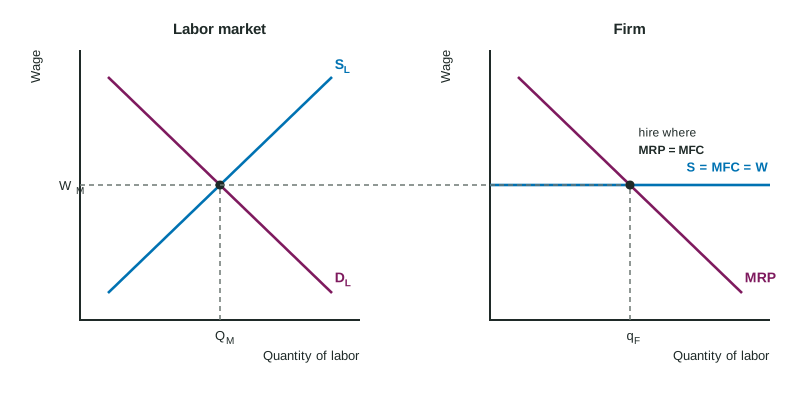
Draw it the way readers score it: both graphs with Wage on the vertical axis and Quantity of labor on the horizontal axis, DL and SL crossing at WM and QM in the market, a dashed line carrying WM across, the firm's horizontal S = MFC = W line, a downward MRP curve, and the firm's quantity qF marked where they meet.
The hiring rule: MRP = MRC
A worker adds MRP to revenue (Topic 5.1) and MRC to cost. If MRP is larger, hiring her raises profit; if smaller, it lowers profit. So a profit-maximizing firm hires up to where MRP = MRC. It is the same marginal thinking as MR = MC for output, applied to an input. From a table, hire every worker whose MRP is at least the MRC, and stop before the first one whose MRP is below it.
Worked example: hiring from a table. The Larkspur workshop (invented) sells chairs at $20 in a competitive market. With 1 to 6 carpenters it makes 10, 18, 25, 31, 36 and 40 chairs a week. The market wage is $110 a week.
- Marginal product: 10, 8, 7, 6, 5 and 4 chairs.
- MRP = MP × P: $200, $160, $140, $120, $100 and $80.
- Compare with MRC = W = $110. The fourth carpenter adds $120, more than $110; the fifth adds $100, less. Hire 4.
- If the wage rises to $130, the fourth carpenter no longer pays for herself: hire 3. A higher wage is a movement up the MRP curve, which is why MRP is the firm's demand for labor.
A fixed cost does not change hiring. If the workshop's rent rises by $500 a week, every carpenter still adds the same MRP and costs the same $110, so it still hires 4. Profit falls by $500, but no hiring choice can avoid that. Readers often see answers that cut workers "to save costs".
What changes the number hired
| Change | What moves | Workers hired by the firm |
|---|---|---|
| Product price rises | MRP shifts right | more |
| Productivity rises | MRP shifts right | more |
| Market wage rises (labor supply falls or market demand rises) | S = MFC = W moves up | fewer |
| Rent or another fixed cost rises | nothing at the margin | no change |
The least-cost combination of inputs
Firms use more than one input, for example workers and machines (capital). To make a given output as cheaply as possible, a firm compares how much each input adds per dollar spent on it. If the last dollar on labor buys more output than the last dollar on capital, shifting spending toward labor lowers cost. The firm is at its least-cost combination when
where w is the wage and r the rental price of capital. This is the same idea as marginal utility per dollar for a consumer (Topic 1.6), but it is about cost, not utility.
Worked example: least cost. At Ortolan Ceramics (invented), the last worker-hour adds 40 bowls and costs $20; the last kiln-hour adds 90 bowls and costs $30.
- Labor: 40 ÷ $20 = 2 bowls per dollar.
- Capital: 90 ÷ $30 = 3 bowls per dollar.
- Decision: capital gives more per dollar, so use more kiln time and fewer worker-hours. As it does, diminishing returns lower the MP of kiln time and raise the MP of labor until the two ratios are equal.
Least cost is not the whole story. To maximize profit the firm must also use each input until its MRP equals its price: MRPL = w and MRPK = r, so each ratio MRP ÷ price equals 1. A firm can be at the least-cost mix for the wrong amount of output.