The Money Market
The money market sets the nominal interest rate.
Part 1 · Hook
Why this matters
Part 2 · Before you start
What this builds on
Part 3 · Prerequisite check
Quick check before you start
1. Market interest rates rise. What happens to the prices of existing bonds?
- They fall
- They rise
- They stay the same
- They double
Show the answer
Bond prices move opposite to interest rates.
- Correct: They fall:
- They rise:
- They stay the same:
- They double:
2. Which interest rate is the rate stated in dollars, before adjusting for inflation?
- The nominal interest rate
- The real interest rate
- The inflation rate
- The growth rate
Show the answer
The nominal rate is the stated rate; the real rate subtracts the expected inflation rate.
- Correct: The nominal interest rate:
- The real interest rate:
- The inflation rate:
- The growth rate:
3. Who controls the size of the money supply most directly?
- The central bank, with the banking system
- Each household
- The stock market
- Exporters
Show the answer
The central bank and bank lending determine the money supply.
- Correct: The central bank, with the banking system:
- Each household:
- The stock market:
- Exporters:
Part 4 · See it
See it first
Part 5 · Step by step
How it works, step by step
- The price level or real GDP risespeople need more money for transactions, so money demand shifts right
- Money demand shifts right while the money supply is fixedpeople sell bonds to get money, so bond prices fall
- Bond prices fallthe nominal interest rate rises until people want to hold the money that exists
Part 6 · Key ideas
Key ideas
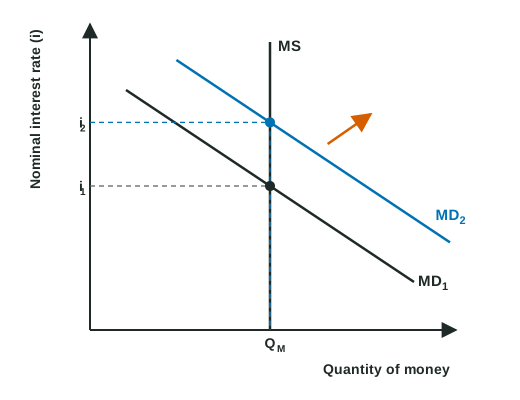
- The money market graph: nominal interest rate on the vertical axis, quantity of money on the horizontal; money demand (MD) slopes down and the money supply (MS) is vertical.
- MD slopes down because the nominal interest rate is the opportunity cost of holding money (asset demand).
- MD shifts right when the price level or real GDP rises (transaction demand); MS shifts when the central bank changes the money supply.
- Rate above equilibrium: people buy bonds, bond prices rise, the rate falls. Below: they sell bonds and the rate rises.
Part 7 · Misconception
A common mistake
The wrong idea: A change in the interest rate shifts money demand.
What actually happens: The nominal interest rate is on the axis, so a change in it moves along MD. Money demand shifts with the price level, real GDP and payment technology.
Part 8 · Check yourself
Check yourself
Exam-style questions. Anything you miss goes into your review queue.
1. Label the axes and the curves of the money market graph.
Work on the graph (it needs JavaScript), then check.
Show the answer
The money market has the nominal interest rate on the vertical axis and the quantity of money on the horizontal axis, with downward-sloping money demand (MD) and vertical money supply (MS).
- Key: see the explanation
2. With limited reserves, the central bank increases the money supply. Shift the right curve and mark the new equilibrium.
Work on the graph (it needs JavaScript), then check.
Show the answer
More money shifts the vertical money supply right; people hold the extra money only at a lower nominal interest rate.
- Key: money supply shifts right
3. Why does the money demand curve slope down?
- A higher price level means people need less money
- Banks lend more when interest rates rise
- The central bank supplies less money at high rates
- The nominal interest rate is the opportunity cost of holding money
Show the answer
Money pays little or no interest, so the interest given up on bonds is the cost of holding it: higher rates, less money demanded.
- A higher price level means people need less money: A higher price level shifts money demand right; it does not explain the slope.
- Banks lend more when interest rates rise: That is about lending, not about how much money people choose to hold.
- The central bank supplies less money at high rates: The money supply is vertical; the slope of demand comes from households' choices.
- Correct: The nominal interest rate is the opportunity cost of holding money: Right: when bonds pay more, holding cash costs more, so people hold less of it.
Graph
A money market after a shift
4. The graph shows money demand shifting from MD1 to MD2. Which event could have caused this shift?
- A rise in the nominal interest rate
- A rise in the price level
- A rise in the money supply
- Wider use of payment cards and phone apps
Show the answer
Money demand shifts with the price level, real GDP and payment technology; the interest rate moves along it.
- A rise in the nominal interest rate: A change in the interest rate moves along money demand; it does not shift it.
- Correct: A rise in the price level: Right: higher prices mean people need more money for the same purchases, so MD shifts right.
- A rise in the money supply: That would shift the vertical MS curve, not MD.
- Wider use of payment cards and phone apps: Easier payments let people hold less money, which shifts MD left.
5. In the graph, what happens to the equilibrium nominal interest rate?
- It falls, because more money is demanded
- It stays the same, because the money supply is fixed
- It rises, from i1 to i2
- It rises at first, then returns to i1
Show the answer
With a vertical money supply, a rightward shift of money demand raises the nominal interest rate and leaves the quantity of money unchanged.
- It falls, because more money is demanded: More money demanded with a fixed supply pushes the rate up, not down.
- It stays the same, because the money supply is fixed: The fixed supply is why the rate must rise to balance the larger demand.
- Correct: It rises, from i1 to i2: Right: MD2 crosses the vertical MS at a higher nominal interest rate.
- It rises at first, then returns to i1: With MS unchanged, the new equilibrium stays at the higher rate.
6. As the economy moves to the new equilibrium in the graph, what happens to the prices of existing bonds?
- They fall, as people sell bonds to get money
- They rise, as people buy bonds
- They do not change, since bonds are not money
- They rise, because interest rates rise
Show the answer
Bond prices and interest rates move in opposite directions; selling bonds to raise money pushes bond prices down.
- Correct: They fall, as people sell bonds to get money: Right: to hold more money, people sell bonds, which lowers bond prices and raises interest rates.
- They rise, as people buy bonds: People want more money, so they sell bonds rather than buy them.
- They do not change, since bonds are not money: Bonds are how people adjust their money holdings, so their prices move.
- They rise, because interest rates rise: Bond prices move opposite to interest rates: the rate rises, so bond prices fall.
7. Make it specific: explain how a rise in the price level affects the nominal interest rate when the money supply does not change.
Build the answer part by part, then write it in your own words.
Show the answer
A higher price level raises money demand; with a fixed money supply the nominal interest rate rises (and bond prices fall).
- An answer that earns the point: The price level rises, so people need more money for the same purchases and money demand shifts right; because the money supply is fixed, the nominal interest rate increases and the prices of existing bonds decrease.
Part 9 · Summary
Summary
Part 10 · Up next
What comes next
Part 11 · Connections