Ecological Succession
Ecological succession is the series of changes in a community after a disruption.
Part 1 · Hook
Why this matters
Part 2 · Before you start
What this builds on
Part 3 · Prerequisite check
Quick check before you start
1. How is a disruption that recurs at irregular intervals, such as wildfire in many forests, classified?
- Episodic
- Periodic
- Random
- Constant
Show the answer
Recurring, but not at regular intervals, is episodic.
- Correct: Episodic:
- Periodic:
- Random:
- Constant:
2. What does species richness count?
- The number of different species
- The number of individuals
- How equal the populations are
- The number of habitats
Show the answer
Richness is the count of species.
- Correct: The number of different species:
- The number of individuals:
- How equal the populations are:
- The number of habitats:
Part 4 · See it
See it first
Part 5 · Step by step
How it works, step by step
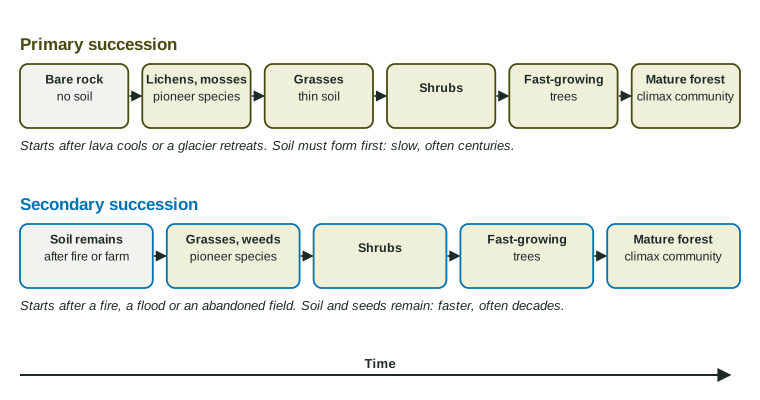
- A disruption leaves bare rock (primary) or bare soil (secondary)pioneer species, which grow fast and spread easily, arrive first
- Pioneers change the site: they help make soil, add nutrients and give shadeconditions become suitable for larger plants that could not grow there before
- Larger, longer-lived plants arrive and outcompete the pioneersthe community changes in stages, and species richness and biomass increase
- Many years pass without a major disruptiona mature, more stable community (climax community) develops
Part 6 · Key ideas
Key ideas
- Ecological succession is the gradual change in the species of a community after a disruption, in a series of stages.
- Primary succession starts where there is no soil: new lava rock, rock left by a retreating glacier. Soil must form first, so it is slow (often centuries).
- Secondary succession starts where soil remains after a disruption such as a fire, a flood, a hurricane or an abandoned farm field. With soil and seeds already present, it is faster (often decades).
- Pioneer species (lichens and mosses on rock; grasses and weeds on soil) arrive first. Over time biodiversity and biomass increase, and a mature, more stable climax community develops.
Part 7 · Misconception
A common mistake
The wrong idea: Succession after a forest fire is primary succession, because almost everything was burned.
What actually happens: A fire leaves soil, and usually seeds and roots in it, so regrowth after a fire is secondary succession. Primary succession needs a start with no soil at all, such as new rock.
Part 8 · Check yourself
Check yourself
Exam-style questions. Anything you miss goes into your review queue.
Data
Plants in abandoned farm fields
| Years since farming stopped | Plant species | Plant biomass (kg per m²) | Most common plants |
|---|---|---|---|
| 1 | 12 | 0.4 | annual weeds |
| 5 | 25 | 1.2 | grasses, wildflowers |
| 20 | 38 | 6.0 | shrubs, young pines |
| 60 | 45 | 18.0 | pines, young oaks |
| 150 | 42 | 30.0 | oaks, hickories |
1. Which statement best describes how plant biomass changes as the fields age?
- It increases throughout, from 0.4 to 30.0 kg per m²
- It rises for 60 years, then falls to its starting level
- It stays near 1 kg per m² throughout
- It falls as larger plants shade out the weeds
Show the answer
Give the direction and the start and end values.
- Correct: It increases throughout, from 0.4 to 30.0 kg per m²: Right: biomass rises at every step, most of all as trees take over.
- It rises for 60 years, then falls to its starting level: Biomass is higher at 150 years (30.0) than at 60 (18.0).
- It stays near 1 kg per m² throughout: It reaches 30.0 kg per m² by 150 years.
- It falls as larger plants shade out the weeds: Larger plants add biomass; the total rises.
2. Write the setup for the percent change in the number of plant species from the 1-year field to the 20-year field, then give the answer.
Type the setup as on the exam, with brackets and units, then the answer.
Show the answer
Start at 12 species:
- Setup: ; answer 216.7 %
3. What kind of succession do these fields show, and why?
- Primary, because the fields began with no plants growing
- Secondary, because soil remained when farming stopped
- Primary, because weeds are pioneer species
- Secondary, because the fields began as bare rock
Show the answer
The key question is whether soil was present at the start.
- Primary, because the fields began with no plants growing: Primary succession needs no soil; these fields had soil.
- Correct: Secondary, because soil remained when farming stopped: Right: an abandoned field keeps its soil and seeds, so succession is secondary.
- Primary, because weeds are pioneer species: Pioneer species appear in both kinds; the starting soil decides the kind.
- Secondary, because the fields began as bare rock: Bare rock would make it primary, and these fields had soil.
Passage
Life returns to a volcano
In May 1980, Mount St. Helens in Washington State erupted. The blast flattened 600 square kilometers of forest, and a fan of hot rock and ash on the volcano’s north side, later named the Pumice Plain, buried the ground under many meters of fresh rock. On the Pumice Plain, nothing survived; a few years later only scattered plants had arrived. Farther out, where the blast knocked trees down but left soil, roots and buried seeds, plants sprouted the first summer, and pocket gophers dug fresh soil up to the surface. Ecologists who have studied both areas since 1980 report that life returned much faster where soil remained than on the rock of the Pumice Plain.
Invented passage for practice, summarizing USGS accounts and published research at Mount St. Helens.
4. Which claim does the passage support?
- The eruption killed each plant across 600 square kilometers
- Pocket gophers caused the eruption by digging
- The Pumice Plain recovered first because it was closest
- Life returned faster where soil remained
Show the answer
The passage compares the two areas and states which recovered faster.
- The eruption killed each plant across 600 square kilometers: Plants sprouted the first summer where soil, roots and seeds survived.
- Pocket gophers caused the eruption by digging: Gophers dug soil after the eruption; they did not cause it.
- The Pumice Plain recovered first because it was closest: The passage says the Pumice Plain recovered slowly.
- Correct: Life returned faster where soil remained: Right: plants sprouted the first summer where soil remained, but slowly on the Pumice Plain.
5. Which detail from the passage best supports calling the Pumice Plain an example of primary succession?
- It was buried under fresh rock, with nothing surviving
- It lies on the north side of the volcano, facing the blast
- It covers part of the 600 square kilometers of flattened forest
- It was given its name by scientists after the eruption
Show the answer
Primary succession starts with no soil and no surviving organisms.
- Correct: It was buried under fresh rock, with nothing surviving: Right: no soil and no surviving life is the starting point of primary succession.
- It lies on the north side of the volcano, facing the blast: The direction does not decide the kind of succession.
- It covers part of the 600 square kilometers of flattened forest: The size does not decide the kind of succession.
- It was given its name by scientists after the eruption: A name does not show anything about soil.
6. Which of these sites would undergo primary succession?
- A forest after a wildfire
- A cornfield that is no longer farmed
- Rock bared by a melting glacier
- A floodplain after a spring flood
Show the answer
Primary succession starts on surfaces with no soil.
- A forest after a wildfire: Soil remains after a fire, so that is secondary succession.
- A cornfield that is no longer farmed: An old field keeps its soil, so that is secondary succession.
- Correct: Rock bared by a melting glacier: Right: the glacier scraped the land to bare rock with no soil.
- A floodplain after a spring flood: Floods leave soil, often adding more, so that is secondary.
7. Explain why secondary succession is faster than primary succession.
Build the answer part by part, then write it in your own words.
Show the answer
Name what secondary succession starts with, what primary succession must do first, and the result.
- An answer that earns the point: In secondary succession, soil, seeds and roots are already present, while primary succession must first build soil from bare rock, which takes centuries, so plants can grow sooner in secondary succession.
Part 9 · Summary
Summary
Part 10 · Up next
What comes next
Part 11 · Connections