Generalist and Specialist Species
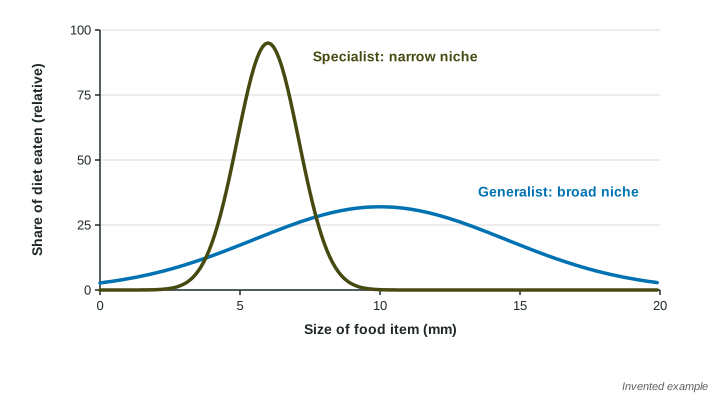
Specialist species have narrow niches: a few foods, one habitat or a narrow range of conditions.
Part 1 · Hook
Why this matters
Part 2 · Before you start
What this builds on
Part 3 · Prerequisite check
Quick check before you start
1. What is a species’ niche?
- Its role and the full set of conditions and resources it uses
- The place where it sleeps
- The number of individuals in its population
- The name of its habitat
Show the answer
A niche is how a species lives: what it eats, where and when it is active, the conditions it needs.
- Correct: Its role and the full set of conditions and resources it uses:
- The place where it sleeps:
- The number of individuals in its population:
- The name of its habitat:
2. A species survives only between 20 and 24 °C. How would you describe its range of tolerance for temperature?
- Narrow
- Wide
- Optimal
- Unlimited
Show the answer
A four-degree band is a narrow range of tolerance.
- Correct: Narrow:
- Wide:
- Optimal:
- Unlimited:
Part 4 · See it
See it first
Part 5 · Step by step
How it works, step by step
- A specialist depends on a narrow set of foods, habitats or conditionsit can be very efficient where those resources are plentiful
- The environment changes and its one key resource declinesthe specialist has nothing to switch to, so its population falls
- A generalist uses many foods, habitats and conditionswhen one resource declines it switches to others, so it copes better with change
Part 6 · Key ideas
Key ideas
- Specialist species have a narrow niche: they eat a few foods, live in one kind of habitat, or tolerate a narrow range of conditions. Examples: the giant panda (bamboo) and the koala (eucalyptus leaves).
- Generalist species have a broad niche: they eat many foods, live in many habitats and tolerate a wide range of conditions. Examples: raccoons, coyotes, rats and cockroaches.
- Specialists do well in stable environments where their resource is reliable. They are more likely to decline or die out when the environment changes.
- Generalists cope better with change, and they often spread into new places, including towns and farms.
Part 7 · Misconception
A common mistake
The wrong idea: Generalists are always better off than specialists.
What actually happens: Specialists are often more efficient at using their one resource, so they can outcompete generalists where that resource is plentiful and stable. Generalists win when conditions change.
Part 8 · Check yourself
Check yourself
Exam-style questions. Anything you miss goes into your review queue.
Data
Two bird species before and after a forest is cleared
| Species | Foods eaten | Nesting sites used | Pairs before clearing | Pairs after clearing |
|---|---|---|---|---|
| Woodpecker W | insects in dead trees | holes in large dead trees | 40 | 6 |
| Bird X | insects, seeds, fruit, scraps | trees, shrubs, buildings | 50 | 65 |
1. Based on the table, which statement correctly classifies the two birds?
- W is a specialist and X is a generalist
- W is a generalist and X is a specialist
- Both are specialists, because both eat insects
- Both are generalists, because both live in forests
Show the answer
Classify by how many foods, habitats and conditions a species can use.
- Correct: W is a specialist and X is a generalist: Right: W uses one food and one nesting site; X uses many of each.
- W is a generalist and X is a specialist: W eats one food type and nests in one kind of site, which is a narrow niche.
- Both are specialists, because both eat insects: Bird X also eats seeds, fruit and scraps, a broad diet.
- Both are generalists, because both live in forests: Living in a forest does not make a species a generalist; the range of resources it uses does.
2. Write the setup for the percent change in breeding pairs of woodpecker W after the clearing, then give the answer.
Type the setup as on the exam, with brackets and units, then the answer.
Show the answer
Start at 40 pairs: .
- Setup: ; answer -85 %
3. Which explanation best accounts for the change in woodpecker W?
- Bird X ate most of the woodpecker’s eggs after clearing
- Clearing removed the large dead trees it needs for both food and nests
- The woodpecker moved to the new houses and was not counted
- The woodpecker began eating seeds and scraps instead
Show the answer
A specialist declines when the one resource it depends on is removed.
- Bird X ate most of the woodpecker’s eggs after clearing: Nothing in the data shows predation by bird X.
- Correct: Clearing removed the large dead trees it needs for both food and nests: Right: as a specialist, W had no other food or nest site to switch to.
- The woodpecker moved to the new houses and was not counted: W nests only in holes in large dead trees, not in buildings.
- The woodpecker began eating seeds and scraps instead: If it had switched foods, it would have done better, not worse.
4. By how many breeding pairs did bird X increase after the clearing?
Type a number, then its unit (pairs). Scale words (2.5 million) and powers of ten (2.5 × 10^6) are read.
Show the answer
Subtract: pairs.
- Answer: 15 pairs
Model or diagram
Food sizes eaten by two species
5. Where 6 mm seeds are plentiful year after year, the specialist is more common than the generalist. Which explanation fits best?
- It handles 6 mm seeds more efficiently than the generalist
- The generalist is unable to eat 6 mm seeds
- Specialists have more offspring in each generation
- Generalists avoid areas where seeds are common
Show the answer
Specialists can win where conditions are stable and their resource is abundant.
- Correct: It handles 6 mm seeds more efficiently than the generalist: Right: specializing often means being better at one task, which pays off when that resource is reliable.
- The generalist is unable to eat 6 mm seeds: The generalist’s curve includes 6 mm food.
- Specialists have more offspring in each generation: The figure shows food use, not number of offspring.
- Generalists avoid areas where seeds are common: Nothing in the figure suggests that.
6. Why are specialist species more likely than generalists to decline when a habitat changes?
- They reproduce faster and use up their food
- They are smaller and weaker than most generalists
- They rely on few resources, with little to switch to
- They are eaten by generalists in disturbed areas
Show the answer
A narrow niche means fewer options when conditions change.
- They reproduce faster and use up their food: How fast they reproduce is not what makes a species a specialist.
- They are smaller and weaker than most generalists: Body size does not define a specialist; pandas are large.
- Correct: They rely on few resources, with little to switch to: Right: if their resource declines, they have no fallback.
- They are eaten by generalists in disturbed areas: Predation can happen, but the main reason is their narrow niche.
Part 9 · Summary
Summary
Part 10 · Up next
What comes next
Part 11 · Connections