Sewage Treatment
Sewage treatment cleans wastewater in stages.
Part 1 · Hook
Why this matters
Part 2 · Prerequisite check
Quick check before you start
1. In the eutrophication chain, what uses up dissolved oxygen?
- Decomposers breaking down dead organic matter
- Living algae making food
- Sunlight on the water
- Cold water
Show the answer
Decomposers respire as they break down organic matter, using oxygen.
- Correct: Decomposers breaking down dead organic matter:
- Living algae making food:
- Sunlight on the water:
- Cold water:
2. Which is a point source of water pollution?
- A sewage plant outfall pipe
- Runoff from many lawns
- Dust from plowed fields
- Exhaust from all cars in a city
Show the answer
An outfall is a single pipe, a point source.
- Correct: A sewage plant outfall pipe:
- Runoff from many lawns:
- Dust from plowed fields:
- Exhaust from all cars in a city:
Part 3 · See it
See it first
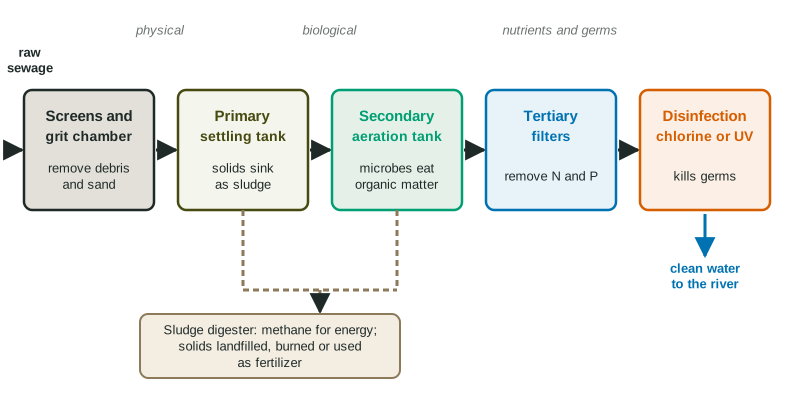
Part 4 · Step by step
How it works, step by step
- Screens and settling tanks remove debris and let solids sink (primary)large objects, grit and much of the solid matter are removed as sludge
- Microbes in aerated tanks eat the dissolved organic matter (secondary)BOD falls, so the waste will not use up the river's oxygen
- Filters and chemicals remove nitrogen and phosphorus (tertiary)nutrients that would feed algal blooms are kept out of the river
- Chlorine, ozone or UV light treats the water (disinfection)germs are killed before the water is released
- Sludge is digested, dried and disposed of or reusedmethane can be captured for energy and solids are landfilled, burned or spread as fertilizer
Part 5 · Key ideas
Key ideas
- Primary treatment: physical. Screens, grit chambers and settling tanks remove solids as sludge.
- Secondary treatment: biological. Microbes in aerated tanks break down dissolved organic matter, cutting BOD so the river keeps its oxygen.
- Tertiary treatment: removes nitrogen and phosphorus (preventing eutrophication) and other chemicals. Then disinfection with chlorine, ozone or UV kills germs.
- Homes without sewers use a septic system: a tank where solids settle and a drain field where soil filters the liquid. Combined sewers can overflow untreated sewage in heavy rain.
Part 6 · Misconception
A common mistake
The wrong idea: Sewage treatment just filters the water.
What actually happens: Filtering and settling are only the first step. Secondary treatment uses living microbes to eat the dissolved waste, and tertiary treatment and disinfection remove nutrients and kill germs.
Part 7 · Check yourself
Check yourself
Exam-style questions. Anything you miss goes into your review queue.
1. What happens in primary sewage treatment?
- Microbes break down dissolved organic matter
- Chemicals remove nitrogen and phosphorus
- Ultraviolet light kills the bacteria
- Solids settle out of the water in tanks
Show the answer
Primary treatment is physical: screens remove large debris, and wastewater sits in settling tanks so solids sink as sludge and grease floats off.
- Microbes break down dissolved organic matter: That is secondary treatment.
- Chemicals remove nitrogen and phosphorus: That is tertiary treatment.
- Ultraviolet light kills the bacteria: That is disinfection, the last step.
- Correct: Solids settle out of the water in tanks: Right: a physical process using gravity.
2. Put the stages of a sewage treatment plant in order.
- Screens and grit chambers remove large objects and sand
- Primary settling tanks let solids sink as sludge
- Aerated tanks let microbes break down dissolved organic matter
- Tertiary filters and chemicals remove nitrogen and phosphorus
- Chlorine or UV light kills remaining germs
- Clean water is released to a river or lake
Show the answer
Physical removal, then biological breakdown, then nutrient removal, then disinfection, then discharge.
- Correct order: 1. Screens and grit chambers remove large objects and sand 2. Primary settling tanks let solids sink as sludge 3. Aerated tanks let microbes break down dissolved organic matter 4. Tertiary filters and chemicals remove nitrogen and phosphorus 5. Chlorine or UV light kills remaining germs 6. Clean water is released to a river or lake
Data
Wastewater quality through a treatment plant
| Sample point | Suspended solids (mg/L) | BOD (mg/L) | Total phosphorus (mg/L) | Fecal coliform bacteria (per 100 mL) |
|---|---|---|---|---|
| Raw sewage in | 240 | 220 | 7.0 | 10,000,000 |
| After primary | 120 | 150 | 6.0 | 5,000,000 |
| After secondary | 20 | 20 | 4.5 | 200,000 |
| After tertiary and disinfection | 5 | 5 | 0.5 | 20 |
3. What percent of the BOD in raw sewage is removed by the end of secondary treatment?
Type a number, then its unit (%). Scale words (2.5 million) and powers of ten (2.5 × 10^6) are read.
Show the answer
Removed: mg/L. .
- Answer: 90.91 %
4. Which stage removes the most BOD?
- Primary treatment, from 220 to 150 mg/L
- Secondary, from 150 to 20 mg/L
- Tertiary treatment, from 20 to 5 mg/L
- Each stage removes the same amount
Show the answer
Secondary treatment lowers BOD from 150 to 20 mg/L, a drop of 130. Primary removes 70, tertiary 15.
- Primary treatment, from 220 to 150 mg/L: That is a drop of 70 mg/L, less than secondary.
- Correct: Secondary, from 150 to 20 mg/L: Right: a drop of 130 mg/L.
- Tertiary treatment, from 20 to 5 mg/L: That is a drop of 15 mg/L.
- Each stage removes the same amount: The drops are 70, 130 and 15 mg/L.
5. Why does secondary treatment remove so much BOD?
- Microbes in aerated tanks eat it
- Screens catch the large objects in the sewage
- Chlorine dissolves the organic matter
- Settling tanks let the dissolved matter sink
Show the answer
In secondary treatment, aerated tanks let bacteria and other microbes eat the dissolved organic matter, so it is broken down in the plant instead of in the river.
- Correct: Microbes in aerated tanks eat it: Right: the plant uses oxygen so the river does not have to.
- Screens catch the large objects in the sewage: Screens act at the start and remove little BOD.
- Chlorine dissolves the organic matter: Chlorine kills germs; it is not the main BOD step.
- Settling tanks let the dissolved matter sink: Settling is primary treatment; dissolved organics do not sink.
6. Phosphorus falls from 4.5 to 0.5 mg/L only after tertiary treatment. Why does that step matter for the lake downstream?
- It raises the water temperature for fish
- It adds oxygen directly to the lake
- It kills the bacteria in the sewage
- It keeps out a nutrient algae need
Show the answer
Primary and secondary treatment leave most phosphorus. Removing it in tertiary treatment keeps the limiting nutrient out of the lake, which prevents algal blooms and the oxygen drop that follows.
- It raises the water temperature for fish: Phosphorus removal does not change temperature.
- It adds oxygen directly to the lake: Removing phosphorus prevents the oxygen drop; it does not add oxygen.
- It kills the bacteria in the sewage: Disinfection kills bacteria; phosphorus removal targets a nutrient.
- Correct: It keeps out a nutrient algae need: Right: less phosphorus, less eutrophication.
7. A city of 80,000 people produces about 300 liters of wastewater per person per day. Write the setup, with units, for the liters of wastewater the plant treats per day, then give the answer in liters per day.
Type the setup as on the exam, with brackets and units, then the answer.
Show the answer
- Setup: ; answer 24,000,000 L/day
Part 8 · Summary
Summary
Part 9 · Up next
What comes next
Part 10 · Connections