Lethal Dose 50% (LD50)
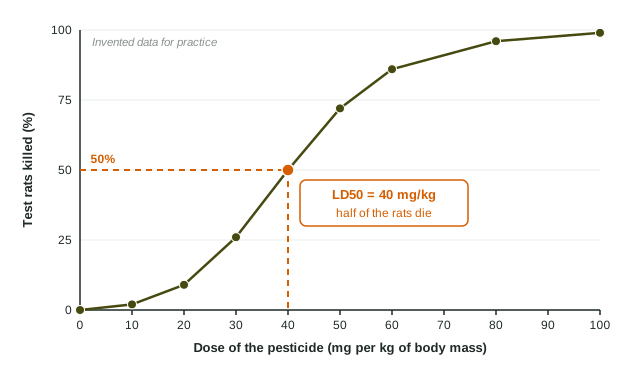
LD50 is the dose, in milligrams per kilogram of body mass, that kills half of a test population; it is read off a graph of percent killed against dose at the 50% line.
Part 1 · Hook
Why this matters
Part 2 · Prerequisite check
Quick check before you start
1. A substance builds up in one fish over its lifetime because the fish takes it in faster than it gets rid of it. What is this called?
- Bioaccumulation
- Biomagnification
- Eutrophication
- Leaching
Show the answer
Buildup inside one organism over time is bioaccumulation; biomagnification is the rise in concentration up a food chain.
- Correct: Bioaccumulation:
- Biomagnification:
- Eutrophication:
- Leaching:
2. How many milligrams are in 2.5 grams?
- 2,500 mg
- 250 mg
- 0.0025 mg
- 25 mg
Show the answer
There are 1,000 mg in a gram:
- Correct: 2,500 mg:
- 250 mg:
- 0.0025 mg:
- 25 mg:
Part 3 · See it
See it first
Part 4 · Step by step
How it works, step by step
- Researchers give groups of test animals larger and larger doses (mg per kg of body mass)a larger percent of each group dies
- They plot percent killed against dose and read across from 50%the dose under that point is the LD50
- A substance with a lower LD50 kills half the animals at a smaller doseit is more toxic and gets a stronger warning label
- Multiplying the LD50 by a body mass, with kilograms cancellinggives the whole-body dose in milligrams for an animal of that size
Part 5 · Key ideas
Key ideas
- Toxicity is how harmful a substance is. The dose is how much enters the body, usually in milligrams per kilogram of body mass (mg/kg).
- LD50 is the dose that kills 50% of a test population. A lower LD50 means a more toxic substance.
- Whole-body dose: , for example
. Write the units so kilograms visibly cancel. - LD50s come from animal tests, so they only estimate the effect on people, and they say nothing about harm that does not kill.
Part 6 · Misconception
A common mistake
The wrong idea: A chemical with an LD50 of 5,000 mg/kg is more toxic than one with an LD50 of 5 mg/kg, because 5,000 is bigger.
What actually happens: It is the reverse. The LD50 is the dose needed to kill half the animals, so the chemical that needs only 5 mg/kg is 1,000 times as toxic.
Part 7 · Check yourself
Check yourself
Exam-style questions. Anything you miss goes into your review queue.
1. In toxicology, what does LD50 mean?
- The dose that kills half of a test population
- The dose at which half the test animals first show any effect
- The dose that kills 50 animals out of a test group
- The largest dose that causes no deaths in the test
Show the answer
LD50 is the lethal dose for 50% of a test population, usually in milligrams of substance per kilogram of body mass.
- Correct: The dose that kills half of a test population: Right: LD stands for lethal dose, and 50 for the 50% of test animals it kills.
- The dose at which half the test animals first show any effect: A dose that causes any effect in half the animals is a different measure; LD50 counts deaths only.
- The dose that kills 50 animals out of a test group: The 50 is a percent of the group, not a count of animals, so it works for a group of any size.
- The largest dose that causes no deaths in the test: That would be a safe-looking dose with zero deaths, not the dose that kills half the animals.
2. Pesticide P has an LD50 of 20 mg/kg in rats. Pesticide Q has an LD50 of 2,000 mg/kg in rats. Which statement is correct?
- Q is more toxic, because its LD50 is the larger number
- P is more toxic: less of it per kilogram kills half the rats
- P and Q are equally toxic, since both were tested on rats
- Q is safe for people, since its LD50 is above 1,000 mg/kg
Show the answer
LD50 and toxicity run in opposite directions: the lower the LD50, the more toxic the substance. P is times as toxic as Q per kilogram.
- Q is more toxic, because its LD50 is the larger number: A larger LD50 means more of the substance is needed to kill half the rats, so Q is less toxic.
- Correct: P is more toxic: less of it per kilogram kills half the rats: Right: a lower LD50 means less of the substance is needed to kill, so it is more toxic.
- P and Q are equally toxic, since both were tested on rats: Testing in the same species makes them comparable, but the LD50s differ a hundredfold.
- Q is safe for people, since its LD50 is above 1,000 mg/kg: A high LD50 means low toxicity in rats, not that a substance is safe; large doses can still kill.
3. The LD50 of a pesticide in rats is 60 mg/kg. What dose of pesticide would be expected to kill half of a group of rats that each have a mass of 0.40 kg? Give the dose for one rat in milligrams.
Type a number, then its unit (mg). Scale words (2.5 million) and powers of ten (2.5 × 10^6) are read.
Show the answer
The setup multiplies the dose per kilogram by the body mass, so kilograms cancel:
- Answer: 24 mg
4. A cleaning chemical has an LD50 of 25 mg/kg, measured in dogs. Write the setup, with units, for the dose expected to kill half of a group of 12 kg dogs, then give the answer in milligrams.
Type the setup as on the exam, with brackets and units, then the answer.
Show the answer
Multiply the LD50 by the body mass so kilograms cancel: .
- Setup: ; answer 300 mg
Model or diagram
Mice killed at each dose of a solvent
5. Read the graph. What is the LD50 of the solvent in mice?
Type a number, then its unit (mg/kg). Scale words (2.5 million) and powers of ten (2.5 × 10^6) are read.
Show the answer
Go across from 50% on the vertical axis to the line, then down to the dose axis: the LD50 is 400 mg/kg.
- Answer: 400 mg/kg
6. What percent of the mice died at a dose of 600 mg/kg?
- 84%
- 68%
- 96%
- 50%
Show the answer
Read straight up from 600 mg/kg to the line, then across: 84% of the mice died.
- Correct: 84%: Right: the point at 600 mg/kg sits at 84% of mice killed.
- 68%: 68% is the value at 500 mg/kg. Read straight up from 600 mg/kg.
- 96%: 96% is the value at 800 mg/kg, the highest dose tested.
- 50%: 50% is the response at the LD50 (400 mg/kg), not at 600 mg/kg.
7. A mouse has a mass of 0.025 kg. Using the LD50 you read from the graph, what dose of the solvent, in milligrams, would be expected to kill half of a group of such mice?
Type a number, then its unit (mg). Scale words (2.5 million) and powers of ten (2.5 × 10^6) are read.
Show the answer
- Answer: 10 mg
Part 8 · Summary
Summary
Part 9 · Up next
What comes next
Part 10 · Connections