Solubility
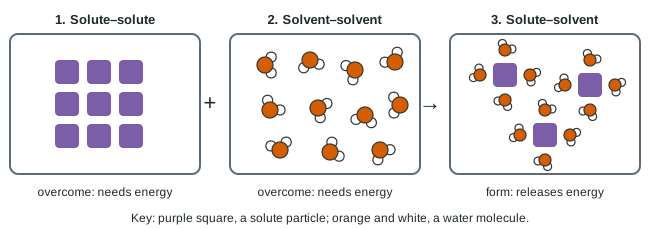
A substance dissolves when the attractions it forms with the solvent are comparable to the solute–solute and solvent–solvent attractions it replaces, so like dissolves like.
Part 1 · Hook
Why this matters
Part 2 · Before you start
What this builds on
Part 3 · Prerequisite check
Quick check before you start
1. Which molecule can hydrogen-bond to water?
- CH₃OH
- CH₄
- CCl₄
Show the answer
Methanol has an O–H group and lone pairs on O.
- Correct: CH₃OH:
- CH₄:
- CCl₄:
2. In a dissolved ionic compound, which end of water faces a cation?
- The oxygen end
- A hydrogen end
- Neither end
Show the answer
Water's δ− oxygen is attracted to a positive ion.
- Correct: The oxygen end:
- A hydrogen end:
- Neither end:
Part 4 · See it
See it first
Part 5 · Step by step
How it works, step by step
- Dissolving overcomes solute–solute and solvent–solvent attractionsit must form solute–solvent attractions of comparable strength to proceed
- Polar and ionic solutes form hydrogen bonds or ion-dipole forces with watermany of them dissolve well in water
- Nonpolar solutes attract water only weakly, and fitting them in costs water–water hydrogen bondsthey do not dissolve well in water but do in nonpolar solvents
- Dissolved gas molecules escape more easily when they move fastergases dissolve less as temperature rises, and more as their partial pressure rises
Part 6 · Key ideas
Key ideas
- Dissolving trades attractions: overcome solute–solute and solvent–solvent, form solute–solvent.
- Like dissolves like: polar and ionic in polar, nonpolar in nonpolar.
- Oil and water separate because water attracts itself far more strongly, not because they repel.
- Gas solubility in water rises with partial pressure and falls with temperature.
Part 7 · Misconception
A common mistake
The wrong idea: Nonpolar molecules do not dissolve in water because they repel water molecules.
What actually happens: They attract water weakly. Dissolving them would cost water many hydrogen bonds and give back much weaker attractions, so the water molecules stay together.
Part 8 · Check yourself
Check yourself
Exam-style questions. Anything you miss goes into your review queue.
Graph
How much alcohol dissolves in water
Solubility at 20 °C of straight-chain alcohols with one –OH group, plotted against the number of carbon atoms. Methanol, ethanol and 1-propanol mix with water in all proportions and are not plotted.
Data table
| Carbon atoms per molecule | Solubility |
|---|---|
| 4 | 7.7 |
| 5 | 2.2 |
| 6 | 0.59 |
| 7 | 0.17 |
1. Which statement describes the trend in the graph?
- Solubility in water falls as the carbon chain gets longer.
- Solubility in water rises as the carbon chain gets longer.
- Solubility in water is about the same for each alcohol.
- Solubility rises to a maximum at 6 carbons, then falls.
Show the answer
From 4 to 7 carbons the solubility drops from 7.7 to 0.17 g per 100 g water, each bar lower than the one before.
- Correct: Solubility in water falls as the carbon chain gets longer.: Right: a steady fall.
- Solubility in water rises as the carbon chain gets longer.: This reverses the trend.
- Solubility in water is about the same for each alcohol.: The values span a factor of about 45.
- Solubility rises to a maximum at 6 carbons, then falls.: The 6-carbon bar is lower than the 4- and 5-carbon bars.
2. Which explanation accounts for the trend?
- A longer nonpolar chain costs more water–water hydrogen bonds; the one –OH adds the same.
- Longer alcohols have more –OH groups, which repel the water molecules around them.
- Longer alcohols are heavier, and heavier molecules sink rather than dissolving.
- Longer chains are more polar, so they are attracted to water too strongly to dissolve.
Show the answer
Each alcohol has one –OH that hydrogen-bonds to water. The growing carbon–hydrogen part attracts water only weakly, and fitting it in costs water–water hydrogen bonds, so solubility falls.
- Correct: A longer nonpolar chain costs more water–water hydrogen bonds; the one –OH adds the same.: Right: the nonpolar part grows; the polar part does not.
- Longer alcohols have more –OH groups, which repel the water molecules around them.: Each of these alcohols has one –OH group, and –OH attracts water.
- Longer alcohols are heavier, and heavier molecules sink rather than dissolving.: Dissolving depends on attractions, not on whether a molecule is heavy.
- Longer chains are more polar, so they are attracted to water too strongly to dissolve.: Carbon–hydrogen chains are nonpolar; longer chains make the molecule less polar overall.
3. 1-Hexanol dissolves only slightly in water, but it mixes completely with hexane (C₆H₁₄). Which explanation is best?
- Its chain attracts hexane by dispersion forces like those hexane loses; in water it costs hydrogen bonds.
- Hexane hydrogen-bonds to the –OH group of 1-hexanol more strongly than water can.
- 1-Hexanol becomes nonpolar when mixed with hexane, because its –OH group breaks off.
- Hexane molecules repel water, so they push 1-hexanol out of the water and into the hexane.
Show the answer
Like dissolves like: hexane is nonpolar, and the long chain of 1-hexanol interacts with it by dispersion forces of similar strength to those it replaces. In water the same chain disrupts strong hydrogen bonds.
- Correct: Its chain attracts hexane by dispersion forces like those hexane loses; in water it costs hydrogen bonds.: Right: comparable attractions in hexane; a poor trade in water.
- Hexane hydrogen-bonds to the –OH group of 1-hexanol more strongly than water can.: Hexane has no H on N, O or F and cannot hydrogen-bond.
- 1-Hexanol becomes nonpolar when mixed with hexane, because its –OH group breaks off.: Mixing does not break covalent bonds; the –OH stays on the molecule.
- Hexane molecules repel water, so they push 1-hexanol out of the water and into the hexane.: Water and hexane do not repel; water molecules just attract each other much more.
Data table
Oxygen dissolved in water
The concentration of O₂ dissolved in water that is in contact with air (O₂ partial pressure 0.21 atm) at several temperatures.
| Water temperature (°C) | Dissolved O₂ (mg/L) |
|---|---|
| 0 | 14.6 |
| 10 | 11.3 |
| 20 | 9.1 |
| 30 | 7.6 |
| 40 | 6.4 |
4. How does the solubility of O₂ in water change as the temperature rises?
- It increases.
- It decreases.
- It stays the same.
- It increases, then decreases.
Show the answer
The dissolved O₂ falls from 14.6 mg/L at 0 °C to 6.4 mg/L at 40 °C.
- It increases.: This reverses the trend in the table.
- Correct: It decreases.: Right: lower at each higher temperature.
- It stays the same.: The values change by more than half.
- It increases, then decreases.: Every value is lower than the one before.
5. Which particle-level explanation accounts for the trend?
- Faster dissolved O₂ molecules escape their weak attractions to water more easily.
- At higher temperature, water molecules hydrogen-bond more strongly to O₂ and pull it apart into atoms.
- At higher temperature, O₂ molecules become polar and are repelled by the polar water molecules.
- At higher temperature, the air contains less oxygen, so less of it can dissolve in the water.
Show the answer
O₂ is held in water only by weak dipole-induced dipole and dispersion forces. Faster-moving molecules break away and escape into the air more readily.
- Correct: Faster dissolved O₂ molecules escape their weak attractions to water more easily.: Right: more kinetic energy, more escape.
- At higher temperature, water molecules hydrogen-bond more strongly to O₂ and pull it apart into atoms.: O₂ cannot hydrogen-bond, and dissolving does not break the O=O bond.
- At higher temperature, O₂ molecules become polar and are repelled by the polar water molecules.: O₂ is nonpolar at any temperature.
- At higher temperature, the air contains less oxygen, so less of it can dissolve in the water.: The O₂ partial pressure in air is 0.21 atm throughout.
6. Which pairs of liquids are likely to mix completely? Select all that apply.
- Water and methanol, CH₃OH
- Hexane and octane, C₈H₁₈
- Water and hexane
- Water and carbon tetrachloride, CCl₄
Show the answer
Like dissolves like. Water and methanol both hydrogen-bond. Hexane and octane are both nonpolar. Water with nonpolar hexane or CCl₄ separates into layers.
- Correct: Water and methanol, CH₃OH: Right: both hydrogen-bond.
- Correct: Hexane and octane, C₈H₁₈: Right: both nonpolar, attracting by dispersion.
- Water and hexane: Hexane would cost water its hydrogen bonds.
- Water and carbon tetrachloride, CCl₄: CCl₄ is symmetric and nonpolar.
Part 9 · Summary
Summary
Part 10 · Up next
What comes next
Part 11 · Connections