Reaction Quotient and Equilibrium Constant
The equilibrium constant expression puts products over reactants, each raised to its coefficient, and leaves out pure solids and liquids; K c uses concentrations and K p partial pressures.
Part 1 · Hook
Why this matters
Part 2 · Before you start
What this builds on
Part 3 · Prerequisite check
Quick check before you start
1. At equilibrium, how do the forward and reverse rates compare?
- They are equal
- The forward rate is larger
- The reverse rate is larger
- Both are zero
Show the answer
Equal rates keep the concentrations constant.
- Correct: They are equal:
- The forward rate is larger:
- The reverse rate is larger:
- Both are zero:
2. If the reverse rate is greater than the forward rate, what happens to the product concentrations?
- They decrease
- They increase
- They stay constant
- They become equal to the reactant concentrations
Show the answer
A faster reverse reaction turns products back into reactants overall.
- Correct: They decrease:
- They increase:
- They stay constant:
- They become equal to the reactant concentrations:
3. What is the partial pressure of a gas in a mixture?
- The pressure that gas alone would exert in the same volume
- The total pressure divided by the number of gases
- The pressure of the gas before it was mixed
- The pressure of the gas at STP
Show the answer
Each gas contributes its own share of the total pressure (Dalton’s law).
- Correct: The pressure that gas alone would exert in the same volume:
- The total pressure divided by the number of gases:
- The pressure of the gas before it was mixed:
- The pressure of the gas at STP:
Part 4 · See it
See it first
Part 5 · Step by step
How it works, step by step
- The expression for K is written from the balanced equationproducts over reactants, each raised to its coefficient, with pure solids and liquids left out
- Today’s concentrations or pressures are put into the same expressionyou get Q, a snapshot of where the mixture is now
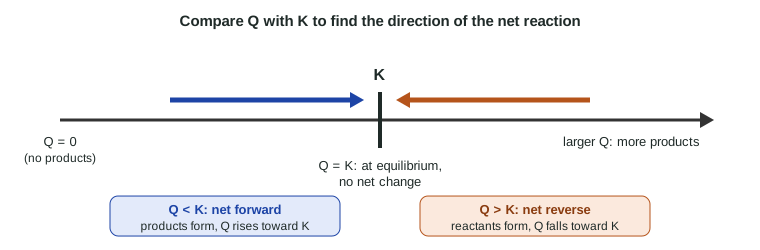
- Q is less than Kthe forward rate is larger, so products form and Q rises toward K
- Q is greater than Kthe reverse rate is larger, so reactants form and Q falls toward K
- Q reaches Kthe system is at equilibrium and the concentrations stop changing
Part 6 · Key ideas
Key ideas
- K = products over reactants, each to the power of its coefficient, at equilibrium. Leave out pure solids and liquids.
- Kc uses molar concentrations in brackets; Kp uses partial pressures (no brackets).
- Q has the same expression, filled in with the amounts present now.
- Q < K: net forward. Q > K: net reverse. Q = K: at equilibrium.
Part 7 · Misconception
A common mistake
The wrong idea: If a mixture contains more product than reactant, it will react in reverse.
What actually happens: Direction comes only from Q compared with K. A flask full of SO₃ can still react forward if its Q is below K, as flask 1 does with Q = 80.0 and K = 280.
Part 8 · Check yourself
Check yourself
Exam-style questions. Anything you miss goes into your review queue.
Data table
Four mixtures of SO₂, O₂ and SO₃
For 2 SO2(g) + O2(g) ⇌ 2 SO3(g), Kc = 2.80 × 10² at a certain temperature. Four sealed flasks are prepared at that temperature with the starting concentrations below.
| Flask | [SO2] (M) | [O2] (M) | [SO3] (M) |
|---|---|---|---|
| 1 | 0.100 | 0.0500 | 0.200 |
| 2 | 0.0200 | 0.0400 | 0.0800 |
| 3 | 0.0500 | 0.0200 | 0.118 |
| 4 | 0.300 | 0.100 | 0 |
1. Calculate the reaction quotient, Qc, for flask 1.
Type a number.
Show the answer
Qc = [SO₃]² / ([SO₂]²[O₂]) = (0.200)² / ((0.100)² × 0.0500) = 0.0400 / 0.000500 = 80.0.
- Answer: 80.0
2. For flask 2, Qc = 400. Which way does the net reaction go as flask 2 approaches equilibrium?
- In reverse, because Q > K: there is too much product for equilibrium.
- Forward, because Q > K means the forward reaction is faster.
- Forward, because flask 2 holds more SO3 than SO2.
- No net reaction, because Q and K are both greater than 1.
Show the answer
Compare Q with K. If Q > K, the mixture has too many products relative to reactants, so the net reaction goes in reverse, lowering Q until Q = K.
- Correct: In reverse, because Q > K: there is too much product for equilibrium.: Right: Q = 400 > K = 280. To lower Q, products must turn back into reactants until Q = K.
- Forward, because Q > K means the forward reaction is faster.: This flips the rule. Q > K means the ratio of products to reactants is already too high, so the net reaction runs in reverse.
- Forward, because flask 2 holds more SO3 than SO2.: Direction comes from comparing Q with K, not from comparing amounts in the flask.
- No net reaction, because Q and K are both greater than 1.: Being on the same side of 1 means nothing. The flask is at equilibrium only when Q equals K.
3. Which flask is already at equilibrium when it is prepared?
- Flask 3
- Flask 1
- Flask 2
- Flask 4
Show the answer
A mixture is at equilibrium when Q = K. Only flask 3 has Q ≈ 280.
- Correct: Flask 3: Right: Q = (0.118)² / ((0.0500)² × 0.0200) = 278, equal to K = 280 within the precision of the data.
- Flask 1: Q = 80.0 for flask 1, well below K, so it will react forward.
- Flask 2: Q = 400 for flask 2, above K, so it will react in reverse.
- Flask 4: Flask 4 has no SO₃, so Q = 0. It can only react forward.
4. What happens in flask 4 after it is prepared?
- SO3 forms, because Q = 0 is less than K.
- Nothing, because there is no SO3 to react.
- SO2 forms, because Q is less than K.
- Q is undefined, because [SO3] is zero.
Show the answer
A mixture with reactants and no products has Q = 0, which is smaller than any K, so it reacts forward.
- Correct: SO3 forms, because Q = 0 is less than K.: Right: with no product, Q = 0 < K, so the net reaction must go forward.
- Nothing, because there is no SO3 to react.: The forward reaction needs SO₂ and O₂, which are present. Only the reverse reaction lacks a reactant.
- SO2 forms, because Q is less than K.: Q < K means net forward, which uses SO₂. It cannot form SO₂.
- Q is undefined, because [SO3] is zero.: Q can be calculated: zero on top gives Q = 0. Only a zero on the bottom would be a problem.
5. A student says flask 1 will react in reverse because it contains the most SO3. Which response is best?
- Disagree: Q = 80.0 is less than K, so flask 1 reacts forward and makes more SO3.
- Agree: the flask with the most product reacts in reverse.
- Disagree: flask 1 is at equilibrium because it has more SO3 than SO2.
- Agree: Q = 80.0 is greater than 1, so the net reaction goes in reverse.
Show the answer
The ratio, not a single concentration, decides direction. Flask 1 has Q = 80.0 < K = 280, so more SO₃ forms until Q = K.
- Correct: Disagree: Q = 80.0 is less than K, so flask 1 reacts forward and makes more SO3.: Right: the comparison that matters is Q with K, and Q is below K.
- Agree: the flask with the most product reacts in reverse.: The amount of product alone does not decide direction. What matters is the whole ratio Q compared with K.
- Disagree: flask 1 is at equilibrium because it has more SO3 than SO2.: Q = 80.0 is not 280, so flask 1 is not at equilibrium.
- Agree: Q = 80.0 is greater than 1, so the net reaction goes in reverse.: Q is compared with K, not with 1. Here Q < K, so the net reaction goes forward.
6. Which is the equilibrium constant expression for CaCO3(s) ⇌ CaO(s) + CO2(g)?
- Kc = [CO2]
- Kc = [CaO][CO2] / [CaCO3]
- Kc = [CaO] / [CaCO3]
- Kc = 1 / [CO2]
Show the answer
Pure solids and pure liquids do not appear in K or Q, because their concentration is fixed by their density. Only gases and dissolved species are included.
- Correct: Kc = [CO2]: Right: the two pure solids are left out, leaving only the gas.
- Kc = [CaO][CO2] / [CaCO3]: Pure solids are left out of K: their "concentration" does not change however much solid is present.
- Kc = [CaO] / [CaCO3]: This keeps the two solids and drops the gas, the opposite of the rule.
- Kc = 1 / [CO2]: CO₂ is a product, so it goes on top.
7. For H2(g) + I2(g) ⇌ 2 HI(g), a mixture holds [H2] = 0.0150 M, [I2] = 0.0300 M and [HI] = 0.0900 M. Calculate Qc.
Type a number.
Show the answer
Qc = [HI]² / ([H₂][I₂]) = (0.0900)² / (0.0150 × 0.0300) = 0.00810 / 0.000450 = 18.0.
- Answer: 18.0
Part 9 · Summary
Summary
Part 10 · Up next
What comes next
Part 11 · Connections