Calculating the Equilibrium Constant
To calculate K, substitute equilibrium concentrations (or partial pressures for K p ) into the expression; every equilibrium mixture at one temperature gives the same value.
Part 1 · Hook
Why this matters
Part 2 · Before you start
What this builds on
Part 3 · Prerequisite check
Quick check before you start
1. What is Kc for N2O4(g) ⇌ 2 NO2(g)?
- [NO2]2 / [N2O4]
- 2[NO2] / [N2O4]
- [N2O4] / [NO2]2
- [NO2] / [N2O4]
Show the answer
Products over reactants, each raised to its coefficient.
- Correct: [NO2]2 / [N2O4]:
- 2[NO2] / [N2O4]:
- [N2O4] / [NO2]2:
- [NO2] / [N2O4]:
2. In 2 H2 + O2 → 2 H2O, if 0.30 mol O2 reacts, how much H2 reacts?
- 0.60 mol
- 0.30 mol
- 0.15 mol
- 0.90 mol
Show the answer
The mole ratio is 2 H₂ : 1 O₂.
- Correct: 0.60 mol:
- 0.30 mol:
- 0.15 mol:
- 0.90 mol:
3. What is the molarity of 0.40 mol of solute in 2.0 L of solution?
- 0.20 M
- 0.80 M
- 5.0 M
- 0.40 M
Show the answer
Molarity = moles / liters = 0.40 / 2.0.
- Correct: 0.20 M:
- 0.80 M:
- 5.0 M:
- 0.40 M:
Part 4 · See it
See it first
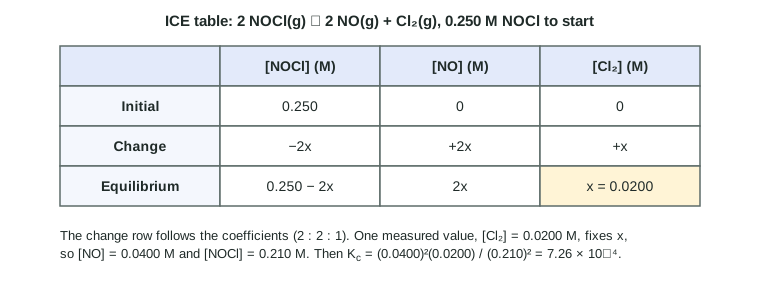
Part 5 · Step by step
How it works, step by step
- Different equilibrium mixtures of one reaction are measured at the same temperaturetheir concentrations differ, but K = products over reactants (with exponents) comes out the same
- Only the starting amounts and one equilibrium value are knownan ICE table writes every change as x times a coefficient
- The measured value fixes xevery equilibrium concentration follows from Initial + Change
- The equilibrium concentrations are put into the K expressionyou get the value of K, with no units and the data’s significant figures
Part 6 · Key ideas
Key ideas
- K is calculated from equilibrium concentrations or pressures only.
- Every equilibrium mixture of a reaction at one temperature gives the same K.
- In a heterogeneous equilibrium (more than one phase), pure solids and liquids still drop out of K.
- An ICE table (Initial, Change, Equilibrium) writes each change as x times the coefficient, so one measured value gives them all.
Part 7 · Misconception
A common mistake
The wrong idea: You can put the starting concentrations into the K expression to find K.
What actually happens: Starting concentrations give Q at the start, which can be any value. K needs the equilibrium concentrations; use an ICE table to get them from the starting amounts and one measured value.
Part 8 · Check yourself
Check yourself
Exam-style questions. Anything you miss goes into your review queue.
Data table
Three equilibrium mixtures of H₂, I₂ and HI
Three sealed flasks at 450 °C each start with different amounts of H2, I2 and HI and are left to reach equilibrium: H2(g) + I2(g) ⇌ 2 HI(g). The table gives the equilibrium concentrations.
| Trial | [H2] (M) | [I2] (M) | [HI] (M) |
|---|---|---|---|
| 1 | 0.0114 | 0.00120 | 0.0262 |
| 2 | 0.00456 | 0.00456 | 0.0322 |
| 3 | 0.00353 | 0.0148 | 0.0511 |
1. Calculate Kc from the data for trial 1.
Type a number.
Show the answer
Kc = [HI]² / ([H₂][I₂]) = (0.0262)² / (0.0114 × 0.00120) = 50.2.
- Answer: 50.2
2. What do the three trials show about Kc?
- Kc is about the same in each trial.
- Kc is largest in the trial with the most HI.
- Kc depends on which substances were put into the flask first.
- Kc is the same because [H2] equals [I2] in each trial.
Show the answer
At one temperature, every equilibrium mixture of the same reaction gives the same value of K, whatever amounts it started with. Small differences come from measurement precision.
- Correct: Kc is about the same in each trial.: Right: K comes out at about 50 every time (50.2, 49.9, 50.0), though the mixtures look nothing alike.
- Kc is largest in the trial with the most HI.: K is a ratio. Trial 3 has the most HI but also by far the most I₂, so the ratio [HI]² / ([H₂][I₂]) comes out about the same.
- Kc depends on which substances were put into the flask first.: All three started differently, yet K is about the same. At a fixed temperature, K does not depend on the starting mixture.
- Kc is the same because [H2] equals [I2] in each trial.: [H₂] equals [I₂] only in trial 2. K is constant anyway.
Experimental setup
Nitrosyl chloride decomposing
A student puts 0.500 mol of NOCl gas into an empty, sealed 2.00 L flask and holds it at a constant temperature: 2 NOCl(g) ⇌ 2 NO(g) + Cl2(g). When equilibrium is reached, the flask contains 0.0400 mol of Cl2.
3. Calculate [NOCl] at equilibrium.
Type a number and its unit.
Show the answer
[Cl₂]eq = 0.0400 mol / 2.00 L = 0.0200 M, so x = 0.0200 M. NOCl changes by −2x: 0.250 M − 2(0.0200 M) = 0.210 M.
- Answer: 0.210 M
4. Use your equilibrium concentrations to calculate Kc for the decomposition of NOCl at this temperature.
Type a number.
Show the answer
x = 0.0200 M, so [NO] = 2x = 0.0400 M, [Cl₂] = 0.0200 M, [NOCl] = 0.250 − 0.0400 = 0.210 M. Kc = [NO]²[Cl₂] / [NOCl]² = (0.0400)²(0.0200) / (0.210)² = 7.26 × 10⁻⁴.
- Answer: 7.26 × 10⁻⁴
5. Put the steps for finding Kc in this experiment in order.
- Convert the moles of NOCl and of Cl2 to molarities.
- Write the ICE table with the change row as −2x, +2x and +x.
- Set x equal to the equilibrium [Cl2] and fill in the equilibrium row.
- Substitute the equilibrium concentrations into the expression for Kc.
Show the answer
Concentrations first; then the ICE table links the one measured value to every other species through the coefficients; then substitute.
- Correct order: 1. Convert the moles of NOCl and of Cl2 to molarities. 2. Write the ICE table with the change row as −2x, +2x and +x. 3. Set x equal to the equilibrium [Cl2] and fill in the equilibrium row. 4. Substitute the equilibrium concentrations into the expression for Kc.
6. Solid NH4HS is sealed in an evacuated flask: NH4HS(s) ⇌ NH3(g) + H2S(g). At equilibrium, [NH3] = [H2S] = 0.0150 M, and 2.00 g of solid remains. Calculate Kc.
Type a number.
Show the answer
The solid is left out: Kc = [NH₃][H₂S] = (0.0150)(0.0150) = 2.25 × 10⁻⁴.
- Answer: 2.25 × 10⁻⁴
7. For A(g) ⇌ 2 B(g), a flask starts with 0.40 M A. At equilibrium [B] = 0.20 M. Which ICE table row is correct for the equilibrium concentrations?
- [A] = 0.30 M, [B] = 0.20 M
- [A] = 0.20 M, [B] = 0.20 M
- [A] = 0.00 M, [B] = 0.20 M
- [A] = 0.40 M, [B] = 0.20 M
Show the answer
Change row: A −x, B +2x. 2x = 0.20 M gives x = 0.10 M. Equilibrium [A] = 0.40 − 0.10 = 0.30 M.
- Correct: [A] = 0.30 M, [B] = 0.20 M: Right: B rose by 2x = 0.20 M, so x = 0.10 M and A fell to 0.40 − 0.10 = 0.30 M.
- [A] = 0.20 M, [B] = 0.20 M: This subtracts the change in B directly from A. A falls by x, which is half of B’s rise.
- [A] = 0.00 M, [B] = 0.20 M: A reversible reaction does not use up its reactant; A remains at equilibrium.
- [A] = 0.40 M, [B] = 0.20 M: A cannot stay at its starting value while B forms; B is made from A.
Part 9 · Summary
Summary
Part 10 · Up next
What comes next
Part 11 · Connections