Properties of Buffers
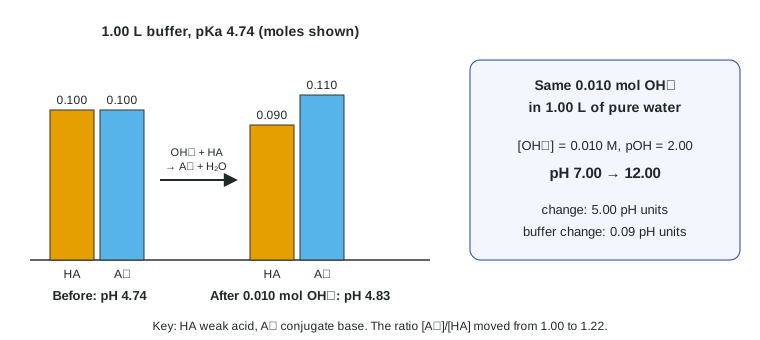
A buffer resists pH change because its two components react with whatever is added: the conjugate base takes up added acid and the weak acid takes up added base.
Part 1 · Hook
Why this matters
Part 2 · Before you start
What this builds on
Part 3 · Prerequisite check
Quick check before you start
1. Which pair makes a buffer?
- HNO₂ and NaNO₂
- HCl and NaCl
- NaOH and NaCl
- HNO₃ and NaNO₃
Show the answer
A weak acid and its conjugate base; HNO₂ is weak.
- Correct: HNO₂ and NaNO₂:
- HCl and NaCl:
- NaOH and NaCl:
- HNO₃ and NaNO₃:
2. For an acid with pKa 4.7, which form predominates at pH 5.7?
- A⁻, about 10 to 1
- HA, about 10 to 1
- Equal amounts
- A⁻, about 1.2 to 1
Show the answer
pH is 1 unit above pKa, so [A⁻]/[HA] = 10.
- Correct: A⁻, about 10 to 1:
- HA, about 10 to 1:
- Equal amounts:
- A⁻, about 1.2 to 1:
Part 4 · See it
See it first
Part 5 · Step by step
How it works, step by step
- Strong acid is added to a bufferH₃O⁺ + A⁻ → HA + H₂O runs to completion, so the added H₃O⁺ does not stay free
- Strong base is added to a bufferOH⁻ + HA → A⁻ + H₂O runs to completion, so the added OH⁻ does not stay free
- Each addition only shifts a little HA into A⁻ or backthe ratio [A⁻]/[HA] changes slightly, so [H₃O⁺] = Ka × [HA]/[A⁻] changes slightly
- Diluting a buffer lowers [HA] and [A⁻] by the same factorthe ratio, and so the pH, stays almost the same
Part 6 · Key ideas
Key ideas
- Buffer action: added acid is consumed by A⁻; added base is consumed by HA. The added ion is turned into a member of the pair.
- Buffer pH depends on the ratio [A⁻]/[HA], not on the amounts. Same ratio, same pH.
- Diluting a buffer barely changes its pH.
- A buffer limits pH change; it does not stop it. Each addition shifts the ratio a little.
Part 7 · Misconception
A common mistake
The wrong idea: A more concentrated buffer has a lower pH because it contains more acid.
What actually happens: It also contains more conjugate base. The pH depends on the ratio [A⁻]/[HA], so two buffers with the same ratio have the same pH; the concentrated one can simply absorb more added acid or base.
Part 8 · Check yourself
Check yourself
Exam-style questions. Anything you miss goes into your review queue.
Data table
Adding acid to three solutions
A student adds 1.0 mL of 1.0 M HCl (1.0 × 10⁻³ mol) to 100.0 mL of each solution below and records the pH before and after. The buffer uses acetic acid (pKa = 4.74).
| Solution (100.0 mL) | pH before | pH after |
|---|---|---|
| Pure water | 7.00 | 2.00 |
| 0.10 M CH₃COOH + 0.10 M CH₃COONa | 4.74 | 4.65 |
| 0.10 M NaCl | 7.00 | 2.00 |
1. Which claim do the data support?
- The acetic acid / acetate mixture resists a pH change
- The three solutions resist a change in pH to the same extent
- NaCl solution is a buffer because it contains ions
- Water resists a change in pH better than the mixture
Show the answer
The mixture's pH moved by 0.09 units; water and NaCl solution each dropped by about 5.0.
- Correct: The acetic acid / acetate mixture resists a pH change: Right: the weak acid/conjugate base pair absorbed the H₃O⁺.
- The three solutions resist a change in pH to the same extent: The pH changes differ by a factor of about 50.
- NaCl solution is a buffer because it contains ions: Na⁺ and Cl⁻ do not react with H₃O⁺, so NaCl solution behaves like water.
- Water resists a change in pH better than the mixture: Water changed by about 5 pH units, far more than the buffer.
2. Which equation shows how the mixture removes the added acid?
- H₃O⁺ + CH₃COO⁻ → CH₃COOH + H₂O
- H₃O⁺ + OH⁻ → H₂O + H₂O (with OH⁻ from water)
- H₃O⁺ + Cl⁻ → HCl + H₂O
- CH₃COOH + H₂O → CH₃COO⁻ + H₃O⁺
Show the answer
The added H₃O⁺ is taken up by the base of the pair, acetate, which becomes acetic acid.
- Correct: H₃O⁺ + CH₃COO⁻ → CH₃COOH + H₂O: Right: the conjugate base consumes added acid.
- H₃O⁺ + OH⁻ → H₂O + H₂O (with OH⁻ from water): There is very little OH⁻ in an acidic buffer; the acetate does the work.
- H₃O⁺ + Cl⁻ → HCl + H₂O: Cl⁻, the conjugate base of a strong acid, does not take protons.
- CH₃COOH + H₂O → CH₃COO⁻ + H₃O⁺: This is the ionization of acetic acid, which would add H₃O⁺, not remove it.
3. Show how the "pH after" for the mixture was calculated: find the pH after the HCl is added.
Type a number.
Show the answer
Before: 0.0100 mol CH₃COOH and 0.0100 mol CH₃COO⁻. After H₃O⁺ + CH₃COO⁻ → CH₃COOH: 0.0110 mol acid, 0.0090 mol acetate. Ka = 10^−4.74 = 1.82 × 10⁻⁵. [H₃O⁺] = Ka × 0.0110/0.0090 = 2.22 × 10⁻⁵ M; pH = 4.65.
- Answer: 4.65
Particle view
A buffer before and after an addition
Key: HA weak acid; A⁻ conjugate base; H₃O⁺ hydronium. Spectator ions and water are not drawn.
4. Two OH⁻ ions are added to Box 1. Which box shows the result?
- Box 3
- Box 2
- Box 4
- Box 1, unchanged
Show the answer
OH⁻ + HA → A⁻ + H₂O: two HA become two A⁻, giving 3 HA and 7 A⁻.
- Correct: Box 3: Right: base removes HA and makes A⁻.
- Box 2: Box 2 is what two added H₃O⁺ ions would produce.
- Box 4: Box 4 shows free H₃O⁺ that has not reacted, which a buffer does not allow.
- Box 1, unchanged: The particles change: the buffer works by reacting with what is added.
5. A student adds two H₃O⁺ ions to Box 1 and draws Box 4 as the result. What is wrong with the drawing?
- The H₃O⁺ should have reacted with A⁻, giving 7 HA and 3 A⁻
- The H₃O⁺ should have reacted with HA, giving 3 HA and 7 A⁻
- Nothing is wrong: added ions stay free in a buffer
- The H₃O⁺ should have become two OH⁻ ions
Show the answer
Added H₃O⁺ reacts with A⁻ essentially to completion (H₃O⁺ + A⁻ → HA + H₂O), so it cannot sit beside 5 unreacted A⁻ ions. The correct drawing is Box 2.
- Correct: The H₃O⁺ should have reacted with A⁻, giving 7 HA and 3 A⁻: Right: the conjugate base consumes the added acid.
- The H₃O⁺ should have reacted with HA, giving 3 HA and 7 A⁻: H₃O⁺ is an acid; it reacts with the base of the pair, A⁻, not with HA.
- Nothing is wrong: added ions stay free in a buffer: If added ions stayed free, the mixture would not be a buffer.
- The H₃O⁺ should have become two OH⁻ ions: An acid does not turn into a base; it gives its proton to A⁻.
6. The weak acid has pKa 4.74. What is the pH of the solution shown in Box 2?
Type a number.
Show the answer
Ka = 10^−4.74 = 1.82 × 10⁻⁵. [H₃O⁺] = Ka × [HA]/[A⁻] = 1.82 × 10⁻⁵ × 7/3 = 4.25 × 10⁻⁵ M; pH = 4.37. The volume cancels, so particle counts can be used directly.
- Answer: 4.37
7. Box 1 is diluted with water to twice its volume. How does its pH change?
- It stays about the same, because the ratio [A⁻]/[HA] is unchanged
- It rises by about 0.30, because the concentrations are halved
- It falls, because water is added
- It rises to 7, because the buffer is diluted
Show the answer
Both [HA] and [A⁻] are halved, so their ratio stays 1 and [H₃O⁺] = Ka × 1. The pH depends on the ratio, not on the absolute concentrations.
- Correct: It stays about the same, because the ratio [A⁻]/[HA] is unchanged: Right: dilution leaves the ratio alone.
- It rises by about 0.30, because the concentrations are halved: Halving both concentrations cancels in the ratio; the pH does not shift by log 2.
- It falls, because water is added: Water does not add H₃O⁺ to a buffer in any amount that matters.
- It rises to 7, because the buffer is diluted: A diluted buffer keeps its pH until it is so dilute that water's own ions matter.
Part 9 · Summary
Summary
Part 10 · Up next
What comes next
Part 11 · Connections