Buffer Capacity
Buffer capacity is how much strong acid or base a buffer can absorb before its pH changes sharply.
Part 1 · Hook
Why this matters
Part 2 · Before you start
What this builds on
Part 3 · Prerequisite check
Quick check before you start
1. A buffer has [A⁻]/[HA] = 1. What is its pH?
- pKa
- 7.00
- pKa + 1
- 0
Show the answer
pH = pKa + log 1 = pKa.
- Correct: pKa:
- 7.00:
- pKa + 1:
- 0:
2. Which species in a buffer reacts with added OH⁻?
- The weak acid HA
- The conjugate base A⁻
- Water
- The spectator ion
Show the answer
OH⁻ + HA → A⁻ + H₂O.
- Correct: The weak acid HA:
- The conjugate base A⁻:
- Water:
- The spectator ion:
Part 4 · See it
See it first
Part 5 · Step by step
How it works, step by step
- Each mole of added OH⁻ uses up one mole of HA, and each mole of H₃O⁺ one mole of A⁻the moles of the components set how much acid or base the buffer can absorb
- A buffer with more moles of both componentshas a larger capacity, even at the same pH
- When the components are equal, the ratio is furthest from both endscapacity for acid and for base is balanced, at pH = pKa
- Once one component is used upthe next addition stays free and the pH jumps, as in the steep part of a titration curve
Part 6 · Key ideas
Key ideas
- Buffer capacity grows with the moles of HA and A⁻. Same ratio, more material: same pH, bigger capacity.
- Capacity for added base depends on HA; capacity for added acid depends on A⁻.
- A buffer works best within pKa ± 1, where neither component is less than a tenth of the other.
- Once a component is used up, find the pH from the excess strong acid or base, not from Henderson-Hasselbalch.
Part 7 · Misconception
A common mistake
The wrong idea: A buffer at the right pH can absorb any amount of added acid.
What actually happens: Each mole of added acid uses up a mole of conjugate base. Once A⁻ runs out, the next acid stays free and the pH falls sharply.
Part 8 · Check yourself
Check yourself
Exam-style questions. Anything you miss goes into your review queue.
Data table
Four acetate buffers
Four 1.00 L buffers are made from acetic acid (pKa 4.74) and sodium acetate.
| Buffer | CH₃COOH (mol) | CH₃COO⁻ (mol) | pH |
|---|---|---|---|
| P | 0.50 | 0.50 | 4.74 |
| Q | 0.050 | 0.050 | 4.74 |
| R | 0.90 | 0.10 | 3.79 |
| S | 0.10 | 0.90 | 5.69 |
1. Which buffer has the largest capacity for both added strong acid and added strong base?
- P
- Q
- R
- S
Show the answer
Capacity for acid depends on the moles of CH₃COO⁻ and capacity for base on the moles of CH₃COOH. P has 0.50 mol of each, so it can take up to 0.50 mol of either.
- Correct: P: Right: large and equal amounts of both components.
- Q: Q has the same ratio but a tenth of the amounts, so a tenth of the capacity.
- R: R can absorb up to 0.90 mol of base but only 0.10 mol of acid.
- S: S can absorb up to 0.90 mol of acid but only 0.10 mol of base.
2. What is the pH of Buffer Q after 0.010 mol HCl is added?
Type a number.
Show the answer
Acetate 0.050 − 0.010 = 0.040 mol; acid 0.050 + 0.010 = 0.060 mol. pH = 4.74 + log(0.040/0.060) = 4.56, a drop of 0.18. The same acid would lower P by only 0.02.
- Answer: 4.56
3. Buffer R is much better at handling one kind of addition than the other. Which, and why?
- Added base, because it has 0.90 mol CH₃COOH to react with OH⁻
- Added acid, because its pH is below pKa
- Added acid, because it has 0.90 mol CH₃COOH to react with H₃O⁺
- Both equally, because a buffer resists acid and base the same
Show the answer
OH⁻ is consumed by CH₃COOH, which R has plenty of. H₃O⁺ is consumed by CH₃COO⁻, which R has only 0.10 mol of, so 0.10 mol of acid would use it up.
- Correct: Added base, because it has 0.90 mol CH₃COOH to react with OH⁻: Right: the large acid component handles base.
- Added acid, because its pH is below pKa: A low pH says nothing about how much acetate is left to take up added acid.
- Added acid, because it has 0.90 mol CH₃COOH to react with H₃O⁺: H₃O⁺ reacts with acetate, not with acetic acid.
- Both equally, because a buffer resists acid and base the same: A buffer with unequal components resists one direction much better than the other.
4. What is the pH of Buffer R after 0.15 mol HCl is added? (The buffer is overwhelmed: find the excess first.)
Type a number.
Show the answer
0.10 mol CH₃COO⁻ reacts with 0.10 mol H₃O⁺; 0.05 mol H₃O⁺ is left over in 1.00 L. The H₃O⁺ from 1.00 M acetic acid is negligible beside 0.050 M of strong acid. pH = −log(0.050) = 1.30.
- Answer: 1.30
Graph
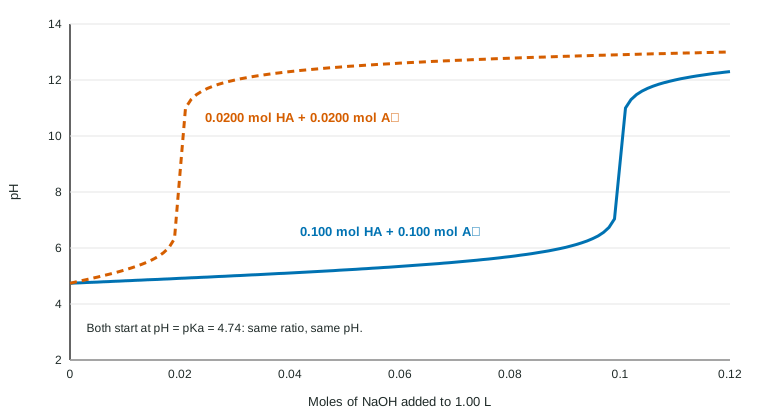
Adding base to two buffers
Solid NaOH is added in portions to two 1.00 L buffers, each made from the same weak acid HA and NaA, and the pH is measured after each addition.
Buffer 1Buffer 2
Data table
| NaOH added (mol) | Buffer 1 | Buffer 2 |
|---|---|---|
| 0 | 4.74 | 4.74 |
| 0.01 | 4.83 | 5.22 |
| 0.02 | 4.92 | 8.67 |
| 0.03 | 5.01 | 12 |
| 0.04 | 5.11 | 12.3 |
| 0.06 | 5.34 | 12.6 |
| 0.08 | 5.69 | 12.78 |
| 0.09 | 6.02 | 12.85 |
| 0.1 | 9.02 | 12.9 |
| 0.11 | 12 | 12.95 |
| 0.12 | 12.3 | 13 |
5. Which statement does the graph support?
- Buffer 1 has the larger capacity: its pH stays nearly flat until about 0.10 mol NaOH
- Buffer 2 has the larger capacity, because its pH rises sooner
- The buffers have different pKa values, because they start at different pH
- The capacities are equal, because both start at pH 4.74
Show the answer
Buffer 1 holds its pH until roughly 0.10 mol of base; Buffer 2 fails after about 0.02 mol. The longer flat stretch means more HA available to react with OH⁻.
- Correct: Buffer 1 has the larger capacity: its pH stays nearly flat until about 0.10 mol NaOH: Right: capacity is how much it can absorb before the pH shoots up.
- Buffer 2 has the larger capacity, because its pH rises sooner: A buffer that fails sooner has the smaller capacity.
- The buffers have different pKa values, because they start at different pH: Both start at pH 4.74, the same pKa and the same 1 : 1 ratio.
- The capacities are equal, because both start at pH 4.74: Equal starting pH means equal ratios, not equal amounts.
6. The pH of each buffer rises sharply once its HA is used up. How many moles of HA did Buffer 2 contain at the start? (Read where its steep rise is centered.)
Type a number in mol.
Show the answer
OH⁻ + HA → A⁻ + H₂O. The steep rise is centered where the base added equals the HA present: about 0.020 mol for Buffer 2.
- Answer: 0.020 mol
7. How do the compositions of the two buffers most likely differ?
- Buffer 1 has about five times the moles of both HA and A⁻
- Buffer 1 has five times as much HA but the same A⁻
- Buffer 1 has a larger ratio [A⁻]/[HA]
- Buffer 1 uses a stronger weak acid
Show the answer
Same starting pH means the same ratio (and the same acid). Buffer 1 resists five times as much base (0.10 vs 0.02 mol), so it has five times the amounts of both.
- Correct: Buffer 1 has about five times the moles of both HA and A⁻: Right: same ratio, five times the amounts.
- Buffer 1 has five times as much HA but the same A⁻: More HA with the same A⁻ would make Buffer 1 start at a lower pH.
- Buffer 1 has a larger ratio [A⁻]/[HA]: A larger ratio would start at a higher pH.
- Buffer 1 uses a stronger weak acid: A different acid would show a different pKa, so a different starting pH.
Part 9 · Summary
Summary
Part 10 · Up next
What comes next
Part 11 · Connections