Acid-Base Titrations
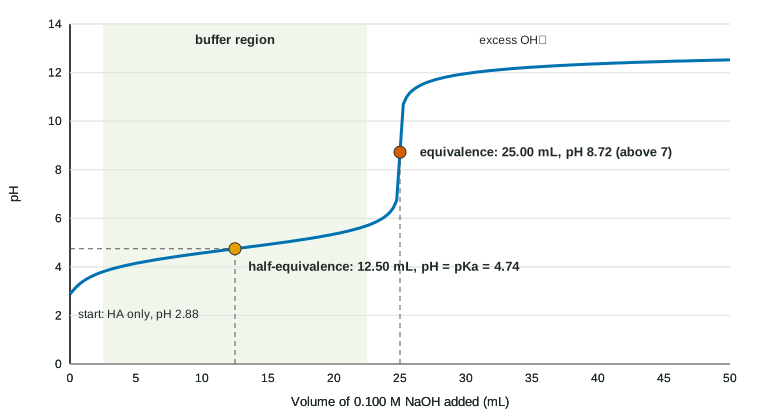
A titration curve shows four regions.
Part 1 · Hook
Why this matters
Part 2 · Before you start
What this builds on
Part 3 · Prerequisite check
Quick check before you start
1. At the equivalence point of a titration, what is true?
- Moles of titrant added equal the moles of analyte (by the equation)
- The pH is 7
- The buret is empty
- The volumes of titrant and analyte are equal
Show the answer
Equivalence is a stoichiometric point: the moles match by the balanced equation. Its pH depends on what is left.
- Correct: Moles of titrant added equal the moles of analyte (by the equation):
- The pH is 7:
- The buret is empty:
- The volumes of titrant and analyte are equal:
2. A mixture holds 2.0 × 10⁻³ mol of HA and 2.0 × 10⁻³ mol of A⁻ (Ka = 1.0 × 10⁻⁵). What is [H₃O⁺]?
- 1.0 × 10⁻⁵ M
- 2.0 × 10⁻³ M
- 1.0 × 10⁻¹⁰ M
- 4.5 × 10⁻⁴ M
Show the answer
[H₃O⁺] = Ka × [HA]/[A⁻] = Ka × 1 = 1.0 × 10⁻⁵ M.
- Correct: 1.0 × 10⁻⁵ M:
- 2.0 × 10⁻³ M:
- 1.0 × 10⁻¹⁰ M:
- 4.5 × 10⁻⁴ M:
3. What is the pH of 0.050 M acetate ion (Kb = 5.6 × 10⁻¹⁰)?
- 8.72
- 5.28
- 7.00
- 1.30
Show the answer
[OH⁻] = √(5.6 × 10⁻¹⁰ × 0.050) = 5.3 × 10⁻⁶ M; pOH = 5.28; pH = 8.72.
- Correct: 8.72:
- 5.28:
- 7.00:
- 1.30:
Part 4 · See it
See it first
Part 5 · Step by step
How it works, step by step
- Each drop of OH⁻ reacts completely with HAthe flask holds HA and A⁻ together, so the pH climbs slowly (the buffer region)
- Halfway to equivalence, half the HA has become A⁻[HA] = [A⁻], so Ka = [H₃O⁺] and pH = pKa
- Near equivalence almost no HA is left to react with new OH⁻each drop changes the pH sharply: the steep rise
- At equivalence only A⁻ remains, a weak basethe equivalence point of a weak acid is above pH 7
- An acid with two protons loses them one at a timea diprotic acid shows two equivalence points, equally spaced in volume
Part 6 · Key ideas
Key ideas
- Equivalence volume → moles of analyte → its concentration. The steep rise is centered on it.
- Half-equivalence (half the equivalence volume): [HA] = [A⁻], so pH = pKa. Do not confuse it with equivalence.
- Equivalence pH: 7 for strong/strong; above 7 for weak acid + strong base; below 7 for weak base + strong acid.
- Weak base titrated with strong acid: pH at half-equivalence is the pKa of the conjugate acid (14.00 − pKb), not pKb.
- Polyprotic acids: one equivalence point per proton; pKa₁, pKa₂ at each half-equivalence.
Part 7 · Misconception
A common mistake
The wrong idea: pH = pKa at the equivalence point.
What actually happens: pH = pKa at the half-equivalence point, where half the acid has been converted and [HA] = [A⁻]. At the equivalence point no HA is left.
Part 8 · Check yourself
Check yourself
Exam-style questions. Anything you miss goes into your review queue.
Graph
Titration of an unknown acid
A student titrates 25.00 mL of a monoprotic weak acid, HA, of unknown concentration with 0.100 M NaOH, recording the pH with a calibrated meter. The steepest rise is centered at 20.00 mL.
Data table
| Volume of NaOH added (mL) | pH |
|---|---|
| 0 | 2.65 |
| 2 | 3.28 |
| 4 | 3.61 |
| 6 | 3.84 |
| 8 | 4.03 |
| 10 | 4.2 |
| 12 | 4.38 |
| 14 | 4.57 |
| 16 | 4.8 |
| 18 | 5.15 |
| 19 | 5.48 |
| 19.5 | 5.79 |
| 20 | 8.42 |
| 20.5 | 11.04 |
| 21 | 11.34 |
| 22 | 11.63 |
| 24 | 11.91 |
| 26 | 12.07 |
| 30 | 12.26 |
| 35 | 12.4 |
1. What is the concentration of HA in the original solution? Include the unit.
Type a number and its unit.
Show the answer
At equivalence, mol OH⁻ = mol HA: 0.02000 L × 0.100 mol/L = 2.00 × 10⁻³ mol. [HA] = 2.00 × 10⁻³ mol / 0.02500 L = 0.0800 M.
- Answer: 0.0800 M
2. Which reading from the curve gives the pKa of HA?
- The pH at 10.00 mL, 4.20
- The pH at 20.00 mL, 8.42
- The pH at 0 mL, 2.65
- The pH at 30.00 mL, 12.26
Show the answer
At the half-equivalence point (half of 20.00 mL), half the HA has become A⁻, so [HA] = [A⁻]. In Ka = [H₃O⁺][A⁻]/[HA] the two cancel: Ka = [H₃O⁺], so pH = pKa.
- Correct: The pH at 10.00 mL, 4.20: Right: half-equivalence, where [HA] = [A⁻].
- The pH at 20.00 mL, 8.42: This is the equivalence point, where no HA is left; its pH is set by A⁻ acting as a base. Confusing equivalence with half-equivalence is the most common titration error.
- The pH at 0 mL, 2.65: At the start no A⁻ has been made, so [HA] ≠ [A⁻].
- The pH at 30.00 mL, 12.26: Past equivalence the pH is set by excess OH⁻.
3. Use the curve to find Ka of HA. Give your answer in scientific notation.
Type a number.
Show the answer
pH at 10.00 mL = 4.20 = pKa, so Ka = 10^−4.20 = 6.3 × 10⁻⁵.
- Answer: 6.3 × 10⁻⁵
4. Calculate the pH at the equivalence point. (Use Ka = 6.3 × 10⁻⁵.)
Type a number.
Show the answer
All 2.00 × 10⁻³ mol HA is now A⁻ in 45.00 mL: [A⁻] = 0.0444 M. Kb = Kw/Ka = 1.0 × 10⁻¹⁴ / 6.3 × 10⁻⁵ = 1.6 × 10⁻¹⁰. [OH⁻] = √(1.6 × 10⁻¹⁰ × 0.0444) = 2.7 × 10⁻⁶ M; pOH = 5.58; pH = 8.42.
- Answer: 8.42
5. A second student repeats the titration with 25.00 mL of the same acid diluted to 50.00 mL with water first. Which change to the curve is expected?
- The equivalence point stays at 20.00 mL, and the pH at 10.00 mL stays about the same
- The equivalence point moves to 40.00 mL, because the volume doubled
- The equivalence point moves to 10.00 mL, because the acid is more dilute
- The pH at 10.00 mL drops, because there is more water to ionize
Show the answer
Adding water does not change the moles of HA, so the same 2.00 × 10⁻³ mol of OH⁻ (20.00 mL) reaches equivalence. At half-equivalence [HA] = [A⁻] still, so pH = pKa again.
- Correct: The equivalence point stays at 20.00 mL, and the pH at 10.00 mL stays about the same: Right: moles of acid set the equivalence volume; the ratio at half-equivalence is unchanged.
- The equivalence point moves to 40.00 mL, because the volume doubled: The equivalence volume depends on moles of acid, not on the volume the acid is dissolved in.
- The equivalence point moves to 10.00 mL, because the acid is more dilute: The moles of acid are the same, so the base needed is the same.
- The pH at 10.00 mL drops, because there is more water to ionize: pH = pKa at half-equivalence whatever the dilution, because [HA]/[A⁻] = 1.
Particle view
Four snapshots of a titration
Key: HA weak acid molecule; A⁻ its conjugate base; Na⁺ sodium ion; OH⁻ hydroxide. Water and the very few H₃O⁺ and OH⁻ ions made by the equilibria are not drawn. All four boxes come from the same titration, at different volumes of NaOH.
6. Which box shows the solution at the equivalence point?
- Z
- W
- X
- Y
Show the answer
At equivalence, base added equals acid present: all 6 HA became 6 A⁻, with 6 Na⁺ from the 6 NaOH, and no OH⁻ left over.
- Correct: Z: Right: only A⁻ and Na⁺.
- W: Box W is the half-equivalence point: half the HA has been converted.
- X: Box X is the start: no base added yet.
- Y: Box Y is past equivalence: 2 extra OH⁻.
7. At which box does pH = pKa of HA?
- W
- Z
- X
- Y
Show the answer
[HA] = [A⁻] (3 and 3), so in Ka = [H₃O⁺][A⁻]/[HA] the ratio is 1 and [H₃O⁺] = Ka.
- Correct: W: Right: equal amounts of the acid and its conjugate base.
- Z: Box Z has no HA left; it is the equivalence point, not the half-equivalence point.
- X: At the start there is no A⁻, so the ratio is not 1.
- Y: Past equivalence, excess OH⁻ sets the pH.
8. Put the boxes in the order they occur during the titration.
- X
- W
- Z
- Y
Show the answer
Start (only HA), half-equivalence (equal HA and A⁻), equivalence (only A⁻), then past equivalence (A⁻ plus excess OH⁻). Na⁺ rises as NaOH is added: 0, 3, 6, 8.
- Correct order: 1. X 2. W 3. Z 4. Y
Part 9 · Summary
Summary
Part 10 · Up next
What comes next
Part 11 · Connections