Cell junctions
1Why this matters
Ms. Haddad, 52, has painful sores in her mouth and soft blisters on her chest that tear open when her shirt rubs them. A skin biopsy shows the cause: her skin cells have come apart from one another, leaving fluid-filled splits. Her immune system is making proteins that attack the adhesion proteins in her desmosomes, the rivets that hold skin cells together. Without them, ordinary friction is enough to pull her skin apart.
2What this builds on
3Quick check before you start
1. Which kind of membrane protein spans the whole phospholipid bilayer?
- A peripheral protein
- An integral protein
- A glycocalyx sugar chain
Show the answer
Integral proteins are embedded in the bilayer, and most span it completely. Junction proteins that reach across to a neighboring cell are integral proteins.
- A peripheral protein:
- Correct: An integral protein:
- A glycocalyx sugar chain:
2. Which fiber of the cytoskeleton is rope-like and resists pulling forces?
- Microtubules
- Microfilaments
- Intermediate filaments
Show the answer
Intermediate filaments are the tough, rope-like fibers that resist tension. Desmosomes anchor them.
- Microtubules:
- Microfilaments:
- Correct: Intermediate filaments:
4Anatomy
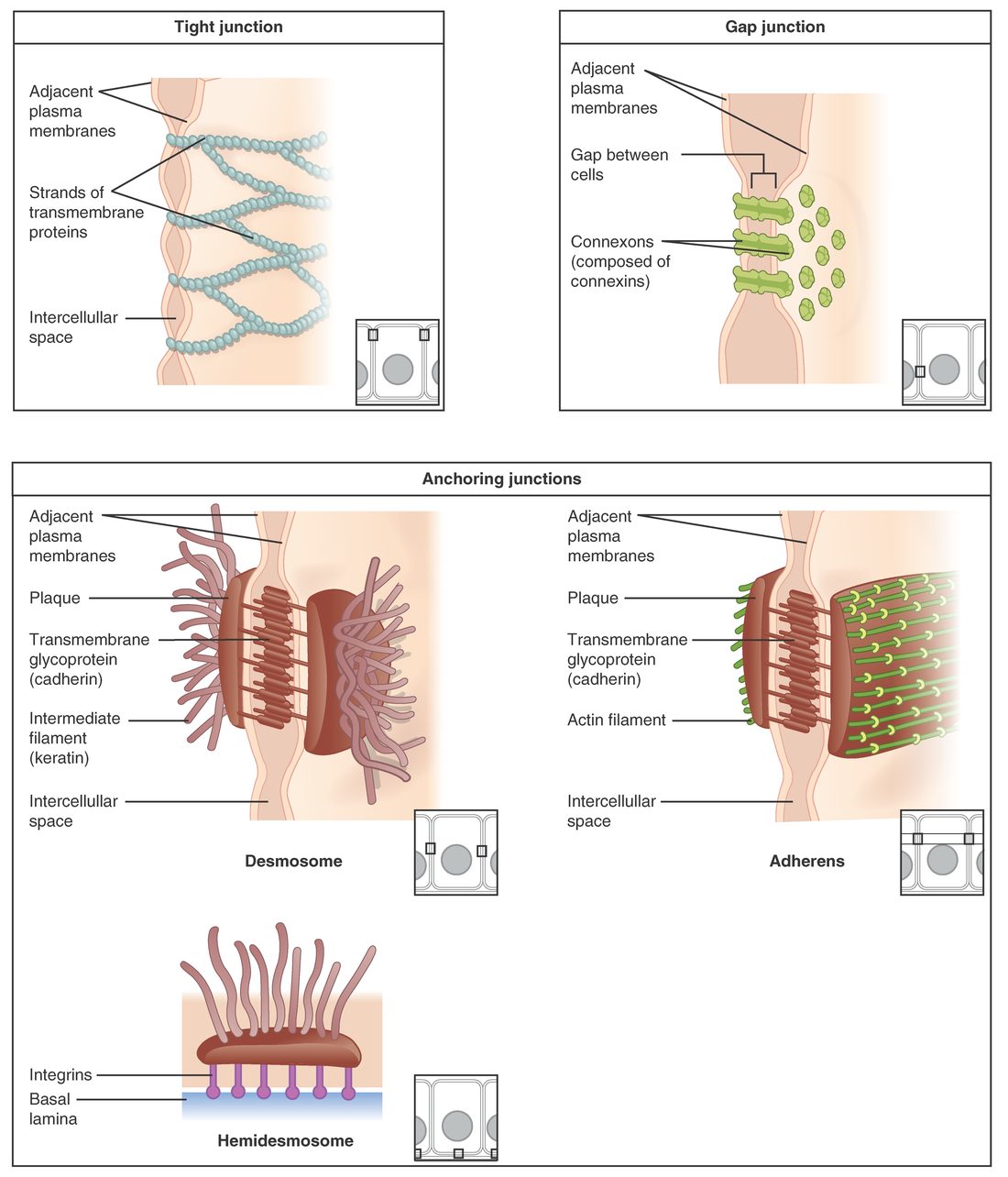
With labels hidden, select a box to reveal its label.
5How it works, step by step
- Friction pulls on one skin cell.The pull is passed to the desmosomes in that cell's plasma membrane.
- Cadherins in each desmosome grip the cadherins of the neighboring cell, and plaques anchor intermediate filaments on both sides.The pull is passed through the desmosome into the intermediate filaments of the neighboring cell.
- Every cell's intermediate filaments are linked to its neighbors' filaments through desmosomes.The force spreads across a whole net of cells instead of landing on one.
- No single cell takes the full force.The sheet of cells resists tearing. If the cadherins are attacked, the pull stays on single cells, and they separate into blisters.
6Core concepts
7A common mistake
The wrong idea: Tight junctions are the strongest junctions, the ones that hold cells together.
What actually happens: Tight junctions seal; they do not provide much strength. Their job is to close the space between cells, so substances must pass through the cells rather than between them. The junctions that hold cells together against pulling are desmosomes, which anchor each cell's intermediate filaments to its neighbors'. A sheet of cells can be well sealed and still tear if its desmosomes fail, as blistering diseases show.
8Check yourself
Anything you miss goes into your review queue.
1. Mr. Lindqvist's skin blisters with light rubbing. A biopsy shows skin cells that have separated from each other, although each cell is intact. Which junction has most likely failed?
- Gap junctions
- Tight junctions
- Microvilli
- Desmosomes
Show the answer
Desmosomes hold skin cells together against pulling and rubbing. When they fail, friction separates the cells and fluid fills the splits as blisters.
- Gap junctions: Gap junctions let ions pass between cells; they provide little strength, so their loss would not make cells separate.
- Tight junctions: Tight junctions seal the spaces between cells but are not what holds cells together against pulling.
- Microvilli: Microvilli are surface folds that increase absorptive area; they are not junctions.
- Correct: Desmosomes: Correct. Loss of desmosomes lets cells pull apart under friction.
2. A bacterial toxin loosens the tight junctions of the intestinal lining. What is the most direct result?
- The cells pull apart and blister
- Neighboring cells stop sharing ions through tunnels
- Fluid and ions leak between the cells
- The microvilli shrink
Show the answer
Tight junctions seal the spaces between lining cells. Loosen them, and fluid and ions can leak through the spaces instead of passing through the cells.
- The cells pull apart and blister: Pulling apart and blistering follows loss of desmosomes, which hold cells together. Tight junctions seal rather than rivet.
- Neighboring cells stop sharing ions through tunnels: Ion sharing through tunnels is the job of gap junctions, which this toxin does not target.
- Correct: Fluid and ions leak between the cells: Correct. Loosened seals let fluid and ions pass between the cells.
- The microvilli shrink: Microvilli have an actin core and are not held up by tight junctions.
3. Suppose every gap junction in the heart were blocked, while desmosomes and tight junctions stayed intact. What would change first?
- The heart wall would tear apart
- The heart's cells would stop contracting together
- Blood would leak between the heart's cells
- Each cell would stop making ATP
Show the answer
Gap junctions let the electrical signal spread from each heart cell to its neighbors. Blocked, the signal could no longer pass cell to cell, so the cells would lose their coordinated wave of contraction.
- The heart wall would tear apart: Holding the heart's cells together is the job of desmosomes, which are intact here.
- Correct: The heart's cells would stop contracting together: Correct. Without gap junctions, the electrical signal cannot spread from cell to cell, so the contraction is no longer coordinated.
- Blood would leak between the heart's cells: Sealing is the job of tight junctions, which are intact, and gap junctions do not seal.
- Each cell would stop making ATP: Mitochondria make ATP inside each cell, which does not depend on gap junctions.
4. A medicine swallowed as a pill must cross the intestinal lining to reach the blood. Why must it pass through the lining cells rather than between them?
- Desmosomes block every molecule
- Gap junctions pull it into cells
- Tight junctions seal the gaps
- Microvilli trap it at the surface
Show the answer
Tight junctions form a continuous seal around each lining cell, so the space between cells is closed. A substance must cross the cells' own plasma membranes instead.
- Desmosomes block every molecule: Desmosomes are spot welds; fluid and small molecules pass around them freely.
- Gap junctions pull it into cells: Gap junctions connect one lining cell to another. They do not draw substances in from the intestine.
- Correct: Tight junctions seal the gaps: Correct. The continuous seal of tight junctions closes the route between the cells.
- Microvilli trap it at the surface: Microvilli increase surface area for absorption. They do not trap substances or block the space between cells.
5. A child with inherited deafness is found to carry a defective form of one connexin. Which job is lost in the affected cells of the ear?
- Riveting cells together against pulling
- Sharing ions directly between neighboring cells
- Sealing the spaces between cells
- Anchoring cells to the layer below
Show the answer
Connexins build gap junctions. A defective connexin blocks the flow of ions between neighboring cells, which these ear cells depend on.
- Riveting cells together against pulling: Riveting is done by desmosomes, which use cadherins, not connexins.
- Correct: Sharing ions directly between neighboring cells: Correct. Connexins make gap junction tunnels, which share ions between cells.
- Sealing the spaces between cells: Sealing is done by tight junctions, which use claudins and occludin.
- Anchoring cells to the layer below: Anchoring to the layer below is done by hemidesmosomes, not by connexins.
6. A sheet of cells has intact tight junctions, but all its desmosomes are destroyed. What would you expect?
- It leaks between cells but resists pulling
- It stays sealed and resists pulling well
- It leaks, and cells stop sharing ions
- It stays sealed, but it tears easily when pulled
Show the answer
Tight junctions seal but give little strength. Desmosomes provide the strength. With tight junctions intact and desmosomes gone, the sheet stays sealed but cannot resist pulling.
- It leaks between cells but resists pulling: The tight junctions are intact, so the sheet does not leak, and without desmosomes it cannot resist pulling.
- It stays sealed and resists pulling well: The seal holds, but resisting pulling depends on desmosomes, which are gone.
- It leaks, and cells stop sharing ions: The seal holds, and sharing ions depends on gap junctions, which are not affected.
- Correct: It stays sealed, but it tears easily when pulled: Correct. The seal survives, but the strength does not.
9Summary
A cell junction is a spot where membrane proteins connect a cell to its neighbor. Tight junctions form a continuous seal of claudin and occludin strands, so substances must cross a sheet of cells through the cells, not between them; they also fence membrane proteins onto one face. Desmosomes are button-like anchoring junctions: cadherins grip across the gap and plaques anchor intermediate filaments, so pulling forces spread across many cells. Gap junctions are clusters of connexin tunnels that let water, ions and small molecules pass straight from one cell's cytoplasm to the next, which lets electrical current spread and coordinates cells such as those of the heart.