Formulas, Order of Operations and Square Roots
Evaluate a formula by substituting values, then following the order of operations: grouped terms first (brackets, fraction bars, roots), then powers, then multiplication and division, then addition and subtraction.
Part 1 · Hook
Why this matters
Part 2 · Prerequisite check
Quick check before you start
1. What is as a decimal?
- 0.75
- 1.33
- 0.18
- 0.6
Show the answer
Divide the top by the bottom: 18 ÷ 24 = 0.75.
- Correct: 0.75:
- 1.33:
- 0.18:
- 0.6:
2. A distribution has a long tail toward larger values. What is its shape?
- Skewed right
- Skewed left
- Symmetric
- Uniform
Show the answer
Skew is named for the tail.
- Correct: Skewed right:
- Skewed left:
- Symmetric:
- Uniform:
Part 3 · See it
See it first
Part 4 · Step by step
How it works, step by step
- A formula is a recipe written in symbolssubstitute the numbers for the letters first
- Brackets and fraction bars group termswork out what is inside them before anything else
- Then powers and roots, then multiplication and division, then addition and subtractionevery reader of the formula gets the same answer
- A square root or fraction bar covers a whole expressiontype it on a calculator with brackets around everything it covers
Part 5 · Key ideas
Key ideas
- Order of operations: brackets (and anything grouped by a fraction bar or root) first, then powers and roots, then multiplication and division, then addition and subtraction.
- A square root is the nonnegative number whose square is : . Squares are never negative: .
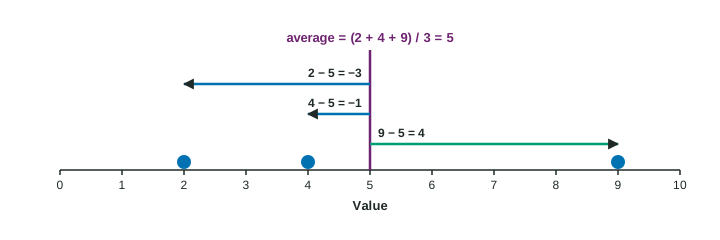
- Summation: says add every value; says subtract 5 from each value, square each result, then add.
- Show the work the way the exam asks: the formula, the numbers substituted, then the answer.
Part 6 · Misconception
A common mistake
The wrong idea: , because that is the average of 2, 4 and 9.
What actually happens: Without brackets only the 9 is divided: . The average is ; the fraction bar groups the whole top.
Part 7 · Check yourself
Check yourself
Exam-style questions. Anything you miss goes into your review queue.
1. Evaluate .
Type a number. A table answer and a calculator answer are both accepted.
Show the answer
The fraction bar acts like brackets: add the top first, , then divide, .
- Answer: 5
2. Evaluate . Give two decimal places.
Type a number. A table answer and a calculator answer are both accepted.
Show the answer
Inside first:
- Answer: 3.61
3. For the values , and , what is ?
- 150
- 18
- 6
- 3
Show the answer
tells you to add every : .
- 150: The summation sign adds; it does not multiply.
- Correct: 18: Right: the summation sign adds every value, .
- 6: Dividing by 3 gives the average; the sum itself is 18.
- 3: That is how many terms there are, not their sum.
4. Type an expression for the average of 12, 15, 18 and 21: add the values, then divide by how many there are.
Type the expression as on the exam, with the values substituted.
Show the answer
- Answer:
5. What is ?
- 9
- −9
- −6
- 6
Show the answer
A square is never negative: . On a calculator, type the brackets, or gives .
- Correct: 9: Right: ; a negative times a negative is positive.
- −9: That is . With the brackets, the whole is squared.
- −6: Squaring multiplies a number by itself, not by 2.
- 6: A square is a number times itself: .
6. Type an expression for the square root of the whole quantity 26 divided by 2.
Type the expression as on the exam, with the values substituted.
Show the answer
. The brackets of the root hold the whole fraction.
- Answer:
Part 8 · Summary
Summary
Part 9 · Up next
What comes next
Part 10 · Connections