Attribution Theory and Person Perception
Attribution theory describes how people explain behavior, by disposition or by situation.
Part 1 · Hook
Why this matters
Part 2 · Prerequisite check
Quick check before you start
1. A study finds that students who sleep more have higher grades. What can you conclude?
- Sleep and grades are related, but sleep may not cause higher grades
- More sleep causes higher grades
- Higher grades cause more sleep
- There is no relationship
Show the answer
A correlation shows a relationship but not its cause; a third variable could affect both.
- Correct: Sleep and grades are related, but sleep may not cause higher grades:
- More sleep causes higher grades:
- Higher grades cause more sleep:
- There is no relationship:
2. Which is an example of the availability heuristic?
- Thinking plane crashes are common after seeing news of one
- Solving a problem by trying every option
- Learning a maze without a reward
- Remembering the first item in a list best
Show the answer
Judging how likely something is by how easily examples come to mind is the availability heuristic, one of the mental shortcuts behind biased judgments.
- Correct: Thinking plane crashes are common after seeing news of one:
- Solving a problem by trying every option:
- Learning a maze without a reward:
- Remembering the first item in a list best:
Part 3 · See it
See it first
Part 4 · Step by step
How it works, step by step
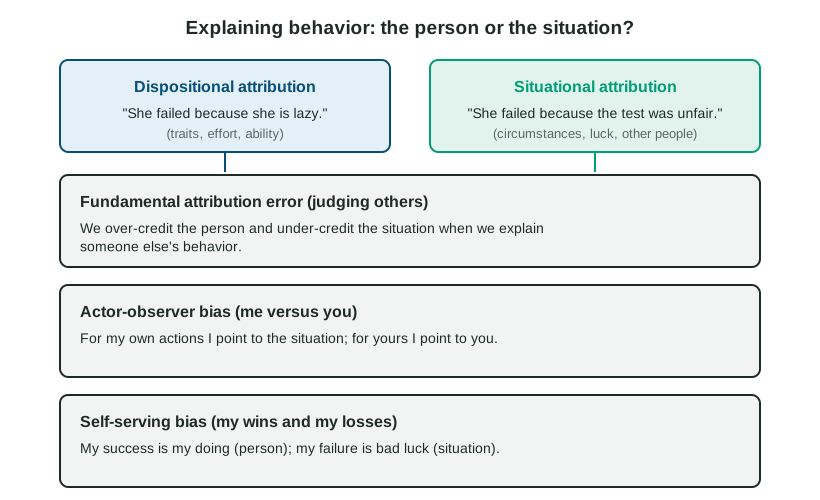
- We see someone act, but not the pressures on themtheir personality is the most visible explanation
- We explain others by personality and overlook the situationthe fundamental attribution error
- We know the pressures on ourselves but not on othersthe actor-observer bias: situation for me, disposition for you
- We want to feel good about ourselvesthe self-serving bias: credit for success, the situation for failure
Part 5 · Key ideas
Key ideas
- Dispositional attributions explain behavior by the person (traits, effort, ability); situational attributions explain it by circumstances (luck, other people, a hard test).
- Three biases: the fundamental attribution error (others: too much disposition), the actor-observer bias (situation for me, disposition for you), the self-serving bias (my wins are me, my losses are the situation).
- About yourself: locus of control is internal (my actions decide outcomes) or external (luck and others decide); explanatory style is optimistic (bad events are temporary and limited) or pessimistic (personal, lasting, everywhere).
- Person perception: the mere exposure effect, the self-fulfilling prophecy, upward and downward social comparison, and relative deprivation.
Part 6 · Misconception
A common mistake
The wrong idea: The fundamental attribution error and the actor-observer bias are the same thing.
What actually happens: The fundamental attribution error is about judging other people (too much personality). The actor-observer bias needs a contrast: the same kind of behavior explained by the situation when I do it and by personality when you do it.
Part 7 · Check yourself
Check yourself
Exam-style questions. Anything you miss goes into your review queue.
1. A driver cuts Elena off on the highway, and she mutters, "What a selfish jerk." She does not consider that he might be rushing to a hospital. Which concept best explains her judgment?
- Fundamental attribution error
- Self-serving bias
- Actor-observer bias
- Relative deprivation
Show the answer
Judging another person by disposition while overlooking the situation is the fundamental attribution error.
- Correct: Fundamental attribution error: Right: she explains another person's behavior by his character and underweights the situation.
- Self-serving bias: The self-serving bias is about explaining your own successes and failures, not a stranger's behavior.
- Actor-observer bias: The actor-observer bias contrasts how you explain your own behavior with someone else's. Only his behavior is judged here.
- Relative deprivation: Relative deprivation is feeling worse off than a comparison group. It does not explain a judgment about a driver.
2. When Theo is late to class he says the bus broke down. When his classmate Ana is late, Theo decides she just does not care about school. Which concept explains the difference?
- Actor-observer bias
- Self-fulfilling prophecy
- Mere exposure effect
- Downward social comparison
Show the answer
The same behavior (being late) is explained by the situation for himself and by disposition for Ana: the actor-observer bias.
- Correct: Actor-observer bias: Right: as the actor he points to the situation; as the observer he points to Ana's disposition.
- Self-fulfilling prophecy: A self-fulfilling prophecy is an expectation that causes itself to come true. No expectation is changing anyone's behavior here.
- Mere exposure effect: The mere exposure effect is liking something more after repeated exposure.
- Downward social comparison: Downward comparison is comparing yourself with someone worse off to feel better. Theo is explaining causes.
3. After acing a test, Jade says, "I studied hard and I'm good at this." After failing the next one, she says, "The questions were unfair." Which concept explains her pattern?
- Self-serving bias
- Fundamental attribution error
- External locus of control
- Belief in a just world
Show the answer
Taking credit for successes (dispositional) and blaming failures on circumstances (situational) protects self-image: the self-serving bias.
- Correct: Self-serving bias: Right: she credits herself for success and the situation for failure.
- Fundamental attribution error: The fundamental attribution error concerns judging other people's behavior, not her own results.
- External locus of control: An external locus means believing outcomes are generally out of your control. Jade credits herself for her success.
- Belief in a just world: That is the belief that people get what they deserve, a different idea.
Study
Invented study: why did a classmate fail?
Introduction
Researchers asked whether people explain a failure differently when it is their own than when it is a classmate's.
Participants
64 high school juniors (ages 16 and 17) at one school in Oregon took part with a parent's consent and their own assent.
Method
Students were randomly assigned to two groups of 32. In the self group, each student recalled a time they failed a test and rated the cause. In the classmate group, each student read a description of a classmate who failed a test and rated the cause. Both groups used two 1-to-7 scales: how much the failure was due to the person (effort, ability), and how much it was due to the situation (a hard test, little time, a bad day).
Results
On the person scale, the classmate group's mean was 5.4 and the self group's was 3.1. On the situation scale, the classmate group's mean was 3.0 and the self group's was 5.2.
Invented study for practice.
4. Which concept do the results most directly show?
- Actor-observer bias
- Self-fulfilling prophecy
- Mere exposure effect
- Upward social comparison
Show the answer
The same outcome (failing a test) got situational explanations from actors and dispositional ones from observers: the actor-observer bias.
- Correct: Actor-observer bias: Right: students blamed the situation for their own failure and the person for a classmate's.
- Self-fulfilling prophecy: No expectation changed anyone's behavior here; students only rated causes.
- Mere exposure effect: Mere exposure is about liking familiar things.
- Upward social comparison: Students did not compare themselves with someone doing better.
5. Why can this study support a cause-and-effect conclusion about the role of whose failure it was?
- Students were randomly assigned to the self or classmate group
- The students came from one school in Oregon
- Each student gave assent
- The ratings were on 1-to-7 scales
Show the answer
Random assignment to conditions is what lets an experiment support a causal claim.
- Correct: Students were randomly assigned to the self or classmate group: Right: random assignment makes the groups similar at the start, so the difference is likely due to the condition.
- The students came from one school in Oregon: One school limits who the results apply to; it does not create a causal comparison.
- Each student gave assent: Assent is an ethical safeguard, not a reason a causal claim is justified.
- The ratings were on 1-to-7 scales: The scale is a measurement choice; it does not allow a causal claim by itself.
Data
Invented data: locus of control and hours studied
6. What relationship does the scatterplot show?
- A positive correlation: more internal scores go with more hours studied
- A negative correlation: more internal scores go with fewer hours
- No relationship between the two variables
- Proof that an internal locus causes more studying
Show the answer
Higher locus of control scores (more internal) go with more hours studied: a positive correlation.
- Correct: A positive correlation: more internal scores go with more hours studied: Right: the points rise from left to right.
- A negative correlation: more internal scores go with fewer hours: A negative correlation would slope down. These points slope up.
- No relationship between the two variables: The points follow a clear upward trend.
- Proof that an internal locus causes more studying: A correlation alone cannot show cause.
Part 8 · Summary
Summary
Part 9 · Up next
What comes next
Part 10 · Connections