Work
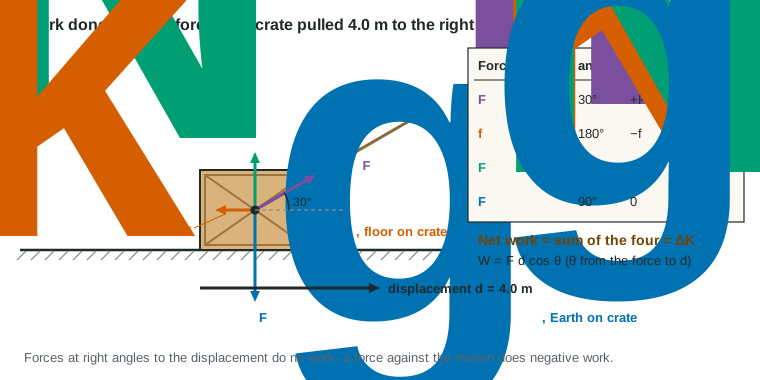
Work is W = F d cos θ: energy carried into an object (positive) or out of it (negative) by a force along a displacement.
Part 1 · Hook
Why this matters
Part 2 · Before you start
What this builds on
Part 3 · Prerequisite check
Quick check before you start
1. Kinetic energy is
- ½mv²
- mv
- mv²
- ½mv
Show the answer
K = ½mv², with the speed squared.
- Correct: ½mv²:
- mv:
- mv²:
- ½mv:
2. In a right triangle, the side next to angle θ equals the hypotenuse times
- cos θ
- sin θ
- tan θ
- 1/cos θ
Show the answer
Adjacent = hypotenuse × cos θ.
- Correct: cos θ:
- sin θ:
- tan θ:
- 1/cos θ:
3. Kinetic friction on a sliding crate points
- opposite the crate's sliding
- along the crate's sliding
- straight down
- perpendicular to the floor
Show the answer
Kinetic friction opposes the sliding of the surfaces.
- Correct: opposite the crate's sliding:
- along the crate's sliding:
- straight down:
- perpendicular to the floor:
Part 4 · See it
See it first
Part 5 · Step by step
How it works, step by step
- A force acts on an object while the object movesthe force does work W = F d cos θ, using only the component along the displacement
- The force has a component along the motionthe work is positive and energy enters the object
- The force opposes the motion (like kinetic friction)the work is negative and energy leaves the object
- The force is perpendicular to the motionit does no work and does not change the speed
- All the works on an object are addedthe net work equals the change in kinetic energy: W_net = ΔK
Part 6 · Key ideas
Key ideas
- Work is energy moved into or out of a system by a force acting along a displacement: W = F d cos θ, with θ between the force and the displacement. It is a scalar, in joules.
- Positive work adds energy, negative work removes it, and a force perpendicular to the motion does none.
- The work-energy theorem: the net work done on an object equals its change in kinetic energy, W_net = ΔK.
- Work by a varying force is the area under its force-position graph.
- Kinetic friction does negative work that grows with the path length, even on a round trip.
Part 7 · Misconception
A common mistake
The wrong idea: Gravity does work on a crate dragged across a level floor, because gravity acts on it the whole time.
What actually happens: A force does work only through its component along the displacement. Gravity is vertical and the motion is horizontal, so gravity does zero work here.
Part 8 · Check yourself
Check yourself
Exam-style questions. Anything you miss goes into your review queue.
Diagram
A crate pulled across a rough floor
The crate starts from rest. Use g = 9.8 m/s².
1. How much work does the rope do on the crate over the 4.00 m? Give the value and its unit.
Type a number and its unit.
Show the answer
W = F_T d cos θ = (45.0 N)(4.00 m)(cos 30°) = 156 J. The angle is between the force and the displacement.
- Answer: 156 J
2. How much work does kinetic friction do on the crate over the 4.00 m, in joules? Include the sign.
Type a number in J.
Show the answer
Friction points opposite the displacement (θ = 180°), so W = f_k d cos 180° = −(28.0 N)(4.00 m) = −112 J.
- Answer: -112 J
3. How much work do the normal force and the gravitational force do on the crate over the 4.00 m?
- Zero each: each is perpendicular to the displacement
- +696 J by the normal force and −784 J by gravity
- Zero by the normal force, −784 J by gravity
- Both positive, since both act on the crate while it moves
Show the answer
Both forces are vertical and the crate moves horizontally, so θ = 90° and W = Fd cos 90° = 0 for each.
- Correct: Zero each: each is perpendicular to the displacement: Right: cos 90° = 0, so a force at right angles to the motion does no work.
- +696 J by the normal force and −784 J by gravity: These multiply each force by 4.00 m as if it pointed along the motion. Both are vertical; the motion is horizontal.
- Zero by the normal force, −784 J by gravity: Gravity is also perpendicular to the horizontal displacement, so it does no work here.
- Both positive, since both act on the crate while it moves: A force does work only through its component along the displacement. Both of these have none.
4. What is the net work done on the crate over the 4.00 m, in joules?
Type a number in J.
Show the answer
W_net = 155.9 J + (−112 J) + 0 + 0 = 43.9 J. By the work-energy theorem this is also the crate's change in kinetic energy.
- Answer: 43.9 J
5. A 0.17 kg puck slides at 6.0 m/s onto rough ice, where a 0.50 N friction force slows it. How far does it slide before stopping, in meters?
Type a number in m.
Show the answer
Friction does all the work: −f d = 0 − ½mv², so d = mv²/(2f) = (0.17 kg)(6.0 m/s)²/(2 × 0.50 N) = 6.1 m.
- Answer: 6.1 m
6. Take a sled as the system. A rope outside the system pulls it forward and does +40 J of work on it. What does this tell you?
- 40 J of energy left the sled
- 40 J of energy entered the sled
- The sled's speed is certain to increase
- The rope gained 40 J
Show the answer
Work by an external force is energy crossing the system boundary: +40 J means 40 J entered the sled. Whether the sled speeds up depends on the net work of all the forces.
- 40 J of energy left the sled: Positive work brings energy in; negative work takes it out.
- Correct: 40 J of energy entered the sled: Right: positive work by an external force is an energy transfer into the system.
- The sled's speed is certain to increase: The net work decides the change in speed. Other forces, such as friction, may do negative work.
- The rope gained 40 J: The rope gave energy to the sled; it did not gain it.
Part 9 · Summary
Summary
Part 10 · Up next
What comes next
Part 11 · Connections