Spring Forces
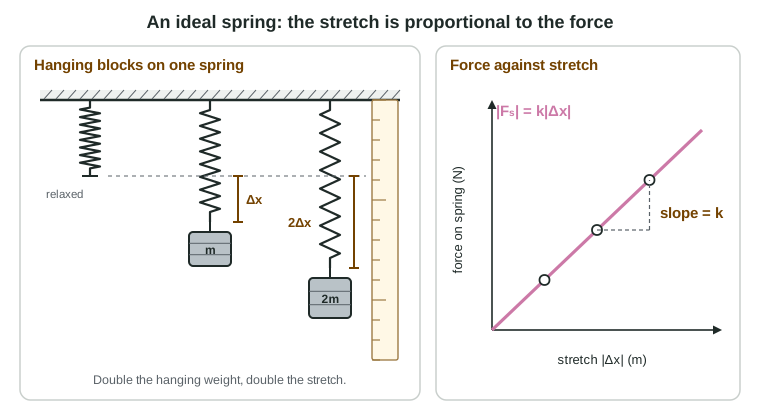
An ideal spring exerts a force proportional to its stretch or compression from its relaxed length, F_s = −kΔx, always back toward the relaxed length; the spring constant k (N/m) is the slope of force against stretch, and a hanging mass at rest stretches it by mg/k.
Part 1 · Hook
Why this matters
Part 2 · Before you start
What this builds on
Part 3 · Prerequisite check
Quick check before you start
1. If y is directly proportional to x and x triples, y
- triples
- stays the same
- is divided by 3
- is multiplied by 9
Show the answer
Direct proportion: same factor of change.
- Correct: triples:
- stays the same:
- is divided by 3:
- is multiplied by 9:
2. A block hangs at rest from a cord. The cord's pull on it is
- equal to its weight
- larger than its weight
- smaller than its weight
- zero
Show the answer
At rest, the net force is zero.
- Correct: equal to its weight:
- larger than its weight:
- smaller than its weight:
- zero:
Part 4 · See it
See it first
Part 5 · Step by step
How it works, step by step
- A spring is stretched or compressed by Δx from its relaxed lengthit exerts a force on whatever is attached to it, toward its relaxed length
- The spring is ideal (massless, within its limit)the force is proportional to the displacement: |F_s| = k|Δx|
- The spring constant k is largerthe spring is stiffer: more force for the same stretch, less stretch for the same force
- A mass hangs at rest on the springkΔx = mg, so measuring the stretch measures the weight (a spring scale)
Part 6 · Key ideas
Key ideas
- Hooke's law: Fs = −kΔx. Δx is the displacement of the spring's end from its relaxed length; the minus sign means the force points back toward the relaxed length.
- A stretched spring pulls; a compressed spring pushes. The spring constant k, in N/m, measures stiffness.
- An ideal spring is massless and obeys Hooke's law, so it pulls equally on whatever is at each end.
- A graph of |Fs| against |Δx| is a straight line through the origin with slope k.
Part 7 · Misconception
A common mistake
The wrong idea: Δx in Hooke's law is the length of the spring.
What actually happens: Δx is how far the spring is stretched or compressed from its relaxed length. A 30 cm spring stretched to 34 cm has Δx = 0.04 m.
Part 8 · Check yourself
Check yourself
Exam-style questions. Anything you miss goes into your review queue.
Data table
Stretching a spring with hanging masses
A student hangs a light spring from a clamp and hangs slotted masses from its lower end. For each mass, once the mass hangs at rest, she measures how far the spring has stretched from its relaxed length with a meterstick. Use g = 9.8 m/s².
| Hanging mass (kg) | Stretch (m) |
|---|---|
| 0.050 | 0.020 |
| 0.100 | 0.040 |
| 0.150 | 0.061 |
| 0.200 | 0.080 |
| 0.250 | 0.100 |
1. When the 0.150 kg mass hangs at rest, how does the spring's upward force on it compare with its weight?
- They are equal in size
- The spring force is larger, since the spring is stretched
- The spring force is smaller, since part of the weight stretches it
- The spring force is zero, since the mass is at rest
Show the answer
The mass hangs at rest, so the net force on it is zero: the spring pulls up exactly as hard as Earth pulls down. That is why the spring force equals mg in this experiment.
- Correct: They are equal in size: Right: translational equilibrium.
- The spring force is larger, since the spring is stretched: A stretched spring pulls, but at rest it pulls with exactly mg; a larger pull would accelerate the mass upward.
- The spring force is smaller, since part of the weight stretches it: The whole weight is balanced by the spring's pull; nothing is left over.
- The spring force is zero, since the mass is at rest: At rest the spring must still hold the mass up; otherwise the mass would fall.
2. A graph of the spring force (the weight of the hanging mass) against the stretch is close to a straight line through the origin. Use the first and last rows to find its slope, the spring constant, in N/m.
Type a number in N/m.
Show the answer
Spring force = mg: 0.050 × 9.8 = 0.49 N and 0.250 × 9.8 = 2.45 N. Slope k = ΔF ÷ Δx = (2.45 − 0.49) N ÷ (0.100 − 0.020) m = 1.96 N ÷ 0.080 m = 25 N/m (24.5).
- Answer: 25 N/m
3. Using the pattern in the table, how far would the spring stretch with a 0.400 kg mass hanging at rest, in meters?
Type a number in m.
Show the answer
The stretch is proportional to the force: 0.400 kg is twice 0.200 kg, so the stretch is twice 0.080 m = 0.16 m. With k: Δx = mg ÷ k = 3.92 N ÷ 24.5 N/m = 0.16 m.
- Answer: 0.16 m
Diagram
A cart held against a compressed spring
A 0.50 kg cart on a level, frictionless track is attached to an ideal spring of spring constant 80 N/m whose other end is fixed to a wall. A student pushes the cart toward the wall, compressing the spring by 0.15 m, and holds it at rest. Take the direction away from the wall as positive.
4. What is the spring force on the cart while the student holds it, including its sign (positive away from the wall), in newtons?
Type a number in N.
Show the answer
Hooke's law: F_s = −kΔx. The spring is compressed, so its end is displaced toward the wall: Δx = −0.15 m. F_s = −(80 N/m)(−0.15 m) = +12 N, away from the wall. A compressed spring pushes outward.
- Answer: 12 N
5. What force does the student exert on the cart while holding it at rest?
- 12 N toward the wall
- 12 N away from the wall
- 24 N toward the wall
- No force, since the cart is at rest
Show the answer
The cart is at rest, so the student's push balances the spring's 12 N push away from the wall: 12 N toward the wall.
- Correct: 12 N toward the wall: Right: equal and opposite to the spring force, on the same cart.
- 12 N away from the wall: Away from the wall is the spring's push; the student must push the other way.
- 24 N toward the wall: Only the spring's 12 N needs balancing.
- No force, since the cart is at rest: At rest means zero net force, but the spring still pushes, so the student must push back.
6. The student lets go. What is the size of the cart's acceleration just after release, in m/s²?
Type a number in m/s^2.
Show the answer
Just after release the only horizontal force is the spring's 12 N: a = F ÷ m = 12 N ÷ 0.50 kg = 24 m/s², away from the wall.
- Answer: 24 m/s^2
Part 9 · Summary
Summary
Part 10 · Up next
What comes next
Part 11 · Connections