Representing and Analyzing SHM
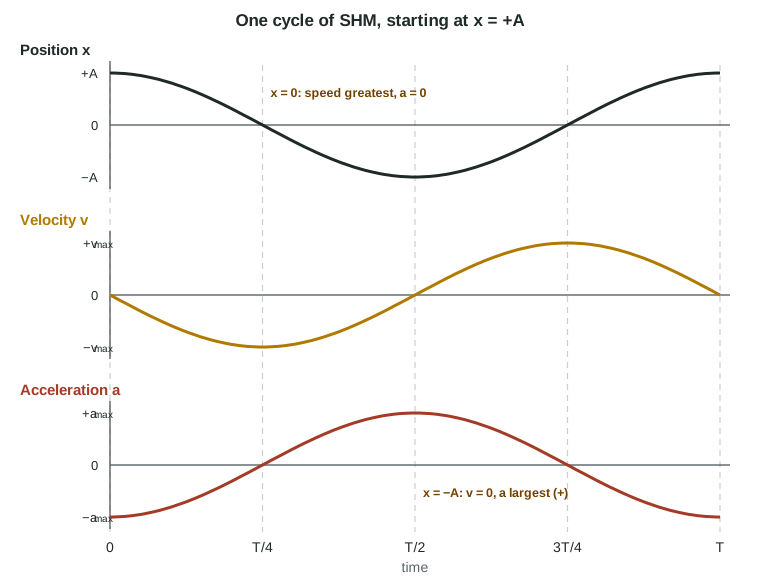
SHM is described by x = A cos(2πft) or A sin(2πft); on the graphs, speed is greatest and acceleration zero at equilibrium, speed zero and acceleration greatest at the turning points, and the period is independent of the amplitude.
Part 1 · Hook
Why this matters
Part 2 · Before you start
What this builds on
Part 3 · Prerequisite check
Quick check before you start
1. On a position-time graph, the slope gives
- the velocity
- the acceleration
- the displacement
- the distance traveled
Show the answer
Velocity is the rate of change of position, the slope of x against t.
- Correct: the velocity:
- the acceleration:
- the displacement:
- the distance traveled:
2. What is cos 0?
- 1
- 0
- −1
- 0.5
Show the answer
cos 0 = 1 and sin 0 = 0.
- Correct: 1:
- 0:
- −1:
- 0.5:
3. A block on a spring is pulled twice as far. Its period
- stays the same
- doubles
- halves
- grows by √2
Show the answer
T = 2π√(m/k) has no amplitude in it.
- Correct: stays the same:
- doubles:
- halves:
- grows by √2:
Part 4 · See it
See it first
Part 5 · Step by step
How it works, step by step
- A restoring force F = −kx acts on the objectits acceleration is always opposite to its displacement, so the a-t graph is the x-t graph flipped
- The object turns around at x = ±Aits velocity is zero there: the x-t graph is flat at its peaks and troughs
- The object passes x = 0 with no force to slow it yetits speed is greatest there: the x-t graph is steepest where it crosses zero
- Doubling the amplitude doubles the force and the speed at each matching pointthe cycle takes the same time: the period does not depend on the amplitude
Part 6 · Key ideas
Key ideas
- Position in SHM is x = A cos(2πft) if the object starts at +A, or x = A sin(2πft) if it starts at equilibrium moving in +x. Use radians.
- On an x-t graph: the height of a peak is A; the time from peak to peak is T; the slope is the velocity.
- Speed is greatest at x = 0 and zero at x = ±A. Acceleration is zero at x = 0 and largest at x = ±A, always pointing toward equilibrium.
- The period does not depend on the amplitude: a bigger swing has more distance to cover and covers it faster.
Part 7 · Misconception
A common mistake
The wrong idea: The object moves fastest at the turning points, because that is where the force on it is largest.
What actually happens: A large force means a large acceleration, not a large speed. At the turning points the object is momentarily at rest; it is fastest at equilibrium, where the force is zero.
Part 8 · Check yourself
Check yourself
Exam-style questions. Anything you miss goes into your review queue.
Graph
Position of a cart on a spring
A motion detector records the position of a cart oscillating on a horizontal spring on a frictionless track. Position is measured from equilibrium; + is to the right.
Data table
| Time (s) | Cart |
|---|---|
| 0 | 0.15 |
| 0.05 | 0.139 |
| 0.1 | 0.106 |
| 0.15 | 0.057 |
| 0.2 | 0 |
| 0.25 | -0.057 |
| 0.3 | -0.106 |
| 0.35 | -0.139 |
| 0.4 | -0.15 |
| 0.45 | -0.139 |
| 0.5 | -0.106 |
| 0.55 | -0.057 |
| 0.6 | 0 |
| 0.65 | 0.057 |
| 0.7 | 0.106 |
| 0.75 | 0.139 |
| 0.8 | 0.15 |
| 0.85 | 0.139 |
| 0.9 | 0.106 |
| 0.95 | 0.057 |
| 1 | 0 |
| 1.05 | -0.057 |
| 1.1 | -0.106 |
| 1.15 | -0.139 |
| 1.2 | -0.15 |
| 1.25 | -0.139 |
| 1.3 | -0.106 |
| 1.35 | -0.057 |
| 1.4 | 0 |
| 1.45 | 0.057 |
| 1.5 | 0.106 |
| 1.55 | 0.139 |
| 1.6 | 0.15 |
1. What is the period of the cart's motion? Give the value and its unit.
Type a number and its unit.
Show the answer
The cart is at +0.15 m at t = 0 and next at t = 0.80 s, so T = 0.80 s. Half a period (0.40 s) only takes it to the other side.
- Answer: 0.80 s
2. At which time is the cart moving fastest?
- t = 0.20 s
- t = 0.40 s
- t = 0.80 s
- t = 0.30 s
Show the answer
Speed is the steepness of the position-time graph. The graph is steepest where it crosses x = 0, at t = 0.20 s (and 0.60 s, 1.00 s...). The cart passes equilibrium at top speed.
- Correct: t = 0.20 s: Right: the slope is steepest where x = 0.
- t = 0.40 s: At 0.40 s the cart is at −0.15 m, a turning point: the slope is zero and the cart is momentarily at rest.
- t = 0.80 s: At 0.80 s the cart is back at +0.15 m, a turning point with zero speed.
- t = 0.30 s: At 0.30 s the cart is between equilibrium and a turning point; it is still moving, but slower than at 0.20 s.
3. What are the directions of the cart's velocity and acceleration at t = 0.50 s?
- Velocity +, acceleration +
- Velocity −, acceleration +
- Velocity +, acceleration −
- Velocity −, acceleration −
Show the answer
At 0.50 s the cart is below zero (x < 0) and the graph is rising, so v is +. The acceleration always points toward equilibrium, opposite to x; x is negative, so a is +.
- Correct: Velocity +, acceleration +: Right: x < 0 and rising, so v > 0 and a = −(k/m)x > 0.
- Velocity −, acceleration +: The graph is rising at 0.50 s (it left −0.15 m at 0.40 s), so the velocity is positive.
- Velocity +, acceleration −: Acceleration is opposite to the displacement; with x negative, a is positive.
- Velocity −, acceleration −: Both signs are off: the graph is rising at 0.50 s (v > 0), and with x below zero the acceleration points toward equilibrium (a > 0).
4. The cart is stopped and released again from x = +0.075 m. Which graph feature changes, compared with the graph shown?
- The peaks are half as high, and the time between them is unchanged
- The peaks are half as high, and the time between them is halved
- The peaks are the same height, and the time between them is halved
- The peaks are half as high, and the time between them is doubled
Show the answer
Releasing from 0.075 m makes the amplitude 0.075 m, half of 0.15 m. The period T = 2π√(m/k) does not depend on the amplitude, so the peaks stay 0.80 s apart.
- Correct: The peaks are half as high, and the time between them is unchanged: Right: smaller amplitude, same period.
- The peaks are half as high, and the time between them is halved: A smaller amplitude does not shorten the period: less distance, but proportionally less force and speed.
- The peaks are the same height, and the time between them is halved: The release point sets the amplitude, so the peaks must be lower.
- The peaks are half as high, and the time between them is doubled: The period depends on m and k only; amplitude does not lengthen it.
5. Two identical blocks on identical springs are released from rest at the same moment, block 1 from 3.0 cm and block 2 from 6.0 cm. Which block returns to its release point first?
- They return at the same time
- Block 1, because it has a shorter distance to travel
- Block 2, because it is pulled back by a larger force
- Block 1, because its smaller force means less acceleration
Show the answer
The period T = 2π√(m/k) is the same for both: block 2 travels twice as far but feels twice the force at each matching point, so it moves twice as fast. The two effects cancel.
- Correct: They return at the same time: Right: the period does not depend on the amplitude.
- Block 1, because it has a shorter distance to travel: Block 1 does travel less distance, but it also moves more slowly; the times match.
- Block 2, because it is pulled back by a larger force: Block 2 does feel a larger force, but it also has farther to go; the times match.
- Block 1, because its smaller force means less acceleration: Less acceleration slows block 1 down, which works against it, not for it; the times still match.
6. A block on a spring is released from rest at x = +A at t = 0. Which equation describes its position?
- x = A cos(2πft)
- x = A sin(2πft)
- x = −A cos(2πft)
- x = A sin(2πft) + A
Show the answer
At t = 0 the block must be at +A: cos 0 = 1 gives x = A. Both sine and cosine describe SHM; the starting point decides which one fits.
- Correct: x = A cos(2πft): Right: cosine starts at its largest value.
- x = A sin(2πft): This starts at x = 0, which fits a block that starts at equilibrium.
- x = −A cos(2πft): This starts at x = −A, the other turning point.
- x = A sin(2πft) + A: This oscillates between 0 and 2A, so its center is not the equilibrium position.
Part 9 · Summary
Summary
Part 10 · Up next
What comes next
Part 11 · Connections