Unit 3 gave you a powerful shortcut: follow the energy instead of the forces. An oscillator is a perfect place to use it, because the energy moves back and forth between two forms in a fixed total. This page shows how to find speeds, amplitudes and energy shares from that one idea, and how to draw the energy graphs and bar charts the exam asks for.
Name the system, state the condition
Take a block on a horizontal spring sliding on a frictionless surface. Choose the system to be the block and the spring. The spring force is internal and conservative, gravity and the normal force do no work on horizontal motion, and there is no friction. So no energy enters or leaves the system as work, and its mechanical energy is constant:
E = K + Us = ½mv² + ½kx² = constant
Always write the condition with the claim ("no friction, so the mechanical energy of the block-spring system is constant"). A bare "energy is conserved" earns no credit on a justification.
The total is set by the amplitude
At a turning point, x = ±A, the block is momentarily at rest, so K = 0 and every joule is in the spring:
E = ½kA²
At equilibrium, x = 0, the spring is relaxed, so Us = 0 and every joule is kinetic: ½mvmax² = ½kA². In between, the energy is shared, but the total does not change.
Two consequences are tested often. First, the energy goes as the amplitude squared: double A and the total energy is four times as large. Second, kinetic energy is never negative, so its smallest value is zero, reached at the turning points.
Worked example 1. A 0.40 kg block on a spring with k = 100 N/m is released from rest at x = 0.10 m on a frictionless surface. Find its top speed.
System: block and spring. No friction, so the mechanical energy is constant.
At release: E = ½kA² = ½(100 N/m)(0.10 m)² = 0.50 J.
At x = 0: ½mv² = 0.50 J, so v = √(2 × 0.50 J / 0.40 kg) = √2.5 m/s = 1.6 m/s.
Energy against position
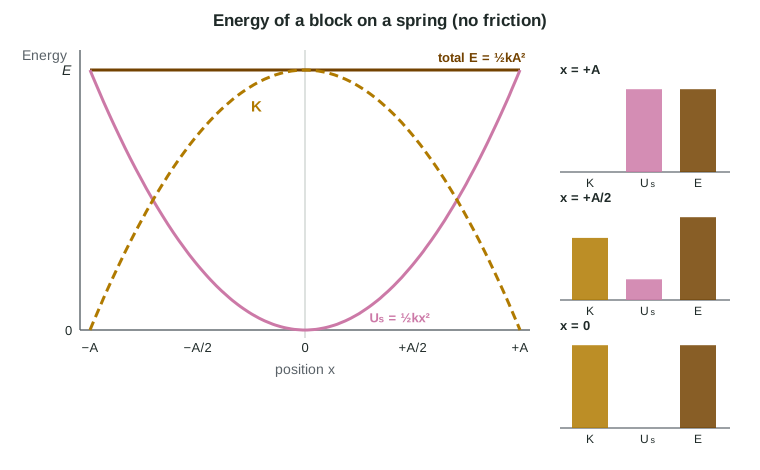
Plot energy against the block's position (not time) and you get the figure:
- Us = ½kx² is a parabola, zero at x = 0 and equal to E at x = ±A.
- K = E − ½kx² is the same parabola turned upside down, largest at x = 0 and zero at x = ±A.
- The total E is a horizontal line. Readers report students drawing a sloped or curved total; with no friction it cannot change.
Because Us goes as x², the energy split is not linear in position. At x = A/2 the spring holds (½)² = ¼ of the energy and the block has ¾. The energy is split evenly only at x = A/√2 ≈ 0.71A.
Worked example 2. For the block in worked example 1, find its speed at x = 0.050 m.
Us = ½(100 N/m)(0.050 m)² = 0.125 J.
K = E − Us = 0.50 J − 0.125 J = 0.375 J.
v = √(2 × 0.375 J / 0.40 kg) = √1.875 m/s = 1.4 m/s, about 87% of the top speed at half the amplitude.
Energy bar charts
An energy bar chart shows each kind of energy as a bar at one instant. For a block on a spring the bars are K and Us, and they must add to the same total at every position. At x = A: no K bar, full Us bar. At x = 0: full K bar, no Us bar. At x = A/2: a Us bar one quarter of the total and a K bar three quarters. Free-response questions ask you to draw these and then write an equation with one term for each nonzero bar.
The pendulum
For a pendulum, choose the bob and Earth as the system. The string pulls at right angles to the bob's motion, so it does no work, and with negligible air resistance the mechanical energy is constant. The energy trades between gravitational potential energy and kinetic energy. If the bob is released from rest a height Δy above its lowest point,
mgΔy = ½mv² so v = √(2gΔy)
at the bottom. The mass cancels, as it did in the pendulum's period. The highest points of the swing are the turning points (K = 0); the lowest point is the equilibrium position (largest K).
We use g = 9.8 m/s² here; the exam accepts 10 m/s² as long as you use one value consistently.