Rotational Kinematics
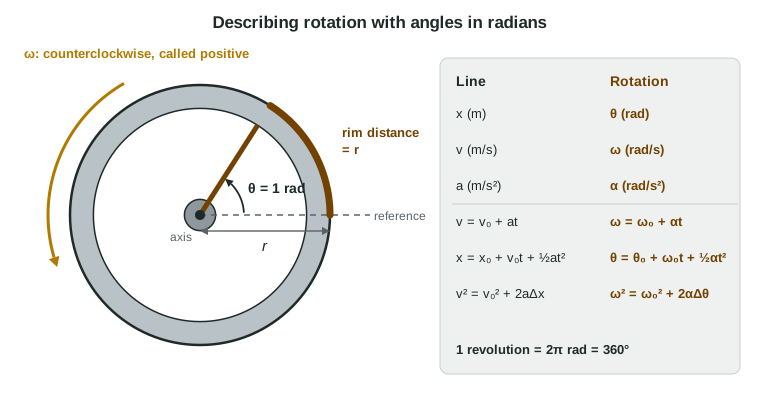
Rotation about a fixed axis is described by the angle θ in radians, the angular velocity ω = Δθ/Δt and the angular acceleration α = Δω/Δt, each with a sign for clockwise or counterclockwise.
Part 1 · Hook
Why this matters
Part 2 · Before you start
What this builds on
Part 3 · Prerequisite check
Quick check before you start
1. A cart starts from rest with a = 4.0 m/s². How far does it go in 3.0 s?
- 18 m
- 12 m
- 36 m
- 6.0 m
Show the answer
x = v₀t + ½at² = 0 + ½(4.0)(3.0)² = 18 m.
- Correct: 18 m:
- 12 m:
- 36 m:
- 6.0 m:
2. On a velocity-time graph, the area under the line gives
- the displacement
- the acceleration
- the velocity
- the time
Show the answer
Area = velocity × time = displacement; the slope is the acceleration.
- Correct: the displacement:
- the acceleration:
- the velocity:
- the time:
3. An object goes around a circle once every 2.0 s. Its frequency is
- 0.50 Hz
- 2.0 Hz
- 3.1 Hz
- 12.6 Hz
Show the answer
f = 1/T = 1/(2.0 s) = 0.50 revolutions per second.
- Correct: 0.50 Hz:
- 2.0 Hz:
- 3.1 Hz:
- 12.6 Hz:
Part 4 · See it
See it first
Part 5 · Step by step
How it works, step by step
- Every point of a rigid wheel turns together about the axisone angle θ describes the whole wheel
- The angle changes over a time intervalthe wheel has an angular velocity ω = Δθ/Δt, in rad/s
- The angular velocity changes over a time intervalthe wheel has an angular acceleration α = Δω/Δt, in rad/s²
- α is constantthe three kinematic equations hold with θ, ω, α in place of x, v, a
- α has the same sign as ω (or the opposite sign)the wheel speeds up (or slows down)
Part 6 · Key ideas
Key ideas
- Measure angles in radians: θ = (distance along the circle) ÷ r. One revolution = 2π rad = 360°.
- Pick a positive direction, usually counterclockwise. Then θ, ω and α carry signs exactly as x, v and a do on a line.
- A rigid system turns as one piece: every point shares the same θ, ω and α.
- Constant α: ω = ω₀ + αt; θ = θ₀ + ω₀t + ½αt²; ω² = ω₀² + 2αΔθ.
- On an ω-t graph the slope is α and the area is Δθ.
Part 7 · Misconception
A common mistake
The wrong idea: A point near the rim of a turning wheel has a larger angular velocity than a point near the axle, because it moves faster.
What actually happens: Both points turn through the same angle in the same time, so they share one ω. The point near the rim covers more distance, which is a separate quantity (its speed, next topic).
Part 8 · Check yourself
Check yourself
Exam-style questions. Anything you miss goes into your review queue.
Diagram
A potter’s wheel speeding up
1. What is the wheel’s angular velocity at the end of the 3.0 s?
Type a number in rad/s.
Show the answer
From rest, ω = ω₀ + αt = 0 + (2.0 rad/s²)(3.0 s) = 6.0 rad/s.
- Answer: 6.0 rad/s
2. Through what angle, in radians, does the chalk mark turn during the 3.0 s?
Type a number in rad.
Show the answer
θ = ω₀t + ½αt² = 0 + ½(2.0 rad/s²)(3.0 s)² = 9.0 rad.
- Answer: 9.0 rad
3. A second chalk mark is drawn halfway between the first mark and the axle. During the same 3.0 s, its angular displacement is
- the same as the first mark’s
- half the first mark’s
- twice the first mark’s
- one quarter of the first mark’s
Show the answer
The wheel is a rigid system: every point on it turns through the same angle in the same time, so both marks have the same angular displacement (9.0 rad), the same ω and the same α.
- Correct: the same as the first mark’s: Right: a rigid wheel turns as one piece, so every mark turns through the same angle.
- half the first mark’s: Halving the distance from the axle changes how far the mark travels, not the angle it turns through.
- twice the first mark’s: Being closer to the axle does not make a mark turn through more angle; the wheel turns as one piece.
- one quarter of the first mark’s: No square law applies here: every mark on a rigid wheel turns through the same angle.
Graph
A ceiling fan switched on, then off
A sensor records the angular velocity of a ceiling fan, counterclockwise positive, as it is switched on, runs, and is switched off.
Data table
| Time (s) | ω |
|---|---|
| 0 | 0 |
| 4 | 12 |
| 10 | 12 |
| 16 | 0 |
| 18 | 0 |
4. What is the fan’s angular acceleration from 0 to 4.0 s?
Type a number in rad/s^2.
Show the answer
α = Δω/Δt = (12.0 rad/s − 0)/(4.0 s) = 3.0 rad/s², the slope of the graph.
- Answer: 3.0 rad/s^2
5. Through what angle does the fan turn from 0 to 16.0 s?
Type a number in rad.
Show the answer
The angle is the area under the ω-t graph: ½(4.0 s)(12.0 rad/s) + (6.0 s)(12.0 rad/s) + ½(6.0 s)(12.0 rad/s) = 24 + 72 + 36 = 132 rad.
- Answer: 132 rad
6. Which describes the fan from 10.0 s to 16.0 s, with counterclockwise positive?
- Turning counterclockwise and slowing down
- Turning clockwise and speeding up
- Turning counterclockwise and speeding up
- At rest, since α is negative
Show the answer
ω is positive (counterclockwise) but decreasing toward zero, so the angular acceleration is negative, opposite to ω: the fan slows down until it stops at 16.0 s.
- Correct: Turning counterclockwise and slowing down: Right: ω stays positive while its size falls, so α is negative.
- Turning clockwise and speeding up: ω is still positive in this interval, so the fan has not reversed.
- Turning counterclockwise and speeding up: ω is getting smaller, so the fan is slowing down.
- At rest, since α is negative: A negative α means ω is decreasing, not that the fan has stopped; it stops at 16.0 s.
7. Counterclockwise is positive. A wheel has a negative angular velocity and a positive angular acceleration. What is it doing?
- Turning clockwise and slowing down
- Turning clockwise and speeding up
- Turning counterclockwise and slowing down
- Turning counterclockwise and speeding up
Show the answer
The sign of ω gives the direction of turning (negative: clockwise). When α has the opposite sign, ω moves toward zero, so the wheel slows, just as a car with v and a of opposite signs slows.
- Correct: Turning clockwise and slowing down: Right: ω and α have opposite signs, so the size of ω is shrinking.
- Turning clockwise and speeding up: Speeding up needs α with the same sign as ω.
- Turning counterclockwise and slowing down: A negative ω means clockwise turning.
- Turning counterclockwise and speeding up: The sign of ω, not α, gives the direction of turning.
8. A rigid wheel turns about a fixed axle. Which statement is true for the points on the wheel?
- Each point turns through the same angle in a given time
- Points farther from the axle turn through larger angles
- Each point moves the same distance in a given time
- Points near the axle have a larger angular velocity
Show the answer
A rigid system keeps its shape, so every point turns through the same angle in the same time: one θ, one ω and one α describe the whole wheel.
- Correct: Each point turns through the same angle in a given time: Right: that is what it means for the wheel to be a rigid system.
- Points farther from the axle turn through larger angles: Points farther out travel farther, but they turn through the same angle.
- Each point moves the same distance in a given time: Points farther from the axle trace bigger circles, so they move farther.
- Points near the axle have a larger angular velocity: Every point of a rigid wheel shares one angular velocity.
Part 9 · Summary
Summary
Part 10 · Up next
What comes next
Part 11 · Connections