Fluids and Newton's Laws
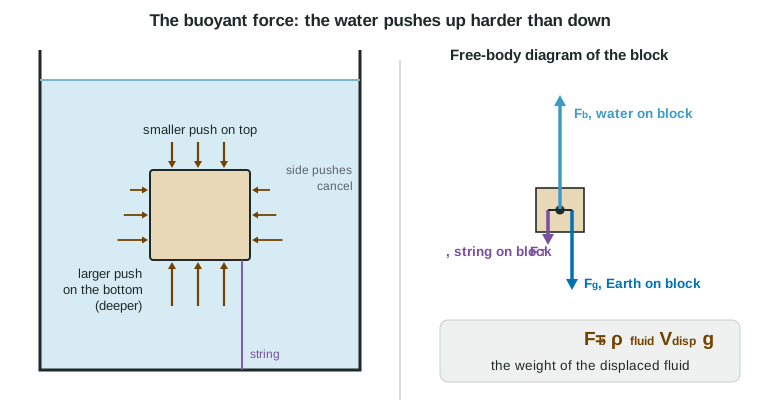
The buoyant force is the fluid's net upward push, caused by pressure increasing with depth; it equals the weight of the displaced fluid, ρ_fluid V_displaced g, and Newton's laws with buoyancy and gravity as separate forces decide whether an object floats, sinks or accelerates.
Part 1 · Hook
Why this matters
Part 2 · Before you start
What this builds on
Part 3 · Prerequisite check
Quick check before you start
1. In a fluid at rest, how does the pressure at the bottom of a block compare with the pressure at its top?
- Larger, because the bottom is deeper
- Smaller, because the block shields it
- The same, because the block is small
- Zero, because the block is solid
Show the answer
P = P₀ + ρgh grows with depth.
- Correct: Larger, because the bottom is deeper:
- Smaller, because the block shields it:
- The same, because the block is small:
- Zero, because the block is solid:
2. An object is at rest with two forces on it. What must be true?
- The two forces are equal in size and opposite
- There are no forces on it
- The larger force points up
- The forces point the same way
Show the answer
Zero acceleration means zero net force, so the two forces balance.
- Correct: The two forces are equal in size and opposite:
- There are no forces on it:
- The larger force points up:
- The forces point the same way:
3. What is the mass of 2.0 × 10⁻³ m³ of water (ρ = 1000 kg/m³)?
- 2.0 kg
- 0.50 kg
- 20 kg
- 2.0 × 10⁻⁶ kg
Show the answer
m = ρV = (1000 kg/m³)(2.0 × 10⁻³ m³) = 2.0 kg.
- Correct: 2.0 kg:
- 0.50 kg:
- 20 kg:
- 2.0 × 10⁻⁶ kg:
Part 4 · See it
See it first
Part 5 · Step by step
How it works, step by step
- Pressure in a fluid increases with depththe fluid pushes up on an object's bottom harder than it pushes down on its top
- The side pushes cancelthe net push of the fluid is upward: the buoyant force
- The pressure difference across the object is ρg times its heightthe buoyant force is ρ_fluid V_displaced g, the weight of the displaced fluid
- Newton's second law applies to the object, with the buoyant force and gravity as separate forcesit floats where F_b = mg, sinks if mg is larger, and accelerates at a = (mg − F_b)/m
Part 6 · Key ideas
Key ideas
- The buoyant force is the fluid's net upward push. On a free-body diagram it is a separate arrow, up, labeled "Fb, water on block", opposite to the gravitational force.
- Archimedes' principle: Fb = ρfluidVdisplacedg, the weight of the displaced fluid. It depends on the fluid's density and the displaced volume, not on the object's density or weight.
- A floating object is in equilibrium: Fb = mg, so the fraction under the surface is ρobject/ρfluid.
- A submerged object denser than the fluid sinks with a = g(1 − ρfluid/ρobject), neglecting drag.
Part 7 · Misconception
A common mistake
The wrong idea: The buoyant force equals the object's weight, so a heavier object feels a larger buoyant force.
What actually happens: The buoyant force equals the weight of the displaced fluid. It equals the object's own weight only when the object floats. Two equal-volume blocks, lead and aluminum, fully submerged feel the same buoyant force.
Part 8 · Check yourself
Check yourself
Exam-style questions. Anything you miss goes into your review queue.
Data table
Lowering a cylinder into water
A solid metal cylinder 10.0 cm tall with a base of area 1.00 × 10⁻³ m² hangs from a spring scale. A student lowers it, flat end first, into a beaker of water (ρ = 1000 kg/m³) and records the scale reading at each depth of the cylinder's bottom below the surface. Use g = 9.8 m/s².
| Depth of bottom below surface (cm) | Scale reading (N) |
|---|---|
| 0.0 | 2.65 |
| 2.0 | 2.45 |
| 4.0 | 2.26 |
| 6.0 | 2.06 |
| 8.0 | 1.87 |
| 10.0 | 1.67 |
| 12.0 | 1.67 |
1. What is the buoyant force on the cylinder when it is fully under water? Give the value and its unit.
Type a number and its unit.
Show the answer
In air the scale holds the whole weight, 2.65 N. Fully under water it reads 1.67 N, because the water pushes up with the rest: F_b = 2.65 N − 1.67 N = 0.98 N. Check: ρVg = (1000)(1.00 × 10⁻⁴ m³)(9.8) = 0.98 N.
- Answer: 0.98 N
2. Why does the scale reading stop changing once the depth is more than 10 cm?
- The cylinder is fully submerged, so the volume of water it displaces stops growing
- The water pressure stops increasing below 10 cm of depth
- The cylinder's weight decreases until it matches the buoyant force
- The buoyant force reaches its largest possible value for any object in water
Show the answer
F_b = ρ_fluid V_displaced g. Once the cylinder is all under water, V_displaced equals its full volume and cannot grow. The pressures on the top and bottom both rise with depth, but their difference stays the same.
- Correct: The cylinder is fully submerged, so the volume of water it displaces stops growing: Right: the buoyant force follows the displaced volume.
- The water pressure stops increasing below 10 cm of depth: Pressure keeps rising with depth; it is the difference between the bottom and top pressures that stays fixed.
- The cylinder's weight decreases until it matches the buoyant force: The weight mg does not change in water; the scale reading changes because the buoyant force supports part of it.
- The buoyant force reaches its largest possible value for any object in water: A bigger object would displace more water and feel a larger buoyant force.
3. Use the data to find the density of the cylinder's metal. Give the value and its unit.
Type a number and its unit.
Show the answer
Fully submerged, F_b = ρ_w V g and the weight is ρ_cyl V g. Dividing, ρ_cyl/ρ_w = W/F_b = 2.65 N / 0.98 N = 2.70, so ρ_cyl = 2.7 × 10³ kg/m³ (aluminum).
- Answer: 2.7 × 10³ kg/m^3
4. The experiment is repeated in salt water, which is denser than fresh water. Compared with the fresh-water value, what is the scale reading when the cylinder is fully submerged?
- Smaller, because the buoyant force is larger
- Larger, because salt water pushes down harder on the top
- The same, because the cylinder displaces the same volume
- Larger, because the cylinder's weight increases in salt water
Show the answer
F_b = ρ_fluid V g: the same displaced volume of a denser fluid weighs more, so the buoyant force is larger and the scale has less weight left to support.
- Correct: Smaller, because the buoyant force is larger: Right: denser fluid, larger buoyant force, smaller reading.
- Larger, because salt water pushes down harder on the top: Salt water pushes harder on both the top and the bottom; the upward push on the bottom grows more.
- The same, because the cylinder displaces the same volume: Same volume, but the buoyant force depends on the fluid's density too.
- Larger, because the cylinder's weight increases in salt water: The gravitational force on the cylinder, mg, does not depend on the fluid around it.
5. While the cylinder hangs at rest fully under water, which equation describes the forces on it?
- F_T + F_b = F_g
- F_T = F_g + F_b
- F_b = F_g
- F_T = F_g
Show the answer
Two forces act up on the cylinder (the scale's tension and the water's buoyant force) and one down (Earth's gravitational force). At rest the net force is zero: F_T + F_b = F_g.
- Correct: F_T + F_b = F_g: Right: up forces balance the down force.
- F_T = F_g + F_b: This puts the buoyant force downward; it acts upward, opposite to gravity.
- F_b = F_g: This leaves out the scale's pull; the cylinder would sink without it.
- F_T = F_g: This leaves out the buoyant force, so the reading would equal the weight.
6. A lead block and an aluminum block have the same volume and are both held fully under water. A student claims the lead block feels the larger buoyant force because it is heavier. What is the best response?
- The forces are equal: each displaces the same volume of water
- The claim is right: a heavier object pushes more water aside
- The aluminum feels more, because it is less dense and tends to rise
- The lead feels more, because it sinks deeper and feels more pressure
Show the answer
F_b = ρ_fluid V_displaced g depends on the fluid and the displaced volume, not on the object. The lead sinks because its weight is larger, not because its buoyant force is different.
- Correct: The forces are equal: each displaces the same volume of water: Right: same displaced volume, same buoyant force.
- The claim is right: a heavier object pushes more water aside: Both displace exactly their own volume when fully submerged; weight does not change that.
- The aluminum feels more, because it is less dense and tends to rise: Density decides whether an object floats, not the size of the buoyant force when submerged.
- The lead feels more, because it sinks deeper and feels more pressure: Both are held at the same depth here; and once submerged, depth does not change F_b.
Part 9 · Summary
Summary
Part 10 · Up next
What comes next
Part 11 · Connections