A fluid pushes on everything it touches: the walls of a tank, the inside of a tire, your eardrums underwater. This page defines pressure, explains where it comes from, and derives the rule for how it grows with depth. It also untangles absolute and gauge pressure, a distinction that costs many students points.
Pressure: force spread over an area
Press a thumbtack into a board with 20 N. Under your thumb, 20 N is spread over about 1 cm², and nothing happens. Under the point, the same 20 N is concentrated on a tiny area, and the tack goes in. What matters is the force per area, the pressure:
P = F⊥ / A
F⊥ is the part of the force perpendicular to the surface. The SI unit is the pascal: 1 Pa = 1 N/m². A pascal is small: a sheet of paper lying on a desk exerts about 1 Pa. Atmospheric pressure at sea level is about 1.0 × 10⁵ Pa, printed on the equations sheet as 1 atm.
Pressure is a scalar. It has no direction of its own. When a fluid presses on a surface, the force points perpendicular to that surface, into it, whatever way the surface faces. That is why water pushes sideways on a dam and upward on the bottom of a boat. Do not equate pressure with force; the readers flag it every year.
Worked example 1. A 1200 kg car rests on four tires, each touching the road over 0.020 m². Find the pressure under each tire. Use g = 9.8 m/s².
Each tire carries a quarter of the weight: F = (1200 kg)(9.8 m/s²)/4 = 2940 N.
P = F/A = 2940 N / 0.020 m² = 1.5 × 10⁵ Pa.
Where fluid pressure comes from
The particles of a fluid are always moving. Each time one hits a surface, it bounces off and gives the surface a tiny push. Billions of collisions every second add up to a steady force on each square meter: the fluid's pressure. Because the particles move in every direction, at any point in a fluid the push is the same in every direction.
Pressure grows with depth
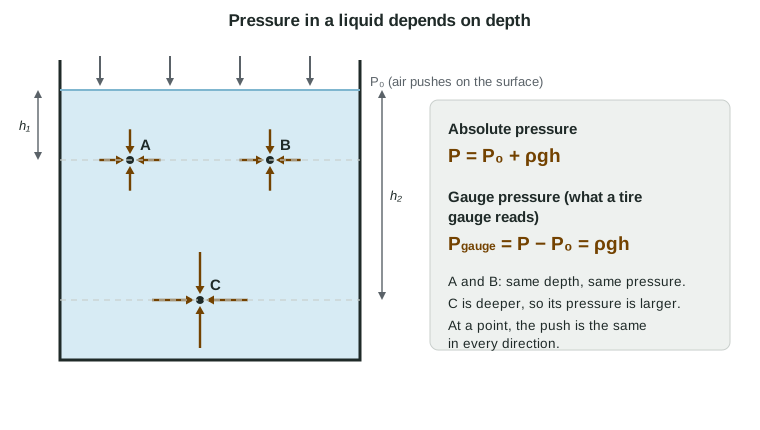
Picture a column of water of cross-sectional area A, reaching from the surface down to a depth h. Treat the column as the system; it is at rest, so the net force on it is zero (Newton's first law). Three vertical forces act on it:
- the air pushes down on its top: P₀A;
- its weight pulls down: mg = (ρAh)g, since its mass is density × volume;
- the water below pushes up on its bottom: PA.
Balance: PA = P₀A + ρAhg. Divide by A:
P = P₀ + ρgh
This is the absolute pressure at depth h. Note what is not in it: the width of the container, its shape, or how much water it holds. Points at the same depth in the same connected fluid have the same pressure.
Worked example 2. Find the absolute pressure 3.0 m below the surface of a pool (ρ = 1000 kg/m³, P₀ = 1.0 × 10⁵ Pa, g = 9.8 m/s²).
P = P₀ + ρgh = 1.0 × 10⁵ Pa + (1000 kg/m³)(9.8 m/s²)(3.0 m) = 1.0 × 10⁵ Pa + 2.94 × 10⁴ Pa = 1.3 × 10⁵ Pa.
Absolute pressure and gauge pressure
A tire gauge reads zero when it is open to the air, not 1.0 × 10⁵ Pa. Most gauges measure how much the pressure exceeds atmospheric pressure. That is the gauge pressure:
Pgauge = P − P₀ = ρgh
| Absolute pressure | Gauge pressure | |
|---|---|---|
| Formula in a liquid | P = P₀ + ρgh | Pgauge = ρgh |
| At the open surface | P₀ ≈ 1.0 × 10⁵ Pa | 0 |
| What reads it | a sensor sealed against a vacuum | a tire gauge, a blood-pressure cuff |
| Doubling the depth | increases, but less than doubles | doubles |
Read each question carefully for which one it wants. "The pressure at the bottom" usually means absolute; "the gauge pressure" or "the pressure above atmospheric" means ρgh alone.
Measuring density from a graph
Because P = P₀ + ρgh is a straight line in h, a graph of pressure against depth has intercept P₀ (for absolute pressure) and slope ρg. Dividing the slope by g gives the fluid's density. A denser liquid gives a steeper line from the same intercept. On the course we use g = 9.8 m/s²; 10 m/s² is accepted on the exam if used consistently.