Real v. Nominal GDP
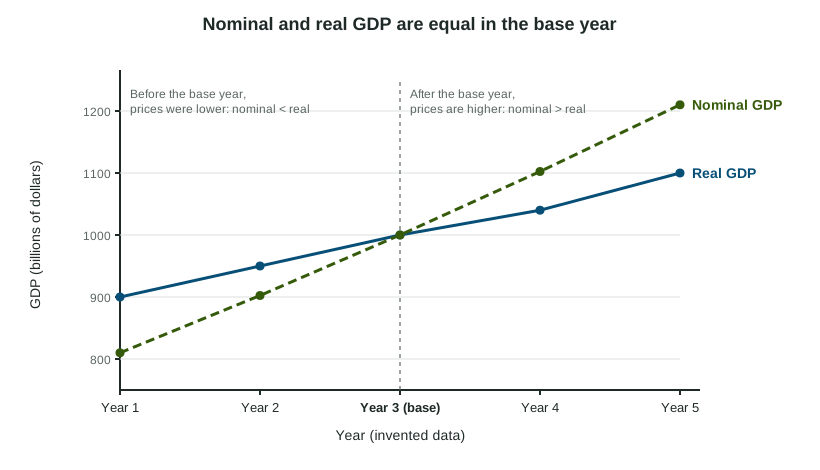
Nominal GDP values output at current prices; real GDP values it at base-year prices, so only real GDP changes with production.
Part 1 · Hook
Why this matters
Part 2 · Before you start
What this builds on
Part 3 · Prerequisite check
Quick check before you start
1. A price index is 125. What does that mean?
- Prices are 25% above the base year
- Prices rose 125%
- The basket costs 125 dollars
- Inflation this year is 125%
Show the answer
The base year is 100, so 125 is 25% higher.
- Correct: Prices are 25% above the base year:
- Prices rose 125%:
- The basket costs 125 dollars:
- Inflation this year is 125%:
2. A nominal wage of with a CPI of 120 is a real wage of
- $25
- $36
- $0.25
- $30
Show the answer
: divide by the index and multiply by 100.
- Correct: $25:
- $36:
- $0.25:
- $30:
3. GDP per capita is
- GDP divided by population
- GDP times population
- GDP minus imports
- GDP divided by the labor force
Show the answer
Output per person: GDP divided by population.
- Correct: GDP divided by population:
- GDP times population:
- GDP minus imports:
- GDP divided by the labor force:
Part 4 · See it
See it first
Part 5 · Step by step
How it works, step by step
- Nominal GDP values each year's output at that year's pricesit can rise because prices rose, because output rose, or both
- Real GDP values each year's output at base-year pricesit changes only when quantities produced change
- Divide nominal GDP by real GDP and multiply by 100the GDP deflator, a price index for everything produced
- Divide nominal GDP by the deflator and multiply by 100real GDP, whose percent change is the growth rate of output
Part 6 · Key ideas
Key ideas
- Nominal GDP uses current prices; real GDP uses base-year prices, so it measures output.
- GDP deflator ; real GDP . Divide by the deflator, never multiply.
- The deflator is an index (base year 100), not a percent or dollars. Below 100 means prices were lower than in the base year.
- Growth rate of real GDP , using real values. Real GDP per capita measures living standards.
Part 7 · Misconception
A common mistake
The wrong idea: To get real GDP, multiply nominal GDP by the deflator, and a rise in nominal GDP means output grew.
What actually happens: Divide nominal GDP by the deflator and multiply by 100. Nominal GDP can rise from higher prices alone, so only real GDP shows whether output grew.
Part 8 · Check yourself
Check yourself
Exam-style questions. Anything you miss goes into your review queue.
Data
A two-good economy over two years
| Year | Apples (quantity) | Price of apples | Bread (loaves) | Price of bread |
|---|---|---|---|---|
| 1 | 100 | $2.00 | 50 | $4.00 |
| 2 | 120 | $2.50 | 50 | $5.00 |
1. What is nominal GDP in Year 2, in dollars?
Type a number. A four-function calculator is allowed, as on the exam.
Show the answer
Nominal GDP uses each year's own prices:
- Answer: 550
2. What is real GDP in Year 2, measured in Year 1 prices, in dollars?
Type a number. A four-function calculator is allowed, as on the exam.
Show the answer
Real GDP values this year's quantities at base-year prices:
- Answer: 440
3. What is the GDP deflator in Year 2?
Type a number. A four-function calculator is allowed, as on the exam.
Show the answer
Deflator
- Answer: 125
Data
Nominal GDP and the GDP deflator in Halvet
| Year | Nominal GDP | GDP deflator |
|---|---|---|
| 1 | 800 | 100 |
| 2 | 900 | 120 |
| 3 | 990 | 110 |
4. What is Halvet's real GDP in Year 2, in billions of dollars?
Type a number. A four-function calculator is allowed, as on the exam.
Show the answer
Real GDP
- Answer: 750
Scenario
A headline about record GDP
A news site in Country Q reports: "GDP hits a record! Nominal GDP rose 6% this year, the biggest jump in a decade." Further down, the article notes that the GDP deflator rose 7% over the same year and that the population grew 1%.
5. Based on the full article, what happened to Country Q's real GDP this year?
- It rose by about 13%
- It rose by about 5%, after population growth
- It fell by about 1%
- It rose by about 6%, a record
Show the answer
Nominal GDP growth is about real growth plus inflation, so real growth is about nominal growth minus the change in the deflator.
- It rose by about 13%: A rising deflator is subtracted from nominal growth, not added.
- It rose by about 5%, after population growth: Population growth matters for output per person, but the first step is removing price changes.
- Correct: It fell by about 1%: Right: real growth is about nominal growth minus the rise in the deflator: .
- It rose by about 6%, a record: Six percent is the nominal rise, which includes higher prices.
6. In a year before the base year, a country's nominal GDP is 400 billion dollars and its GDP deflator is 80. What is its real GDP, in billions of dollars?
Type a number. A four-function calculator is allowed, as on the exam.
Show the answer
billion. Prices were lower than in the base year, so real GDP (at base-year prices) is larger than nominal GDP.
- Answer: 500
7. Why do economists use real GDP rather than nominal GDP to measure changes in output over time?
- Real GDP is measured in current prices
- Real GDP is larger than nominal GDP in each year
- Real GDP holds prices fixed, so only quantities move it
- Real GDP includes used goods and transfers
Show the answer
Valuing every year's output at the same base-year prices means changes in real GDP reflect changes in production.
- Real GDP is measured in current prices: That is nominal GDP; real GDP uses base-year prices.
- Real GDP is larger than nominal GDP in each year: Real GDP is smaller than nominal after the base year when prices have risen.
- Correct: Real GDP holds prices fixed, so only quantities move it: Right: nominal GDP can rise from higher prices alone; real GDP removes that.
- Real GDP includes used goods and transfers: Real and nominal GDP count the same goods; only the prices used differ.
Part 9 · Summary
Summary
Part 10 · Up next
What comes next
Part 11 · Connections