Business Cycles
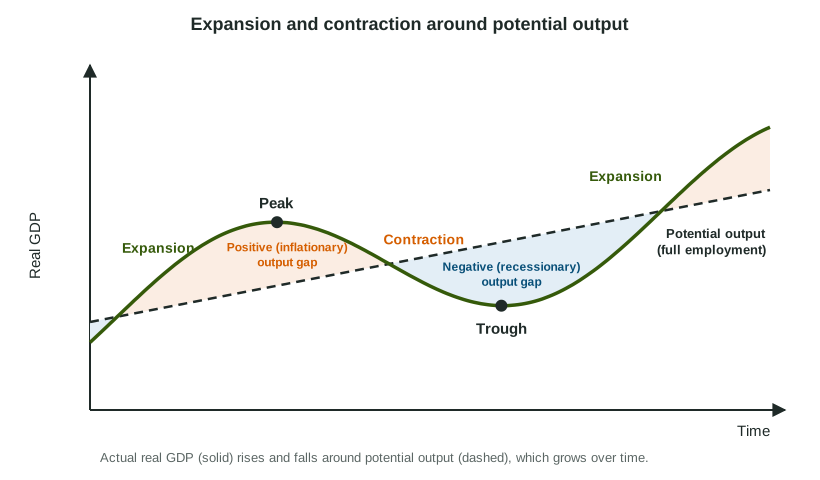
Real GDP rises in expansions and falls in contractions around potential output, the full-employment level that grows over time.
Part 1 · Hook
Why this matters
Part 2 · Before you start
What this builds on
Part 3 · Prerequisite check
Quick check before you start
1. What is cyclical unemployment?
- Unemployment caused by a fall in total spending and output
- Unemployment from searching between jobs
- Unemployment from a skills mismatch
- People who have stopped looking for work
Show the answer
Cyclical unemployment comes from downturns; it equals the actual rate minus the natural rate.
- Correct: Unemployment caused by a fall in total spending and output:
- Unemployment from searching between jobs:
- Unemployment from a skills mismatch:
- People who have stopped looking for work:
2. Why does real GDP, not nominal GDP, show changes in output?
- It holds prices at base-year levels
- It is measured in current prices
- It includes transfer payments
- It is always larger
Show the answer
Real GDP values output at base-year prices, so it changes only with quantities produced.
- Correct: It holds prices at base-year levels:
- It is measured in current prices:
- It includes transfer payments:
- It is always larger:
Part 4 · See it
See it first
Part 5 · Step by step
How it works, step by step
- Total spending in the economy fallsfirms sell less, cut production and real GDP falls: a contraction
- Real GDP falls below potential outputthere is a negative (recessionary) output gap
- Firms need fewer workerscyclical unemployment rises and the unemployment rate goes above the natural rate
- Later, real GDP rises above potential in a boomunemployment falls below the natural rate and inflation tends to rise
Part 6 · Key ideas
Key ideas
- The business cycle has two phases, expansion (real GDP rising) and contraction (real GDP falling). The peak and trough are the turning points.
- Potential output is real GDP at full employment (the natural rate of unemployment). It grows over time.
- Output gap = real GDP - potential output. Negative (recessionary): cyclical unemployment. Positive (inflationary): unemployment below the natural rate and rising inflation.
- A recession is a severe, lasting contraction. On a PPC, a recession is a point inside the curve; potential output is a point on it.
Part 7 · Misconception
A common mistake
The wrong idea: Peak and trough are phases of the business cycle, and potential output is the most an economy can ever produce.
What actually happens: The phases are expansion and contraction; peak and trough are the turning points. Potential output is the sustainable full-employment level, and real GDP can rise above it for a while in a boom.
Part 8 · Check yourself
Check yourself
Exam-style questions. Anything you miss goes into your review queue.
Data
Real GDP and potential output in Country X over ten quarters
| Quarter | 1 | 2 | 3 | 4 | 5 | 6 | 7 | 8 | 9 | 10 |
|---|---|---|---|---|---|---|---|---|---|---|
| Real GDP | 100 | 103 | 106 | 108 | 107 | 104 | 101 | 102 | 105 | 108 |
| Potential output | 100 | 101 | 102 | 103 | 104 | 105 | 106 | 107 | 108 | 109 |
1. In which quarter does Country X reach a peak?
- Quarter 4
- Quarter 10
- Quarter 7
- Quarter 9
Show the answer
A peak is the turning point where an expansion ends and a contraction begins.
- Correct: Quarter 4: Right: real GDP rises to 108 in Quarter 4 and falls afterward, so Quarter 4 is the turning point at the top.
- Quarter 10: Real GDP is 108 again in Quarter 10, but it is still rising at the end of the data; there is no turning point yet.
- Quarter 7: Quarter 7 is the lowest point, the trough.
- Quarter 9: Real GDP is still rising in Quarter 9, which is part of an expansion.
2. What is the output gap in Quarter 7, in billions of dollars? (Use a negative number if output is below potential.)
Type a number. A four-function calculator is allowed, as on the exam.
Show the answer
Output gap = real GDP - potential output billion dollars: a negative (recessionary) gap.
- Answer: -5
Scenario
A slowdown in Halvet
In Halvet, households and firms cut back on spending. For two quarters in a row real GDP falls, stores report weak sales and factories cut shifts. The unemployment rate rises from 4.5% to 7.0%. Economists estimate Halvet's natural rate of unemployment at 4.5%.
3. What is Halvet's cyclical unemployment rate now?
Type a number (%). A four-function calculator is allowed, as on the exam.
Show the answer
Cyclical = actual - natural .
- Answer: 2.5 %
Scenario
A boom in Berovia
Berovia's economy is booming. Firms are running extra shifts and paying overtime, and some workers have put off retiring to take well-paid jobs. The unemployment rate is 3.0%, while the natural rate is estimated at 5.0%. Prices are rising faster each month.
4. What kind of output gap does Berovia have?
- No output gap, because the economy is growing
- A negative gap, because prices are rising
- A positive (inflationary) output gap
- A negative (recessionary) output gap
Show the answer
Unemployment below the natural rate means the economy is producing beyond its potential output for now.
- No output gap, because the economy is growing: Growing output can be above, at or below potential; here it is above.
- A negative gap, because prices are rising: Rising prices point the other way: they come with a positive gap.
- Correct: A positive (inflationary) output gap: Right: unemployment is below the natural rate, so real GDP is above potential output.
- A negative (recessionary) output gap: A negative gap comes with unemployment above the natural rate.
5. Country W is in a deep recession: factories sit idle and many workers cannot find jobs. Mark a point on its PPC graph that shows where it is producing.
Work on the graph (it needs JavaScript), then check.
Show the answer
Idle workers and machines mean the economy produces less than it could: a point inside the PPC.
- Key: see the explanation
6. What is potential output?
- The real GDP an economy produces at full employment
- The largest real GDP an economy has reached in the past
- The real GDP an economy produces with zero unemployment
- The real GDP at the trough of a business cycle
Show the answer
Potential (full-employment) output is the sustainable level, at the natural rate of unemployment. It grows over time as the economy gains resources and better technology.
- Correct: The real GDP an economy produces at full employment: Right: output when unemployment is at its natural rate.
- The largest real GDP an economy has reached in the past: A past high may have been above potential during a boom.
- The real GDP an economy produces with zero unemployment: Full employment leaves frictional and structural unemployment.
- The real GDP at the trough of a business cycle: At a trough output is usually far below potential.
7. Build the explanation: households and firms in Country V cut their spending sharply. Explain what happens to output and unemployment.
Build the answer part by part, then write it in your own words.
Show the answer
Less spending means firms sell less, so they produce less and need fewer workers: real GDP falls below potential (a negative output gap) and cyclical unemployment rises.
- An answer that earns the point: Total spending falls, so firms sell less and produce less: real GDP falls below potential output, which leads to a negative (recessionary) output gap. Cyclical unemployment rises because firms need fewer workers.
Part 9 · Summary
Summary
Part 10 · Up next
What comes next
Part 11 · Connections