Aggregate Demand (AD)
Aggregate demand is total planned spending on real output at each price level, C + I + G + (X - M).
Part 1 · Hook
Why this matters
Part 2 · Before you start
What this builds on
Part 3 · Prerequisite check
Quick check before you start
1. Which expression gives GDP by the expenditure approach?
- C + I + G + (X - M)
- C + I + G + X + M
- C + I + G - X
- Wages + profits - taxes
Show the answer
GDP by spending adds consumption, investment, government spending and net exports (exports minus imports).
- Correct: C + I + G + (X - M):
- C + I + G + X + M:
- C + I + G - X:
- Wages + profits - taxes:
2. What does a price index such as the CPI measure?
- The cost of a fixed basket of goods relative to a base year
- The number of goods produced in a year
- The interest rate on savings
- Total spending in the economy
Show the answer
A price index tracks the cost of a fixed basket against the base year, so it shows the overall level of prices.
- Correct: The cost of a fixed basket of goods relative to a base year:
- The number of goods produced in a year:
- The interest rate on savings:
- Total spending in the economy:
3. On a demand curve for one good, what does a change in that good's own price cause?
- A movement along the demand curve
- A shift of the demand curve to the right
- A shift of the demand curve to the left
- A shift of the supply curve
Show the answer
A change in the variable on the axis moves along the curve; anything else shifts it.
- Correct: A movement along the demand curve:
- A shift of the demand curve to the right:
- A shift of the demand curve to the left:
- A shift of the supply curve:
Part 4 · See it
See it first
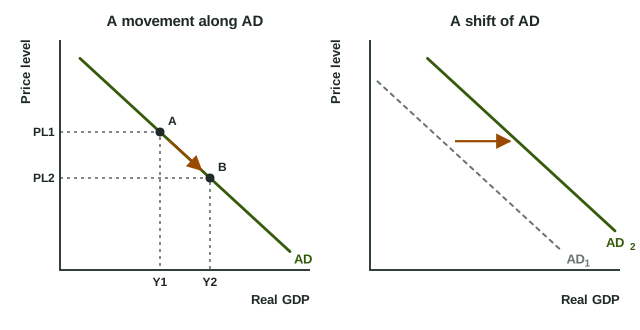
Part 5 · Step by step
How it works, step by step
- The price level fallssavings buy more, interest rates fall and domestic goods get cheaper than foreign goods
- Real wealth rises, borrowing gets cheaper and exports riseconsumption, investment and net exports rise
- Spending rises because the price level fellreal GDP demanded rises: a movement down along AD
- Spending changes for any other reason (wealth, expectations, taxes, foreign incomes)the whole AD curve shifts
Part 6 · Key ideas
Key ideas
- Aggregate demand (AD) is the total real output that households, firms, the government and foreigners plan to buy at each price level: .
- AD slopes down because of three effects of a lower price level: the real wealth effect (savings buy more), the interest rate effect (lower interest rates raise investment) and the exchange rate effect (domestic goods are cheaper than foreign goods).
- A change in the price level moves the economy along AD. A change in C, I, G or X - M for any other reason shifts AD.
- Shifters: wealth, consumer and business expectations, household debt, taxes, interest rates at a given price level, government purchases, foreign incomes.
- The axes are always Price level (vertical) and Real GDP (horizontal), never "price" and "quantity".
Part 7 · Misconception
A common mistake
The wrong idea: AD slopes down for the same reason a demand curve for pizza does: people switch to it when it gets cheaper.
What actually happens: When the whole price level falls, there is no cheaper domestic good to switch to. AD slopes down because of the real wealth effect, the interest rate effect and the exchange rate effect.
Part 8 · Check yourself
Check yourself
Exam-style questions. Anything you miss goes into your review queue.
1. Which pair of labels belongs on the axes of an aggregate demand graph?
- Price on the vertical axis and quantity on the horizontal axis
- Price level on the vertical axis and real GDP on the horizontal axis
- Inflation rate on the vertical axis and unemployment rate on the horizontal axis
- Nominal GDP on the vertical axis and real GDP on the horizontal axis
Show the answer
The aggregate demand graph has the price level (PL) on the vertical axis and real GDP (Y) on the horizontal axis.
- Price on the vertical axis and quantity on the horizontal axis: Those are the labels for one market, such as the market for coffee. AD is the whole economy.
- Correct: Price level on the vertical axis and real GDP on the horizontal axis: Right: AD shows total planned spending on real output at each price level.
- Inflation rate on the vertical axis and unemployment rate on the horizontal axis: Those axes belong to a different graph. AD plots the price level against real GDP.
- Nominal GDP on the vertical axis and real GDP on the horizontal axis: The vertical axis is a price index for the whole economy, the price level, not nominal GDP.
2. The price level falls while household wealth in dollars stays the same. Through the real wealth effect, what happens?
- Households feel poorer, so consumption falls and AD shifts left
- Consumption rises, so the AD curve shifts to the right
- The same savings buy more, so consumption rises and real GDP demanded rises along AD
- Nothing happens, because wealth measured in dollars did not change
Show the answer
The real wealth effect: a lower price level raises the purchasing power of wealth, so real spending rises, a movement down along AD.
- Households feel poorer, so consumption falls and AD shifts left: A lower price level makes the same dollars worth more, so households feel richer, not poorer.
- Consumption rises, so the AD curve shifts to the right: The change starts with the price level, so it is a movement along AD, not a shift of the curve.
- Correct: The same savings buy more, so consumption rises and real GDP demanded rises along AD: Right: a lower price level raises the real value of savings, so households buy more; that is a movement down along AD.
- Nothing happens, because wealth measured in dollars did not change: What matters is what the dollars can buy. With lower prices, the same dollars buy more.
3. Why does the aggregate demand curve slope down for a different reason than the demand curve for one good?
- When the price of one good falls, buyers switch to it from other goods, and the same holds for the whole economy
- A lower price level raises nominal incomes, so people buy more of everything
- Aggregate demand counts government spending, which rises when prices fall
- A lower price level changes real wealth, interest rates and the price of a country's goods against foreign goods
Show the answer
One good's demand slopes down partly because buyers switch goods. For the whole economy three effects do the work: the real wealth effect, the interest rate effect and the exchange rate effect.
- When the price of one good falls, buyers switch to it from other goods, and the same holds for the whole economy: Switching between goods explains one market's demand. When the whole price level falls there is no other domestic good to switch from.
- A lower price level raises nominal incomes, so people buy more of everything: A lower price level does not raise nominal incomes; it raises what a given income or savings can buy.
- Aggregate demand counts government spending, which rises when prices fall: Government spending is set by policy, not by the price level, and it is not why AD slopes down.
- Correct: A lower price level changes real wealth, interest rates and the price of a country's goods against foreign goods: Right: AD slopes down because of the real wealth effect, the interest rate effect and the exchange rate effect, which act on the whole economy.
4. Make it specific: build the chain from a rise in household wealth to aggregate demand.
Build the answer part by part, then write it in your own words.
Show the answer
Higher wealth raises consumption at every price level, so AD shifts right.
- An answer that earns the point: When household wealth rises, consumption increases at every price level because households feel richer, so the aggregate demand curve shifts to the right.
Scenario
Three news stories from Quillon
Quillon is an invented country. In one month its newspapers report three stories:
- Home and stock prices in Quillon jump, so households feel richer.
- A deep recession hits Quillon's main trading partner, so foreign incomes fall.
- Quillon's firms expect sales to boom next year and plan new factories.
Assume nothing else changes, including the price level, unless a question says so.
5. Which component of Quillon's aggregate demand changes first because of story 3?
- Investment
- Consumption
- Government spending
- Net exports
Show the answer
Optimistic firms buy more capital goods (factories and equipment), so investment rises and AD shifts right.
- Correct: Investment: Right: new factories are capital goods bought by firms, which is investment spending.
- Consumption: Consumption is household spending on goods and services. Factories are bought by firms.
- Government spending: The factories are planned by private firms, not by the government.
- Net exports: Nothing in story 3 is about trade with other countries.
6. Put the links of the interest rate effect in order, starting from a fall in the price level.
- The price level falls
- People need less money for the same purchases, so they borrow less and lend more
- Interest rates fall
- Firms and households spend more on investment and big items
- Real GDP demanded rises, a movement down along AD
Show the answer
With lower prices, less money is needed for the same purchases; more lending and less borrowing lower interest rates, and interest-sensitive spending rises.
- Correct order: 1. The price level falls 2. People need less money for the same purchases, so they borrow less and lend more 3. Interest rates fall 4. Firms and households spend more on investment and big items 5. Real GDP demanded rises, a movement down along AD
Part 9 · Summary
Summary
Part 10 · Up next
What comes next
Part 11 · Connections