Price Indices and Inflation
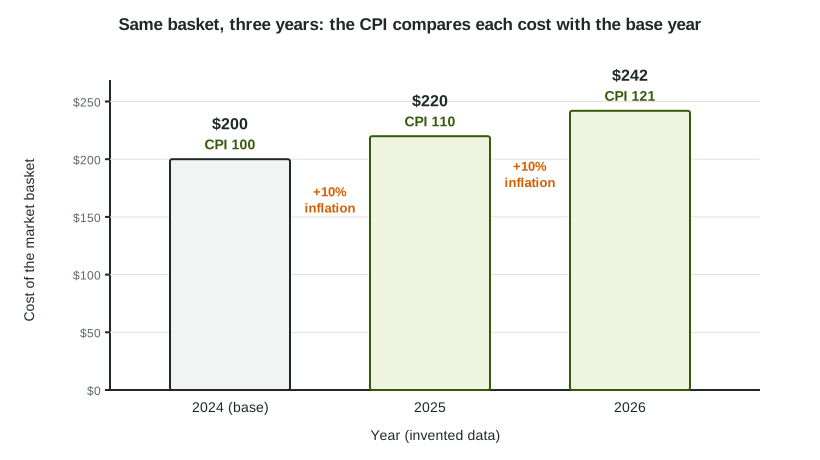
A price index compares the cost of a fixed basket with its cost in the base year (index 100).
Part 1 · Hook
Why this matters
Part 2 · Before you start
What this builds on
Part 3 · Prerequisite check
Quick check before you start
1. In GDP, what is consumption?
- Household spending on goods and services
- Firms' spending on new capital
- Government purchases
- Exports minus imports
Show the answer
Consumption (C) is what households spend. The CPI tracks the prices of a basket of what households buy.
- Correct: Household spending on goods and services:
- Firms' spending on new capital:
- Government purchases:
- Exports minus imports:
2. Why does a smartphone that costs the same as ten years ago show a limitation of GDP?
- GDP counts the price paid and can miss gains in quality
- GDP leaves out goods made abroad
- GDP counts used phones
- GDP leaves out consumer goods
Show the answer
Market values can miss quality gains. The same problem shows up in price indexes.
- Correct: GDP counts the price paid and can miss gains in quality:
- GDP leaves out goods made abroad:
- GDP counts used phones:
- GDP leaves out consumer goods:
Part 4 · See it
See it first
Part 5 · Step by step
How it works, step by step
- A fixed basket of goods is priced each yearits cost this year divided by its cost in the base year, times 100, is the consumer price index
- The index rises from one year to the nextthe percent change in the index is the inflation rate
- Prices rise faster than a person's paytheir real wage (nominal wage divided by the index, times 100) falls
- Consumers switch away from goods whose prices rosethe fixed basket overstates the rise in the cost of living (substitution bias)
Part 6 · Key ideas
Key ideas
- CPI . The base year is 100.
- Inflation rate . Divide by the old index, not 100.
- Real value : what money buys in base-year dollars.
- Deflation: prices fall. Disinflation: inflation slows but prices still rise. Substitution bias and quality gains make the CPI overstate inflation.
Part 7 · Misconception
A common mistake
The wrong idea: A CPI of 130 means prices rose 130%, and a falling inflation rate means prices are falling.
What actually happens: A CPI of 130 means prices are 30% above the base year. A falling inflation rate is disinflation: prices still rise, just more slowly. Only deflation means prices fall.
Part 8 · Check yourself
Check yourself
Exam-style questions. Anything you miss goes into your review queue.
Data
A three-good market basket in Country X
| Good (quantity in the basket) | 2024 price | 2025 price | 2026 price |
|---|---|---|---|
| Pizza (10) | $8.00 | $9.00 | $10.00 |
| Gas (20 gallons) | $3.00 | $3.50 | $3.60 |
| Movie ticket (5) | $12.00 | $12.00 | $14.00 |
1. What does the market basket cost in 2025, in dollars?
Type a number. A four-function calculator is allowed, as on the exam.
Show the answer
Multiply each price by its quantity and add:
- Answer: 220
2. With 2024 as the base year, what is the consumer price index for 2025?
Type a number. A four-function calculator is allowed, as on the exam.
Show the answer
The basket cost in 2024 and in 2025. .
- Answer: 110
3. What is the inflation rate from 2025 to 2026, measured by this index?
Type a number (%). A four-function calculator is allowed, as on the exam.
Show the answer
The basket costs in 2026, so the CPI is . Inflation
- Answer: 10 %
Scenario
Beef, chicken and a fixed basket
In Country Y the consumer price index basket includes 10 pounds of beef and 10 pounds of chicken each month. This year a disease among cattle doubles the price of beef while the price of chicken stays the same. Most families respond by buying much less beef and more chicken. The statistics office keeps the basket the same for the year.
4. How does the fixed basket affect the CPI's measure of how much living costs rose in Country Y?
- It shows no rise, because chicken prices did not change
- It overstates the rise, because families switched to cheaper chicken
- It understates the rise, because beef doubled in price
- It measures the rise exactly, because both meats stay in the basket
Show the answer
Substitution bias: when a price rises, people buy less of it and more of a substitute. A fixed basket misses the switch and overstates the rise in the cost of living.
- It shows no rise, because chicken prices did not change: Beef is in the basket, and its price doubled, so the index rises.
- Correct: It overstates the rise, because families switched to cheaper chicken: Right: the CPI prices the old amount of beef, but families now buy less of it, so their actual costs rose less.
- It understates the rise, because beef doubled in price: The doubling is fully counted at the old quantity of beef; the error goes the other way.
- It measures the rise exactly, because both meats stay in the basket: Keeping quantities fixed ignores how families changed what they buy.
Data
Consumer price index in Country Z
| Year | CPI |
|---|---|
| 1 | 100 |
| 2 | 104 |
| 3 | 107 |
| 4 | 106 |
5. In which year did Country Z have disinflation?
- Year 3
- Year 4
- Year 2
- Year 1
Show the answer
Disinflation is a fall in the inflation rate while prices keep rising. Deflation is a fall in prices themselves.
- Correct: Year 3: Right: inflation fell from 4% to about 2.9%, but prices still rose, so that is disinflation.
- Year 4: The CPI fell in Year 4, which is deflation, not disinflation.
- Year 2: Year 2 is the first year with inflation (4%); there is no earlier rate for it to fall from.
- Year 1: Year 1 is the base year, so there is no earlier index to compare it with.
6. Rosa earns a nominal wage of an hour. The CPI is 120. What is her real wage in base-year dollars per hour?
Type a number. A four-function calculator is allowed, as on the exam.
Show the answer
Real value
- Answer: 25
7. A country's CPI is 130. What does that number mean?
- Prices rose 130% since the base year
- The inflation rate this year is 130%
- The basket costs 130 dollars
- The basket costs 30% more than it did in the base year
Show the answer
A price index compares a cost with the base year, where the index is 100. The rise since the base year is the index minus 100, in percent.
- Prices rose 130% since the base year: An index of 130 is 30% above 100, not 130% above it.
- The inflation rate this year is 130%: The index level is not the inflation rate; the rate compares this year's index with last year's.
- The basket costs 130 dollars: The index is a ratio times 100, not a dollar amount.
- Correct: The basket costs 30% more than it did in the base year: Right: the base year is 100, so 130 is 30% higher.
Part 9 · Summary
Summary
Part 10 · Up next
What comes next
Part 11 · Connections